
Process Manufacturing ERP Software: What Gulf Traders Need
Distributors and process manufacturers in the Gulf need ERP that tracks batches and lots, manages multiple warehouses and routes, enforces credit control automatically, and produces VAT-ready invoices. Generic demos skip these flows. Map how stock actually moves, from batch to shelf to invoice, before comparing systems, not after.
What do distributors and process manufacturers in the Gulf need from ERP?
A trading or process manufacturing business shopping for process manufacturing erp software needs more than a features list. It needs an ERP that follows the goods, not just the paperwork: batch and lot tracking from raw material to finished pallet, stock visibility across every warehouse, route-wise dispatch, credit limits enforced at the order stage, and invoices that meet current VAT and e-invoicing rules.
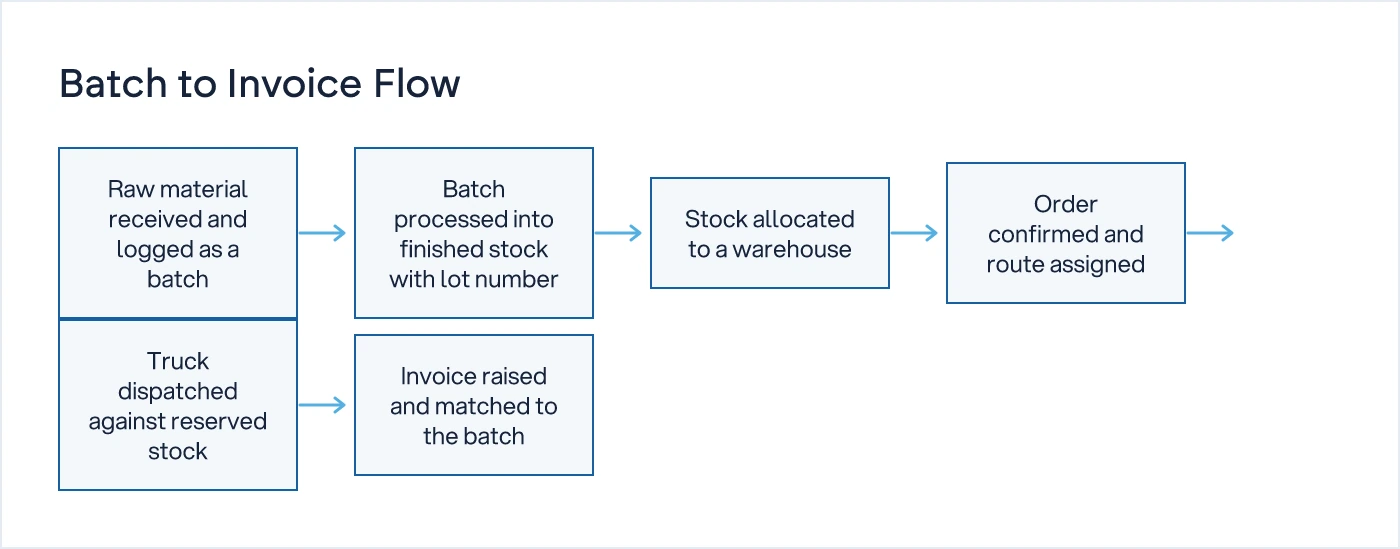
Most demos show screens. Few show your actual flow: a drum of raw material becomes a batch, the batch becomes stock, the stock moves to a route, the route becomes an invoice. This is the gap owners hit when they start searching: vendors sell features, not sequence.
We understand how your business actually works first, then we design the system. That's why the map matters more than the demo. Before you sit through another one, write down your own sequence. Then judge every system against that map, not the other way round.
What is the difference between process manufacturing and discrete manufacturing?
Process manufacturing blends or transforms raw material into a product that cannot easily be unmade, think paints, food ingredients, chemicals, or ghee. Discrete manufacturing assembles separate parts into a countable unit, think a pump or a cabinet. The two need different ERP logic underneath.
A discrete manufacturer's ERP tracks a bill of materials, a job card, and serial numbers. A process manufacturer's ERP tracks a formula or recipe, yield variance, and batch or lot genealogy. If one batch of a food ingredient fails quality, you need to recall precisely that batch, rather than the whole month's production.
If your business does both, say a distributor who also blends lubricants or repacks chemicals under its own brand, your ERP needs to run both logics side by side without forcing one into the other's shape. This is where generic demos fall short. They show a single flow and ask you to imagine the rest.
What does a distribution company need from ERP, beyond stock counts?
A distribution company needs multi-warehouse visibility, route-based dispatch, and credit control enforced automatically, not stock counts alone. Knowing what's sitting in the warehouse answers only the first question. The harder questions are which warehouse should fulfil an order, which route a truck should run, and whether a customer's outstanding balance should block a new order before the salesman promises it.
This is the real test behind most distribution erp software searches: not whether stock is visible, but whether the right warehouse, route and credit decision happens on its own.
Three capabilities matter most for Gulf distributors:
- Multi-warehouse allocation. If you run a central warehouse in Jebel Ali and a satellite in Dubai or Sharjah, the system should allocate stock from the nearest point automatically, not leave it to whoever answers the phone first.
- Route and load planning. Dispatch should know which orders are confirmed, which stock is reserved, and which invoices are ready, before a truck is loaded. Dispatch Planning: Why Trucks Leave Half Full and Late covers why this breaks down in practice.
- Credit control at the order stage. A salesman should not be able to confirm an order that pushes a customer past their credit limit. That decision belongs to the credit controller or the finance head, and the system should enforce it, not just flag it afterwards. Pricing Control: Who Can Actually Change a Price covers the related question of who can discount.
Cash gets blocked when these three break down quietly: stock allocated to the wrong warehouse, dispatch delayed waiting on paperwork, invoices raised against customers who should have been stopped weeks earlier. Where Your Working Capital Is Actually Stuck walks through where this shows up on the balance sheet.
For construction-linked distribution, supplying cement, steel, or fit-out material against project schedules, the same logic applies with one addition: ERP needs to track partial deliveries against a purchase order and retention amounts against a project. This is why construction erp searches in the Gulf often overlap with distribution ERP rather than sitting in a separate category.
How do VAT and e-invoicing rules affect your ERP choice?
Your ERP must generate VAT-compliant invoices today and be able to adapt as e-invoicing rules change. The UAE and Saudi Arabia are both moving towards structured, government-linked e-invoicing, and the exact format and timeline matter for your filings. Confirm the current requirement directly with the Federal Tax Authority before you finalise anything. A vendor's claim of full compliance is not the same as confirmation from the authority.
What you can control now, regardless of the exact date: choose an ERP where the invoice format, tax codes and numbering sequence are configurable, not hardcoded. A system that cannot change its invoice layout without a developer ticket will cost you more later than it saves you now.
What should you check before you compare ERP systems?
Before any demo, write down your own batch-to-invoice sequence and test every vendor against it, not their feature list against yours. Walk one real transaction end to end: a purchase order for raw material, a batch produced, stock moved to a warehouse, an order confirmed, a route assigned, an invoice raised, payment collected. Ask each vendor to show that exact sequence, using your terms, not theirs.
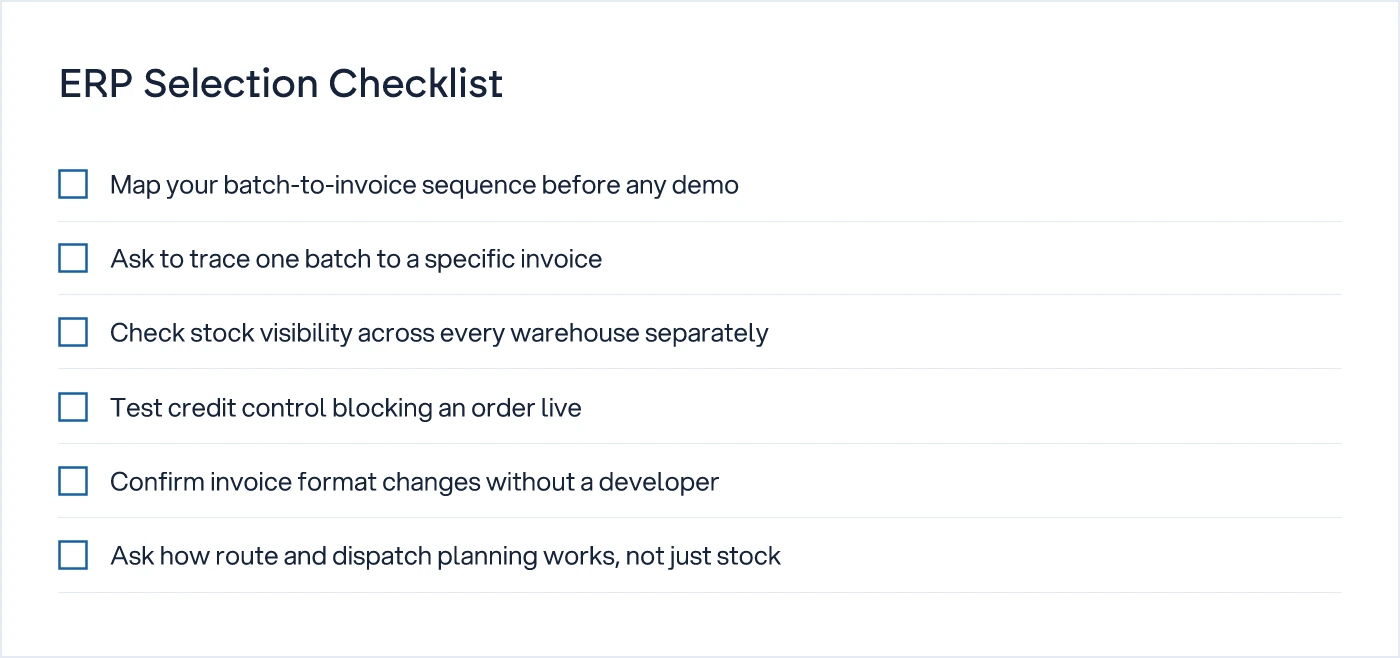
A short comparison helps focus the conversation:
| What you need to see | Generic ERP demo | What to ask for instead |
|---|---|---|
| Batch and lot tracking | Shown as a static field | Ask to trace one batch from receipt to a specific customer invoice |
| Multi-warehouse stock | Shown as a single stock report | Ask to see stock split by warehouse, with transfer history |
| Credit control | Mentioned as a feature | Ask the system to block an order live, in front of you |
| VAT and e-invoicing | Shown as a tax rate field | Ask how the invoice format changes without developer involvement |
| Route and dispatch | Often skipped entirely | Ask to see a route plan built from confirmed orders |
If you are also deciding between an off-the-shelf platform, a lighter cloud ERP software option, or something built around your process, Odoo vs Zoho vs Custom Software: How to Decide sets out the trade-offs without picking a winner for you.
Cloud or on-premise ERP in the UAE?
Most distribution and process manufacturing firms in the UAE and Saudi Arabia are better served by cloud ERP software, because it updates with changing tax rules faster and needs less in-house IT. On-premise still has a place where internet reliability at the plant is a genuine concern, or where data residency rules for your sector apply, which is worth checking with your own compliance advisor rather than assuming either way.
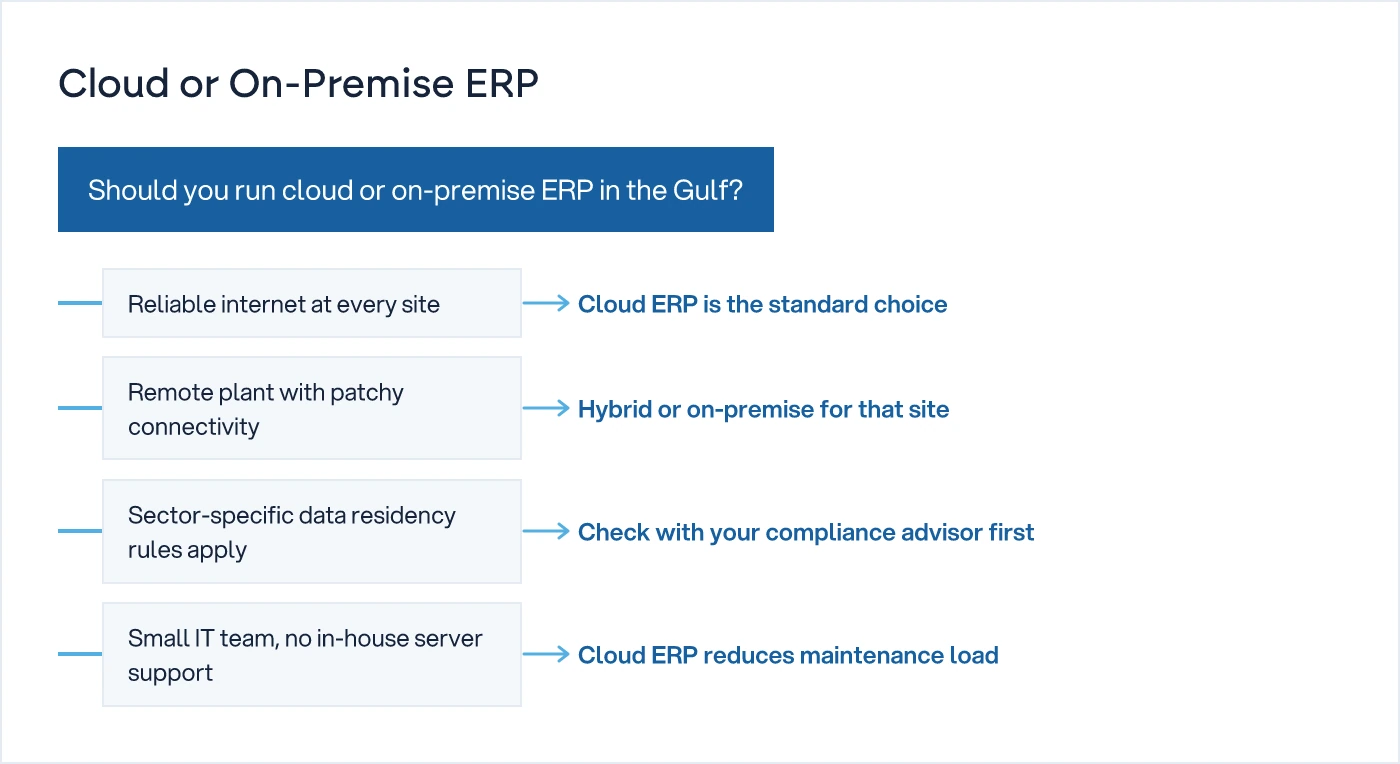
Searches for erp dubai often assume cloud is automatically right because the market is modern. That is not always true. A food processing plant with patchy connectivity at a remote site, or a business handling data under sector-specific residency requirements, may still need an on-premise or hybrid setup for parts of the operation. The decision belongs to whoever owns IT risk in your business, usually the owner or GM in a mid-sized firm, not the vendor selling the licence.
What to do next
Map your batch-to-invoice sequence on one page before you take another ERP demo. If you want a second pair of eyes on that map, start with a free 30-minute call. For businesses that want the sequence documented properly, process by process, warehouse by warehouse, before any software decision, SCAN (System Clarity & Actionable Needs) is the paid on-site step we run after that call.
Visit Distribution, Trading and Wholesale Operations for more on getting dispatch, stock and pricing under control, or see how a Digital Transformation engagement works end to end.
Common questions
What is process manufacturing ERP?
Process manufacturing ERP manages production that blends or transforms raw material into a finished good that cannot be taken apart, such as food, paint or chemicals. It tracks formulas, yield, and batch or lot genealogy, so a quality issue in one batch can be traced forward to exact customers, rather than triggering a recall of an entire production run.
What does a distribution company need from ERP?
A distribution company needs stock visibility across every warehouse, route-based dispatch planning, and credit control that blocks an order automatically when a customer exceeds their limit. Stock counts alone are not enough. The system needs to make the warehouse, route and credit decision on its own, before dispatch, not after a shipment is already loaded.
What should UAE businesses consider for ERP compliance?
Check that the ERP can generate VAT-compliant invoices with configurable tax codes, numbering and invoice formats, since e-invoicing requirements are evolving. Confirm the current rules directly with the Federal Tax Authority rather than relying on a vendor's compliance claim. Build in flexibility now so the invoice layout can change without a developer each time a rule shifts.
Cloud or on-premise ERP in the UAE?
Cloud ERP suits most distribution and process manufacturing firms in the UAE, since it updates faster with tax and compliance changes and needs less in-house IT support. On-premise or hybrid setups still fit where plant-level internet is unreliable or sector-specific data residency rules apply. Check residency requirements with your compliance advisor before deciding.
Sources
- Process Manufacturing — Syspro
- Chemical Manufacturing ERP — NetSuite

Sanket Vanani
Founder & CEO
Sanket Vanani is a business strategist and entrepreneur focused on helping businesses build structured systems for sustainable growth. His work spans sales, operations, manufacturing, process improvement, and business scalability. Through his experience working closely with business owners and teams, Sanket focuses on turning founder-dependent businesses into process-driven organizations that can grow with greater clarity, consistency, and control.
Related reading
Odoo vs Zoho vs Custom Software: How to Decide
Odoo vs Zoho isn't the real decision. Map your process first, then pick the tool, and know when custom software is the better fit.
Dispatch Planning: Why Trucks Leave Half Full and Late
Dispatch delays aren't a warehouse problem. They start upstream, in sales, invoicing and vehicle booking, and the warehouse just absorbs the damage.
Pricing Control: Who Can Actually Change a Price
Margin leakage isn't a pricing problem. It's an access control problem. Here's how to define who can discount, who approves, and who owns the master list.
Where Your Working Capital Is Actually Stuck
Good sales don't guarantee cash. Trace the real leaks: unbilled dispatch, unsent invoices, and payments sitting unreconciled.


