
Pricing Control: Who Can Actually Change a Price
Control pricing leakage by treating it as an access question, not a pricing strategy question. Define who can quote list price, who can discount within a band, who approves exceptions, and who alone can edit the master price list. Build this into the system so discounts above a limit cannot be entered without a logged approval.
Your gross margin on paper is 18%. The number that comes back from finance this quarter is 14%. Nobody stole anything. There was no fraud, no single bad decision anyone can point to.
A sales executive quoted 5% off in March to close a deal before month-end. A branch manager matched a competitor's rate in April without checking with anyone. Counter staff kept giving the old rate to a customer whose volume discount expired eighteen months ago, because nobody ever told them it had. None of these were big decisions. Add them up across a few hundred invoices and the P&L has a hole nobody can explain.
This is not a pricing strategy failure. Your price list was probably fine. It is an access control failure: too many people could change a price, nobody logged why, and nobody reviewed it until the margin showed up wrong.
Margin pressure from rising input costs is what's making this visible now. When margins were comfortable, a 3-4% leak didn't register. When your input cost has gone up 8% and your sell price hasn't moved, every point of unlogged discount shows up directly on the bottom line. The leakage was always there. The cushion that hid it is gone.
Who should be allowed to change a price in a distribution business?
Nobody should have unlimited discretion, and almost nobody needs it. Most distribution businesses can run on three or four tiers of pricing authority, each with a defined ceiling, and each tier should map to a role, not a person.
The counter or sales staff quote from the published price list. They do not set prices. A sales executive can offer a small, pre-approved discount band without asking anyone, because chasing approval for a 2% discount on a routine order just slows the sale down and trains people to work around the system. A branch or regional manager can go further, because they carry the relationship and the volume numbers to justify it. Anything beyond that, including any change to the master price list itself, sits with the sales head or the owner, and it gets documented, not just approved.
The mistake most businesses make is leaving this undefined. The price list exists, but anyone with login access to the billing screen can override it, and the override leaves no trail. That is not a pricing policy. That is an open field.
What is pricing leakage and why does it hide until margin pressure exposes it?
Pricing leakage is the gap between your list price and what actually lands on the invoice, accumulated across hundreds of small, individually defensible decisions. Each one looks reasonable in isolation. A loyal customer, a competitive situation, a slow month. None of them gets flagged because none of them crosses any threshold anyone is watching.
The reason it stays invisible for so long is that most distribution businesses review margin at the aggregate level, by product line or by month, not at the transaction level. A 2% average dip across a thousand invoices doesn't trigger an investigation. It just looks like "margins are a bit soft this quarter." By the time someone pulls the invoice-level detail, three or four quarters of leakage have already gone through.
How do you design approval tiers for discounts?
Start from the discount band each role can approve without escalation, and work outward from there. The table below is a starting structure, not a template to copy exactly. Your bands depend on your margin, your customer base, and how much authority you're comfortable pushing down.
| Role | Pricing authority | Discount without approval | Approval route for exceptions | Logged in system? |
|---|---|---|---|---|
| Counter / sales staff | Quote published list price only | 0% | Not applicable | Yes |
| Sales executive | Standard discount band | Up to 5% | Auto-approved, flagged for review | Yes |
| Branch / regional manager | Customer-specific pricing | Up to 10% | Manager approval entered in system with reason | Yes |
| Sales head / owner | Master price list, contract pricing | No fixed limit | Owner or sales head sign-off, documented | Yes |
The column that matters most is the last one. A discount band is only a control if it's enforced somewhere other than a verbal instruction. If a sales executive can simply type in 12% and the invoice goes through, the 5% band on paper is decoration.
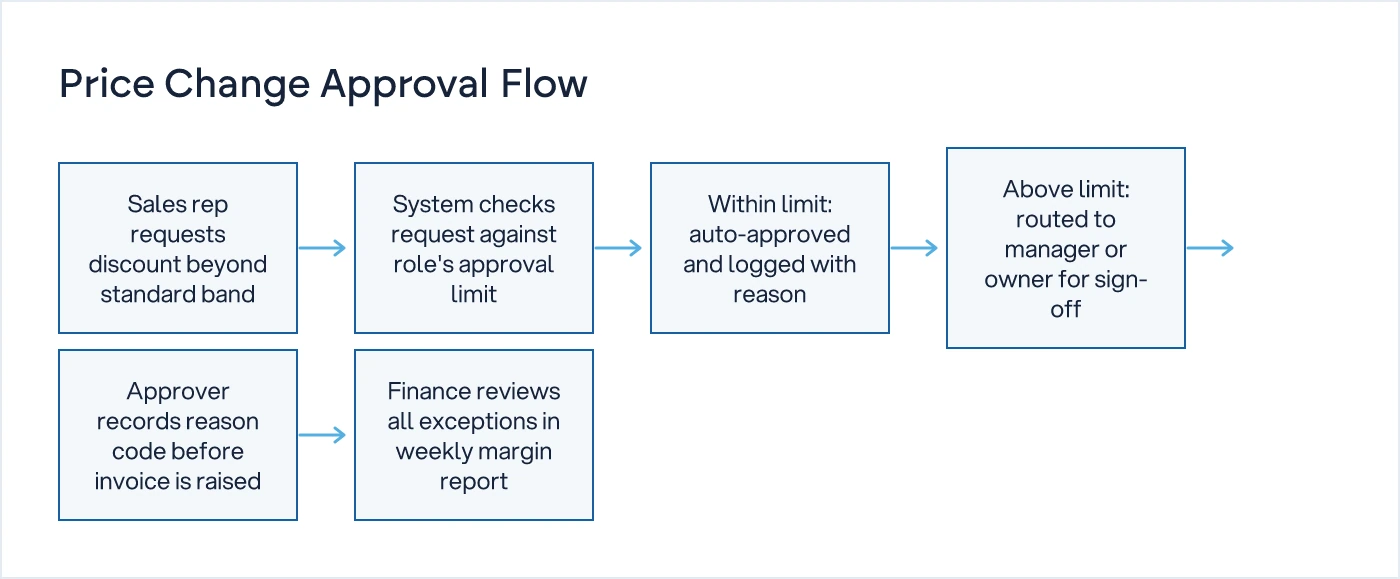
This is the sequence a price change should follow once discount bands are built into the system rather than left to memory and trust. A request within the rep's band clears itself and gets logged automatically. Anything above it stops at the till until someone with the authority to approve it does so, with a reason recorded against that invoice.
What should the system block automatically versus route for approval?
Anything inside the agreed band should go through without a phone call. Anything outside it should be physically impossible to enter without an approval step, not just discouraged by policy.
This distinction matters because most pricing leakage doesn't come from deliberate rule-breaking. It comes from systems that allow an override and trust the person to use good judgement every single time, for years, under deadline pressure, without anyone checking. People are not the control. The system is the control, and the people operate inside it.
If your billing software or ERP doesn't support role-based discount limits, that's a system gap worth fixing before you fix anything else in pricing. Oracle's Advanced Pricing guide is a useful reference for how enterprise systems structure this, even if your own stack is simpler. The principle carries across any system: price changes above a defined threshold need a gate, not a guideline.
Who should own the master price list, and how often should it change?
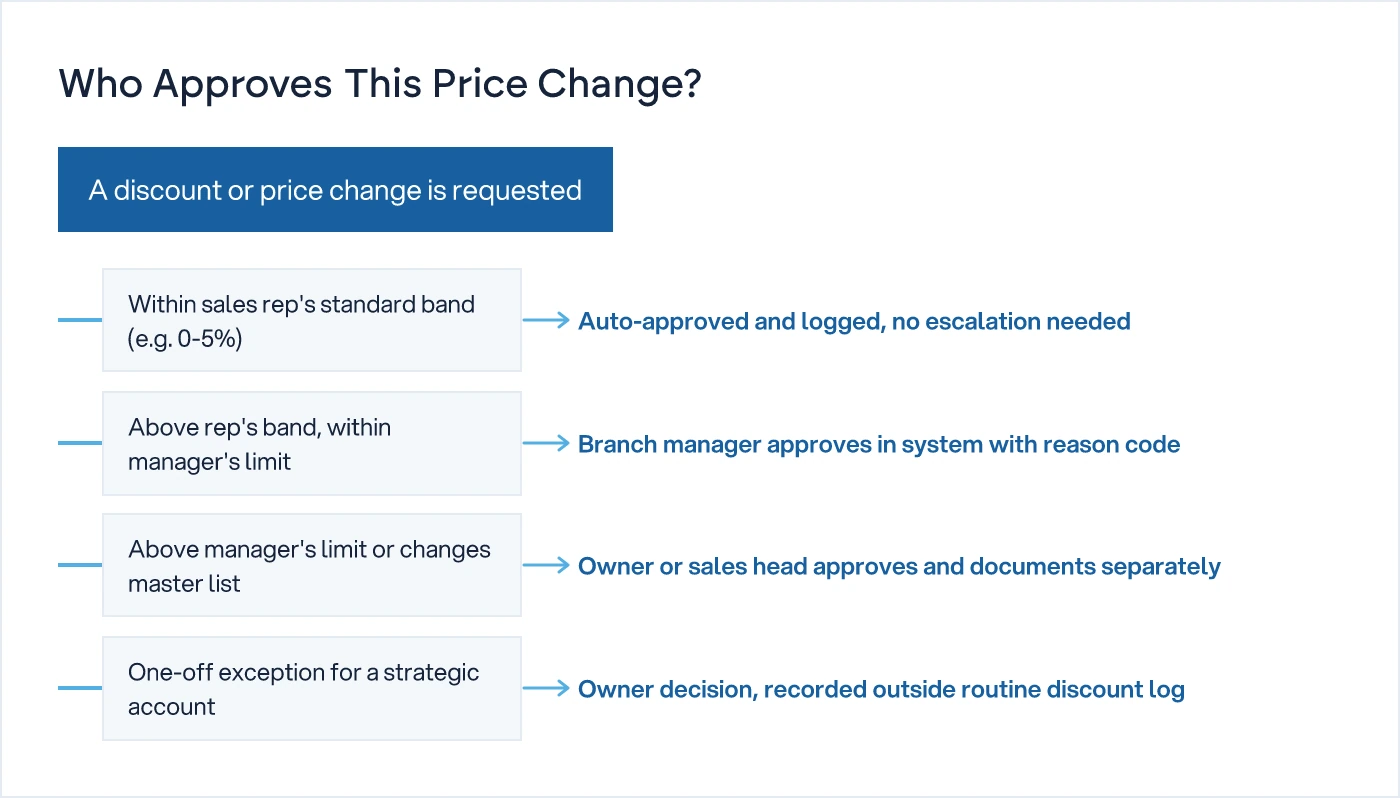
One person, or one small committee, owns the master list, and every change to it is dated and attributed. This is different from discount authority. Discount bands govern what happens on a single invoice. The master list is the baseline everyone discounts from, and if that drifts without anyone noticing, your discount bands are built on sand.
Review the master list on a fixed cycle, tied to your input cost movement, not an arbitrary calendar date. If your raw material cost has moved 6% since the last review and your sell price hasn't, that review is overdue regardless of what the calendar says.
MDM's piece on giving commercial teams pricing power without losing control makes a point worth repeating here: the goal isn't to strip salespeople of discretion. It's to give them discretion inside a boundary that's visible to everyone, including finance.
What records do you need to defend a margin review?
You need, for every approved exception, the approver's name, the date, the discount given, and a reason code, not a free-text note someone will forget to fill in properly. Without this, a margin review three months later becomes a guessing exercise, and the people who gave discounts can no longer remember why.
This is also what separates a pricing policy from a pricing system. A policy lives in a document nobody reads after induction week. A system makes the policy the only way through, and produces a record automatically because the record was never optional.
If the answer to "why was this invoice discounted 11%" needs a phone call to the branch manager to find out, it's not a system. It's a memory, and memories don't survive staff turnover.
How does this connect to the rest of your margin and cash position?
Pricing control doesn't sit in isolation. A discount given without approval shows up later as thinner margin on cash blocked between sale and collection, and a customer who's used to getting unapproved discounts is often the same customer whose receivables ageing quietly extends, because the relationship has been managed on favours rather than terms. If you're also clearing aged stock at discretionary discounts, check whether that stock actually qualifies as dead stock before writing it down that way. Pricing, collections, and inventory decisions are usually made by the same two or three people in a distribution business, which is exactly why the access controls need to be explicit rather than assumed.
What to do about this on Monday
Pull the last three months of invoices and sort by discount percentage, not by customer or product. Look at who entered each discount above your comfort threshold, and ask them, in person, why. You will find patterns fast: a branch that discounts routinely, a product line where the list price is simply wrong, a customer whose special rate was never formally reviewed.
Then decide the three or four tiers above, write them down, and build them into whatever system raises your invoices, whether that's an ERP, a billing tool, or a spreadsheet with someone checking it. We understand how your business actually works first, then we design the system around it. Do not automate a bad process. If your current discount approval is a WhatsApp message to the owner, fix the process before you digitise it.
For a wider view of where distribution businesses lose margin and control before it shows up on the P&L, see our guide to distribution, trading and wholesale operations. If pricing control is one of several operational gaps you're trying to close at once, our digital transformation service is built around mapping the decision points first, pricing included, before any software gets built.
Common questions
What is the difference between discount approval and master price list control?
Discount approval governs what happens on a single invoice, such as whether a sales executive can offer 5% off without asking anyone. Master price list control governs the baseline price everyone discounts from. If the master list drifts without review, every discount band built on top of it is working off the wrong number.
Should salespeople see the cost price when quoting?
Most distribution businesses are better off showing sales staff the floor price or minimum margin they're allowed to quote, not the raw cost price itself. This keeps the discount conversation focused on the number that matters without creating a separate reason for cost data to leak to competitors or customers.
How often should the master price list be reviewed?
Tie the review to input cost movement rather than a fixed calendar date. A reasonable trigger is any input cost change of 5% or more since the last review. Waiting for an annual review cycle while costs move quarterly is one of the more common reasons margin erodes quietly.
What if our billing system doesn't support discount approval limits?
Then the control has to sit outside the software temporarily, through a manual sign-off sheet or a second check before invoicing, while you fix the system gap. This is slower, but it's still better than no control at all. Fixing the system to enforce limits automatically should be a near-term priority, not a someday item.
Who should have final say on pricing for a strategic or large account?
The owner or sales head, and the decision should be documented separately from routine discount approvals, since strategic pricing often involves trade-offs beyond margin on a single order, such as volume commitments or long-term relationship value. Treating it the same as a routine discount hides the reasoning from future review.
Sources
- How to Give Commercial Teams Pricing Power (Without Losing Control) — Modern Distribution Management
- Dealer Pricing Control: Protecting Margins Across Large Distribution Networks — ZunderFlow
- Oracle Advanced Pricing Implementation Guide — Oracle
- Tiered Pricing, MAP & Contract Enforcement — OrderHUBx

Sanket Vanani
Founder & CEO
Sanket Vanani is a business strategist and entrepreneur focused on helping businesses build structured systems for sustainable growth. His work spans sales, operations, manufacturing, process improvement, and business scalability. Through his experience working closely with business owners and teams, Sanket focuses on turning founder-dependent businesses into process-driven organizations that can grow with greater clarity, consistency, and control.
Related reading
Where Your Working Capital Is Actually Stuck
Good sales don't guarantee cash. Trace the real leaks: unbilled dispatch, unsent invoices, and payments sitting unreconciled.
Setting Reorder Points When Demand Isn't Steady
Most reorder-point formulas assume steady demand. This one is built for distributors whose demand is lumpy and lead times swing.
Dead Stock: How Much Is Sitting in Your Warehouse
Dead stock isn't a stock problem. It's a decision no one owns. Here's how to find it and who should be signing off the write-off.
Receivables Ageing: Catching Bad Debt Before Month-End
Month-end ageing reports arrive too late for a trading business. Here is how to review receivables weekly and stop bad debt before it compounds.


