
Dead Stock: How Much Is Sitting in Your Warehouse
Dead stock is inventory with no sales movement for a fixed period, usually 180-365 days depending on your category, that no one has approved to write off or discount. You identify it by ageing every SKU by last movement date, then checking whether a specific person has the authority to act on what the ageing shows.
You already know roughly where it is. The corner of the warehouse nobody walks past on the way to the fast-moving racks. The SKUs that show up on every stock report and never leave. The owner has seen the number in the balance sheet and knows it's higher than it should be. What's missing isn't visibility. It's a decision.
Most distributors can tell you their total inventory value to the rupee. Few can tell you how much of it hasn't moved in a year, because nobody has ever run that specific report, and even fewer can tell you who is supposed to act once that number comes up. That second gap is the real problem. Dead stock doesn't accumulate because warehouses are messy. It accumulates because writing off a batch, or discounting it to clear it, is a decision that touches purchase value, GST input credit, and someone's judgement about whether it was ever a good buy. Nobody wants to be the one who signs that off, so it sits. Quarter after quarter.
How do you know if stock is actually dead, or just slow?
Dead stock is inventory with zero sales movement for a defined period, not inventory that's simply moving slower than you'd like. The two get treated as the same problem and they aren't.
Slow-moving stock still turns, just less often than your fast movers. It might sell twice a year instead of twice a month. That's a demand-planning issue, not a write-off candidate. Dead stock has had zero outward movement for a fixed window, typically 180 to 365 days depending on your category and shelf life, and shows no realistic path to selling at full value.
The distinction matters because they need different owners. A purchase manager can fix slow-moving stock by adjusting reorder quantities. Only someone with authority over the P&L can approve writing off dead stock, because that decision has a financial consequence attached to it.
Why does dead stock keep sitting on the books instead of being cleared?
Because no one has been given the specific authority to clear it, and clearing it usually means admitting a purchase decision didn't work out. In most distribution and trading businesses, purchase decisions are made by one person, storage is managed by another, and the finance view of what's tying up working capital sits with a third. None of them owns the call to say "this batch will never sell at cost, discount it or scrap it."
So it becomes a standing item on a stock report that everyone reads and no one actions. The owner asks about it in a review, someone says "we're looking at options," and the same line appears in the next quarter's report unchanged. This isn't negligence. It's an organisational gap. The decision has no home.
Who should decide to write off or discount dead stock?
One named person, against a fixed rule, reviewed on a set schedule. Not a committee, not "finance and sales together," one person with the authority to say yes.
In most distribution businesses this sits best with whoever owns working capital, usually the owner directly in a smaller firm, or a finance head in a larger one. It should not sit with the purchase manager, because they have an incentive to defend the original buying decision. It should not sit with the warehouse manager, because they don't see the financial picture. The person who decides needs to see both the ageing and the cost of holding, and needs the standing to make a call that might contradict someone else's earlier decision.
Once that person is named, the review becomes routine instead of political. It's not "why didn't sales move this," it's "this SKU crossed the 270-day mark, here's the rule, here's the action."
What rule should trigger the decision, so it isn't argued case by case?
A fixed ageing threshold by category, tied to an automatic action, so the decision-maker is applying a rule rather than making a fresh judgement call every time.
Without a rule, every SKU becomes a negotiation. "Give it one more quarter." "The client who used to buy this is coming back." "We paid a good price for it, we can't write it down." A fixed rule removes the negotiation and replaces it with a trigger.
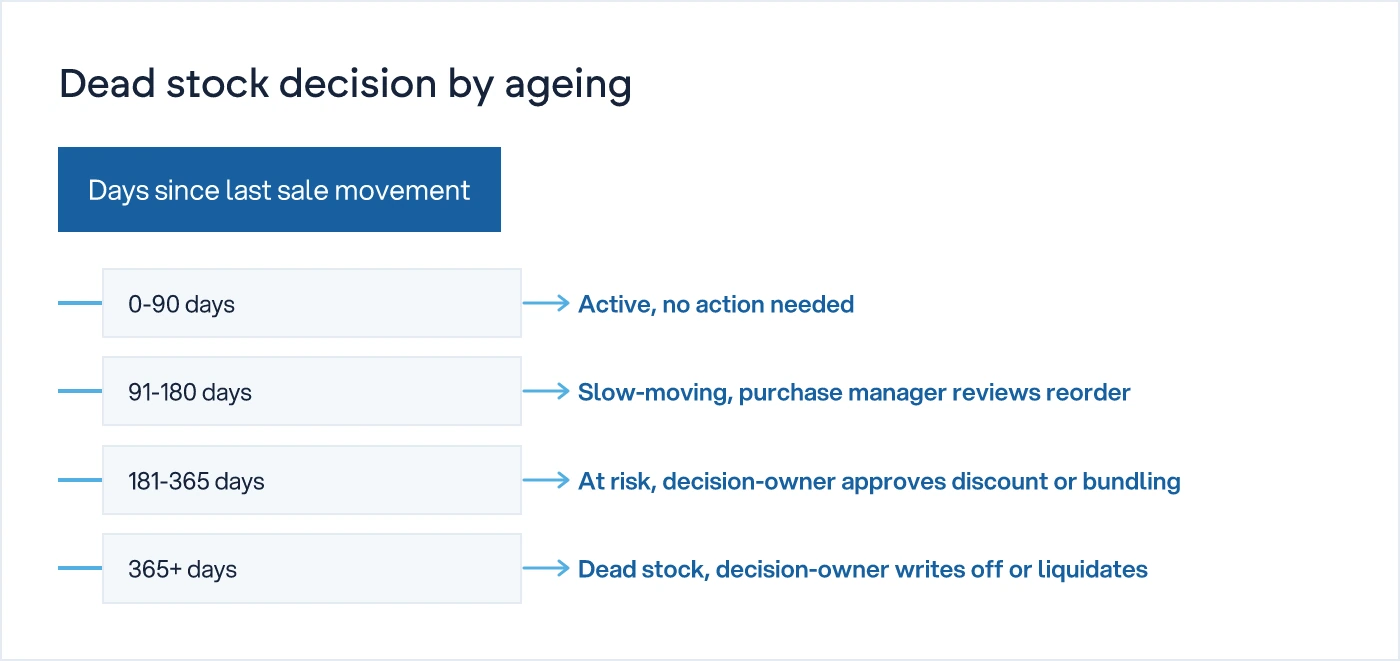
| Days since last sale | Classification | Typical action | Who signs off |
|---|---|---|---|
| 0-90 | Active | No action | N/A |
| 91-180 | Slow-moving | Review reorder quantity, flag to sales | Purchase manager |
| 181-365 | At risk | Discount or bundle to clear | Named decision-owner |
| 365+ | Dead stock | Write off, scrap, or liquidate at any recoverable price | Named decision-owner, ratified by owner |
The exact day counts should match your category. A textile trader might set the dead-stock line at 270 days because of seasonal cycles. An industrial parts distributor might set it at 365 because some parts genuinely have long, irregular demand. The number matters less than having one, applied consistently, so the decision-maker isn't relitigating each SKU from scratch.
How do you calculate what dead stock is actually costing you?
It's the purchase value of the stock plus what it costs you to store it and finance it, not just the number sitting in the inventory line on the balance sheet.
Most owners look at dead stock as a static number: this batch cost us X, it's still worth X on paper. That understates the real cost. Add the warehouse space it occupies, which could hold stock that actually turns. Add the working capital tied up in it, which at current lending rates has a real carrying cost every month it sits unsold. Add the risk that it degrades, goes out of spec, or becomes unsellable at any price the longer it waits.
A rough monthly carrying cost is usually 1.5-2% of the stock's value once you account for interest, storage and obsolescence risk together, though the exact figure depends on your borrowing rate and warehouse arrangement. Run that against a batch that's been sitting for two years and the case for clearing it at 40% of cost, rather than holding out for 100%, becomes obvious once someone actually does the sum.
What do you do with stock once it's flagged as dead?
Move it out at the best price available, through the fastest legitimate channel, rather than continuing to wait for full value.
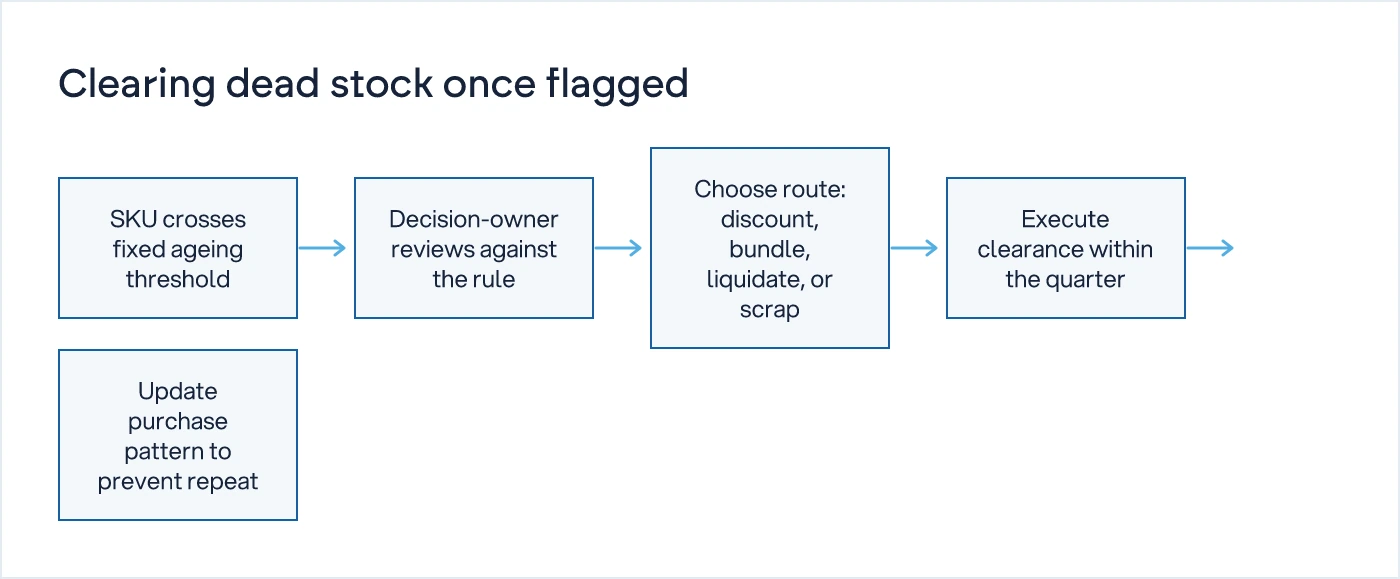
Once a batch is classified dead, the options are usually: discount and clear through existing channels, bundle it with fast-moving stock to shift it as a package, sell it to a liquidator or secondary buyer at a fraction of cost, or scrap it and take the tax write-off. All four are worse outcomes than selling at full margin. All four are better than the stock sitting there for another year earning nothing and costing you carrying cost every month.
The mistake owners make here is treating the write-off as a loss that happened today. It happened when the stock stopped moving. The write-off is just the paperwork catching up with a loss that's already real.
Where dead stock fits into the wider working capital picture
Dead stock and ageing receivables are the same underlying problem in different disguises: money that's technically yours, tied up somewhere in the business, with no one clearly accountable for bringing it back. If you're reviewing one, review the other. Our piece on tracking receivables ageing before it becomes bad debt covers the same logic applied to what customers owe you rather than what's sitting in your racks.
Both problems get solved the same way: a fixed rule, applied on a schedule, with one named person accountable for the decision it produces. Not a system that flags the problem and leaves the decision hanging. If the answer needs a phone call, it's not a system.
We understand how your business actually works first, then we design the system. For a distributor, that usually means the ageing report already exists somewhere in your ERP or a spreadsheet. What's missing is the rule and the named owner sitting on top of it. That's a decision to make this quarter, not a software project.
What to do this week
Pull last-movement dates for every SKU in your warehouse, not just the fast movers. Bucket them by the ageing table above. Name one person, in writing, who owns the decision on anything past your dead-stock threshold. Give them the rule, not just the report. Then put the first batch in front of them and make them decide, in this review, not the next one.
For a broader look at where working capital gets stuck in distribution and trading operations, see our hub on distribution, trading and wholesale operations. If the gap in your business is that decisions like this one have no clear owner anywhere in the process, that's the starting point for a conversation on our digital transformation service page.
Common questions
How do you identify dead stock in inventory?
Pull the last sale or last movement date for every SKU and calculate how many days have passed since. Anything past a fixed threshold, usually 180-365 days depending on your category, is a dead-stock candidate. The identification step is simple. The harder part is deciding what happens once an item crosses that line, which needs a named owner and a fixed rule, not a fresh debate each time.
What is the difference between slow-moving and dead stock?
Slow-moving stock still sells, just infrequently, and can usually be fixed by adjusting order quantities. Dead stock has had zero sales for an extended, defined period with no realistic path to selling at full value. Slow-moving is a demand-planning problem for the purchase manager. Dead stock is a write-off decision for whoever owns working capital in the business.
Who should decide to write off dead stock?
One named person with visibility into both ageing and carrying cost, usually the owner in a smaller distribution business or the finance head in a larger one. It should not be the person who originally bought the stock, since they have an incentive to defend that decision, and it should not be the warehouse team, since they don't see the financial picture.
How much does dead stock actually cost a business?
More than the purchase value shown on the books. Add warehouse space, financing cost on the capital tied up, and obsolescence risk. A rough carrying cost is 1.5-2% of stock value per month once interest, storage and risk are combined, though the exact figure depends on your borrowing rate. Over a year or two, that carrying cost alone can exceed what the stock would fetch at a discount.
What should a business do with stock once it's classified as dead?
Move it through the fastest legitimate channel at the best available price: discount and clear, bundle with fast-moving stock, sell to a liquidator, or scrap and take the tax write-off. The loss already happened when the stock stopped moving. The write-off decision is just catching up with that fact, not creating a new loss.
Sources

Sanket Vanani
Founder & CEO
Sanket Vanani is a business strategist and entrepreneur focused on helping businesses build structured systems for sustainable growth. His work spans sales, operations, manufacturing, process improvement, and business scalability. Through his experience working closely with business owners and teams, Sanket focuses on turning founder-dependent businesses into process-driven organizations that can grow with greater clarity, consistency, and control.
Related reading
Receivables Ageing: Catching Bad Debt Before Month-End
Month-end ageing reports arrive too late for a trading business. Here is how to review receivables weekly and stop bad debt before it compounds.


