
Receivables Ageing: Catching Bad Debt Before Month-End
Track receivables ageing weekly, not at month-end. Split outstanding invoices into 0-30, 31-60, 61-90 and 90+ day buckets, name one person responsible for each overdue account, and check every new order against a credit limit set before the sale, not a report discovered after it.
The order that looked fine in October
A trading firm in Dubai ships a large order to a customer it has worked with for two years. Payment terms: 60 days. The sales team is happy, the warehouse clears stock, everyone moves on.
In December, the accountant runs the month-end ageing report. That customer is 95 days overdue on the October invoice, and has placed two more orders since, both now also unpaid. The credit limit was never checked against the running balance. Nobody decided to extend more credit; it simply happened, order by order, because no one was watching between month-end reports.
This is the pattern behind most bad debt in trading businesses. It is rarely one bad customer. It is a good customer whose balance grew past the point of control before anyone looked.
What is receivables ageing and why does month-end reporting fail traders?
Receivables ageing is a breakdown of what customers owe you, grouped by how long each invoice has been outstanding, typically 0-30, 31-60, 61-90 and 90+ days. A standard ageing report is built from the accounting ledger and is accurate the day it is produced.
The failure is not in the report. It is in the timing. A month-end report tells you what happened over the last 30 days. In a trading business shipping daily on 30, 60 or 90-day terms, an account can move from current to seriously overdue, and back into further exposure through new orders, entirely inside that 30-day gap. By the time the report lands on the owner's desk, the decision that mattered, whether to hold the next shipment, was already missed.
An aged trial balance gives the same buckets from a slightly different angle, matching open invoices against payments received. Either format works. Neither works if it is only reviewed once a month.
How often should a trading business review receivables ageing?
Weekly, at minimum, for any customer within 20 percent of their credit limit or past 30 days outstanding. Daily if you are shipping against open terms to more than a handful of accounts.
The reasoning is arithmetic, not opinion. If your average order size is meaningful relative to a customer's credit limit, one or two missed reviews between month-end reports is enough for exposure to double. A weekly cadence catches an account moving from 30 to 60 days before it becomes a 90-day writeoff conversation.
This does not mean building a new report every week. It means the report that already exists gets pulled and read on a fixed day, by a named person, with a fixed next action, not filed as background information.
Who decides the credit limit, and when?
The credit limit should be set before the sale, by the owner or a credit controller with the authority to say no, not discovered after the fact by whoever runs the ageing report.
In most trading firms we've reviewed, the credit limit exists on paper, in an Excel sheet or an old approval email, but is not checked at the point of order confirmation. Sales checks stock availability. Sales checks pricing. Sales rarely checks the outstanding balance against the approved limit, because that check lives in a different file, owned by a different department, updated on a different schedule.
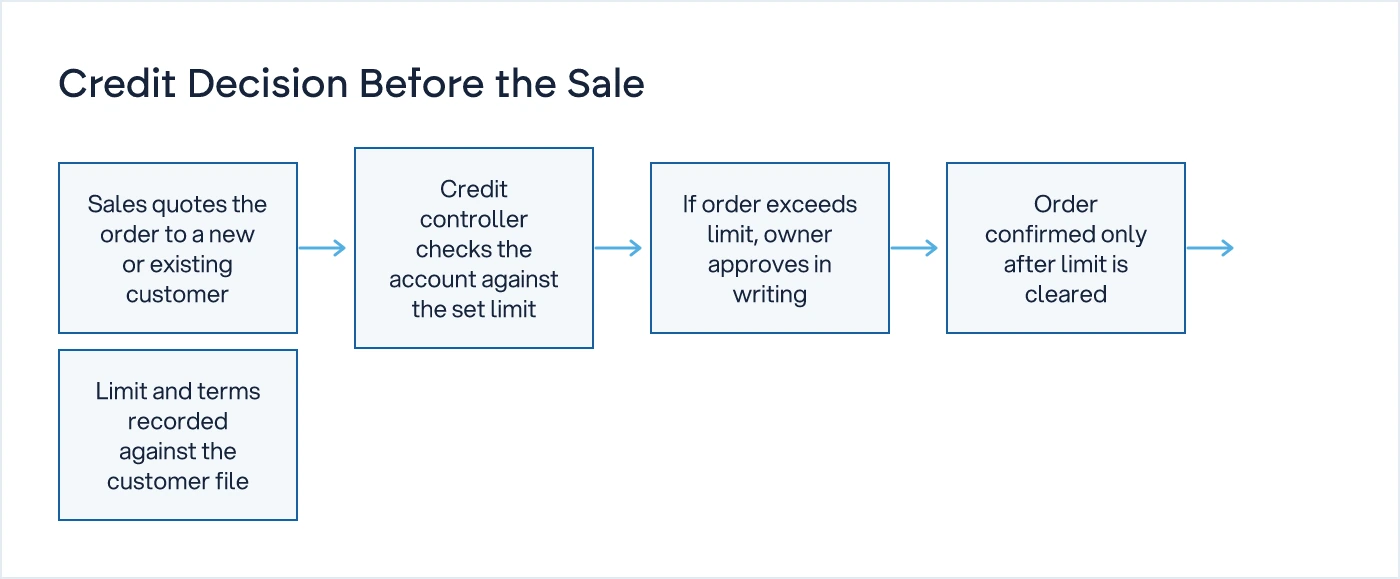
The fix is not a new policy document. It is moving the credit check to the same moment as the order confirmation, so the decision to extend more credit is made deliberately, by the person with authority to make it, before the goods leave the warehouse.
What should a weekly ageing review actually look like?
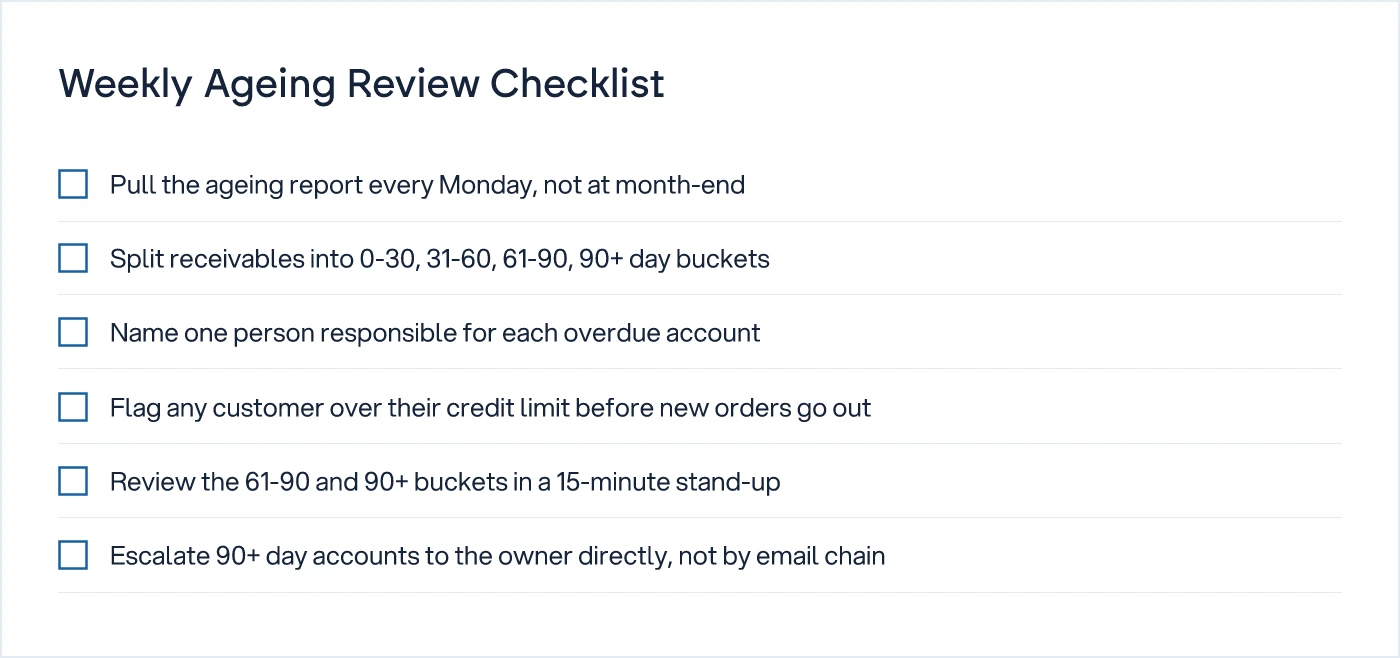
A short, structured look at two things: which accounts have crossed a threshold, and who is chasing them. It should take fifteen minutes, not an afternoon.
| Bucket | Typical cause | Who should own it | Action within |
|---|---|---|---|
| 0-30 days | Normal terms, invoice not yet due | Accounts team, no escalation | Routine |
| 31-60 days | Payment slipping, often a cash-flow issue on their side | Sales rep who owns the relationship | 3 working days |
| 61-90 days | Genuine payment risk, or a dispute not yet raised | Credit controller, with sales copied | 24 hours |
| 90+ days | High risk of write-off | Owner or finance head directly | Immediate, in writing |
The table is the whole system. What breaks it is when a 90-day account is still sitting with the same sales rep who made the original sale, because that rep has every incentive to keep the relationship warm and no incentive to press for payment.
A useful cross-check here is the complete guide to AR ageing and cash flow, which walks through how ageing buckets connect directly to working capital planning, not just collections.
Why does this matter more in the Gulf right now?
Credit terms across UAE and Saudi trading businesses are tightening as regional liquidity conditions shift, which means the customers who were comfortable at 60 days last year are under more pressure to stretch to 90 or 120 this year. A firm that only checks ageing at month-end will discover this shift after several cycles of exposure have already built up, not at the first sign of it.
The businesses handling this well are not the ones with the strictest terms. They are the ones who can see the shift early, because someone is looking at the ageing buckets every week and has the authority to hold the next shipment rather than waiting for finance to flag it two months later.
Where does the system usually break down?
It breaks down in the handoff, not in the report itself. Sales does not see finance data. Finance does not see order status. The owner sees a summary once a month and has no way to ask why a specific account was allowed to grow.
If your accounting platform already produces ageing data, for instance through an Odoo ageing report setup, the gap is rarely the report. It is that the report lives in one system, credit limits live in a spreadsheet, and order confirmation lives in a third place, with no one required to check all three before the goods move.
This is a process question before it is a software question. Fixing it by building a dashboard on top of the same disconnected data sources digitises the delay rather than removing it. The Distribution, Trading and Wholesale Operations hub covers the other operational gaps that sit alongside this one, order-to-cash visibility, stock ageing, and vendor terms, because they tend to break in the same businesses for the same reason.
We understand how your business actually works first, then we design the system. For a trading firm, that usually means one connected view: order status, credit limit and ageing bucket in the same place, checked on the same day, by someone with the authority to act on what they see. If you're evaluating how to get there, our digital transformation service starts with exactly that mapping exercise before any system is proposed.
What to do this week
Pull this week's ageing report and sort it by bucket, not by customer name. Look at every account past 60 days and ask one question: who is chasing this, and by when. If the honest answer is no one, that is the gap to close before anything else.
Common questions
What is a receivables ageing report and how is it different from a trial balance?
A receivables ageing report groups outstanding customer invoices by how many days overdue they are, usually in 0-30, 31-60, 61-90 and 90+ day bands. An aged trial balance shows the same information from the ledger side, matching open invoices against payments. For daily use they answer the same question: who owes you money, and for how long.
How often should a trading business check receivables ageing?
Weekly for any account near its credit limit or past 30 days overdue, and monthly for the full portfolio. A firm shipping daily on open terms cannot rely on a once-a-month report, because an account can move from current to seriously overdue inside that gap without anyone deciding to allow it.
Who should be responsible for chasing overdue receivables?
It should shift by bucket. Early overdue accounts, 31-60 days, stay with the sales rep who owns the relationship. Once an account crosses 60 days, ownership should move to a credit controller or finance head, because the sales rep has an incentive to protect the relationship rather than press for payment.
Should credit limits be checked before or after the sale?
Before. The credit limit should be checked at the moment an order is confirmed, by the person with authority to approve an exception, not discovered afterwards when an ageing report shows the account is over its limit. If the check happens after the sale, it is not a control, it is a record.
Why is receivables ageing suddenly a bigger issue for Gulf trading firms?
Credit terms across the UAE and Saudi Arabia are tightening as regional liquidity conditions shift, which means customers who paid comfortably at 60 days are under more pressure to stretch further. Firms that review ageing only at month-end tend to notice this shift several cycles too late.
Sources
- The AR Ageing: What Indian Businesses Need to Know — Patron Accounting
- Aged Trial Balance: Definition and Practical Guide — Billabex
- The AR Aging Report: A Complete Guide to Protecting Your Cash Flow — Beancount.io
- How to Build an AR/AP Aging Report in Odoo — ECOSIRE

Sanket Vanani
Founder & CEO
Sanket Vanani is a business strategist and entrepreneur focused on helping businesses build structured systems for sustainable growth. His work spans sales, operations, manufacturing, process improvement, and business scalability. Through his experience working closely with business owners and teams, Sanket focuses on turning founder-dependent businesses into process-driven organizations that can grow with greater clarity, consistency, and control.
Related reading

How to Choose the Right ERP Integration Pattern
A technical framework for choosing between API-first, event-driven and batch sync when connecting ERP, CRM and shop floor systems.
Simple ERP System for Small Business: What to Fix First
A simple ERP only stays simple if the process behind it is clear. Fix the process first, then pick the lightest cloud tool that fits.

Kaizen for Small Factories: Start It, Make It Stick
Kaizen fades without daily numbers. A 30-day plan, the metrics to track, and why most 5S boards go quiet after month one.


