
How to Choose the Right ERP Integration Pattern
There is no single best way to integrate ERP with other systems. Use API-first for real-time, two-way transactions like stock checks or order creation. Use event-driven for one-way notifications, such as a dispatch triggering an invoice. Use batch sync for bulk reconciliation, like nightly stock counts. Match the pattern to what the data is for.
What is the best way to integrate ERP with other business systems?
There isn't one correct pattern. The right integration depends on what the receiving system does with the data and how fast it needs to act on it.
Most CTOs default to API-first because it's familiar, then discover it doesn't fit every case. A sales order needs a synchronous answer: is there stock, yes or no. A dispatch confirmation doesn't need an answer at all, it just needs to be known by three other systems eventually. Treating both the same way is where integration debt starts.
The decision isn't technical first. It's operational. Ask who is waiting for this data, and what they do if it's five minutes late.
What's the difference between API-first, event-driven and batch sync?
Each pattern answers a different operational question: does someone need an immediate answer, does a system need to react to a change, or does data just need to be reconciled periodically.
API-first is a direct, synchronous call between two systems. The CRM asks the ERP "is there stock for this SKU" and waits for an answer before the salesperson can confirm the order. It's the right choice when the business decision depends on the answer arriving now.
Event-driven is asynchronous. A system publishes "order confirmed" or "stock dispatched" as an event, and anything subscribed to that event reacts in its own time. The ERP doesn't wait for the WMS to confirm it received the message. This fits one-way notifications where the sender doesn't need to know the outcome immediately.
Batch sync moves data in scheduled bulk jobs, usually overnight or hourly. It fits reconciliation, not decisions. Nightly stock counts, finance exports, CRM contact updates. Nobody is standing at a screen waiting for this to finish.
| Pattern | Latency | Direction | Failure handling | Best for |
|---|---|---|---|---|
| API-first | Seconds | Synchronous, two-way | Caller must handle timeout/retry | Stock checks, order creation, credit limit checks |
| Event-driven | Seconds to minutes | Asynchronous, one-way | Queue retries, dead-letter handling | Dispatch notifications, status updates, cross-system triggers |
| Batch sync | Hours | Bulk, scheduled | Reconciliation job catches mismatches | Nightly stock sync, finance exports, master data refresh |
How do you decide which pattern fits a given integration?
Decide by asking whether a human or another system is blocked waiting for the answer, not by which pattern your team already knows how to build.
If the answer needs a phone call, it's not a system. That's the test for API-first: if a stock check takes too long or fails silently, someone on the floor will pick up the phone to ask the stores clerk directly, and the integration has already failed its purpose.
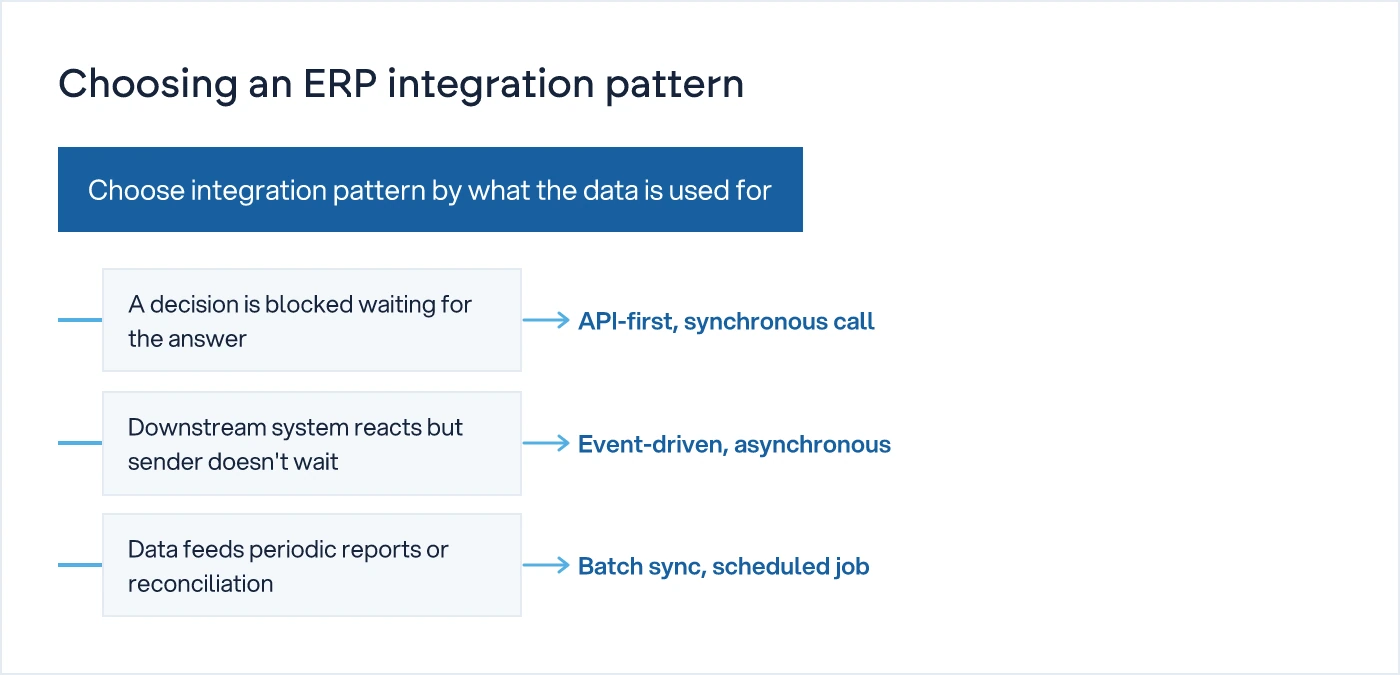
For event-driven cases, the test is different. Ask whether the sending system needs to know the outcome. If the ERP publishes a dispatch event and the CRM takes three minutes to update the customer's delivery status, nothing breaks. That's an event, not an API call.
For batch sync, the test is whether anyone is making a decision between runs. If the sales team only checks consolidated stock once a day before placing orders, a nightly batch is enough. Building a real-time API for that is effort spent on a problem that doesn't exist.
What does this look like for ERP, CRM and shop floor systems together?
In practice, a single order touches all three patterns depending on which step you're looking at, not just one pattern for the whole flow.
Take a sales order moving from CRM to ERP to the shop floor. The CRM needs an immediate stock answer before the salesperson commits a delivery date, that's API-first. Once the order is confirmed, the ERP doesn't need the WMS to acknowledge the pick list in real time, that's event-driven. And the finance team's nightly reconciliation between ERP and the accounting system is a batch job, because nobody needs it until the next morning.
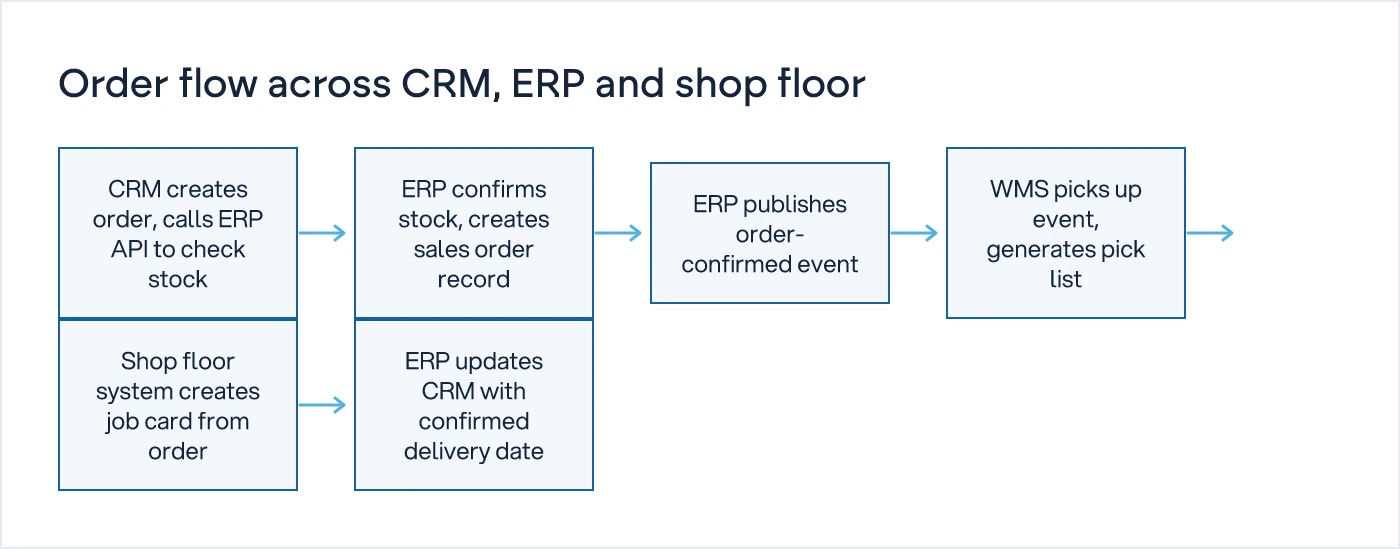
Teams get into trouble when they force one pattern across the whole chain. Building everything as synchronous API calls makes the CRM dependent on the WMS being online, which it doesn't need to be. Building everything as batch means the salesperson is quoting stock that's twelve hours stale. The shop floor interface for this handoff is its own decision, covered in Mobile App or Web Dashboard for Shop Floor Operations, but the integration pattern feeding it is decided separately, by latency need, not by screen type.
Where does integration debt come from?
Integration debt builds when every new system gets a direct, point-to-point connection instead of a shared layer, and nobody owns the growing web of connections.
Three systems need three connections. Five systems, if every pair talks directly, need ten. Add a sixth and it's fifteen. Each one has its own retry logic, its own field mapping, its own undocumented assumption about what "active customer" means. When the ERP changes a field name, four other systems break and nobody remembers why they were connected in the first place.
This is the same pattern described in Technical Debt in an Internal Tool: When to Pay It Down. Integration debt isn't messy code. It's connections the business can no longer trace without a developer tracking down which job failed overnight.
When do you need a dedicated integration layer instead of more point-to-point connections?
Bring in a middleware layer, an iPaaS or a custom integration service, the moment a third system needs the same piece of data as the first two.
Two systems talking directly is fine. The moment a third system needs the same customer record, stock figure or order status, route it through one layer instead of adding a third direct connection. The layer becomes the single place that knows the field mappings, the retry rules and who owns what. It's the same principle behind introducing a reporting layer once a second source feeds the same report, covered in Designing a Reporting Architecture for Multiple Sources.
This isn't a call to rebuild everything on day one. Start point-to-point if there are only two systems. Plan the layer before the third one goes live, not after the fourth integration breaks in production. And when picking the stack for that layer, the same constraint applies as any other internal system: choose what your team can support in three years, a point covered in How to Choose a Tech Stack When the Business Has to Live With It.
What to do next
Map every system that currently talks to your ERP and write down, for each connection, whether it's a decision, a notification or a reconciliation. That one column tells you which pattern you actually need, and usually reveals two or three point-to-point connections that should never have been built that way.
If that map is bigger than you expected, that's the conversation worth having before the next system gets added. A free 30-minute call is enough to walk through what you have and where it's heading. For the wider set of build, migrate and MVP decisions this sits inside, see the Building Software hub.
Common questions
Should every ERP integration use an API?
No. APIs suit cases where one system needs an immediate answer from another, such as a stock check before confirming an order. If the receiving system doesn't need to know the outcome right away, an API call adds unnecessary coupling and failure points. Use event-driven or batch patterns for notifications and reconciliation instead.
What is integration debt in ERP systems?
Integration debt is the accumulated cost of connecting systems point-to-point instead of through a shared layer. Each direct connection carries its own retry logic and field mapping. As systems are added, the number of connections grows faster than anyone can track, and a single field change can break several systems at once without warning.
Do we need middleware or an iPaaS, or can we build point-to-point connections?
Point-to-point is fine for two systems. Bring in a middleware layer or iPaaS once a third system needs the same data, such as a customer record used by CRM, ERP and a WMS. The layer becomes the one place that owns field mappings and failure handling, instead of three separate undocumented connections.
How does integration pattern choice affect reporting across systems?
Batch-synced data is usually good enough for daily reports, but real-time dashboards built on event-driven feeds need the reporting layer designed separately from the operational integration. Mixing report queries directly into a live API integration slows down the transactional system it was meant to serve.
What if our legacy ERP doesn't expose an API?
Older ERPs often only support database-level access or flat-file exports. In that case, batch sync through scheduled exports is usually the realistic starting pattern, even for data that would ideally be real-time. Plan the API or event layer as part of a future migration rather than forcing a workaround now.
Sources

Sanket Vanani
Founder & CEO
Sanket Vanani is a business strategist and entrepreneur focused on helping businesses build structured systems for sustainable growth. His work spans sales, operations, manufacturing, process improvement, and business scalability. Through his experience working closely with business owners and teams, Sanket focuses on turning founder-dependent businesses into process-driven organizations that can grow with greater clarity, consistency, and control.
Related reading
Mobile App or Web Dashboard for Shop Floor Operations
Decide mobile vs web for shop floor tools by where the user physically stands, not by platform trends. A role-by-role way to choose.
Designing a Reporting Architecture for Multiple Sources
Decision criteria for technical leads: when direct database queries are still fine, and when you need a dedicated reporting layer instead.
Technical Debt in an Internal Tool: When to Pay It Down
Technical debt in an internal ops tool is decision-capability debt. Price it, prioritise it, and pay it down without stopping the business.
How to Choose a Tech Stack When the Business Has to Live With It
Stack choice isn't about frameworks. It's about who can maintain the system after the developer who built it leaves.


