
Technical Debt in an Internal Tool: When to Pay It Down
Technical debt in an internal tool is not messy code. It is decisions the tool can no longer support without a phone call. Manage it by tracking which decisions route around the system, costing each workaround in delay and error, and paying down the debt blocking the most decisions first.
What does "technical debt" actually mean in an internal operations tool?
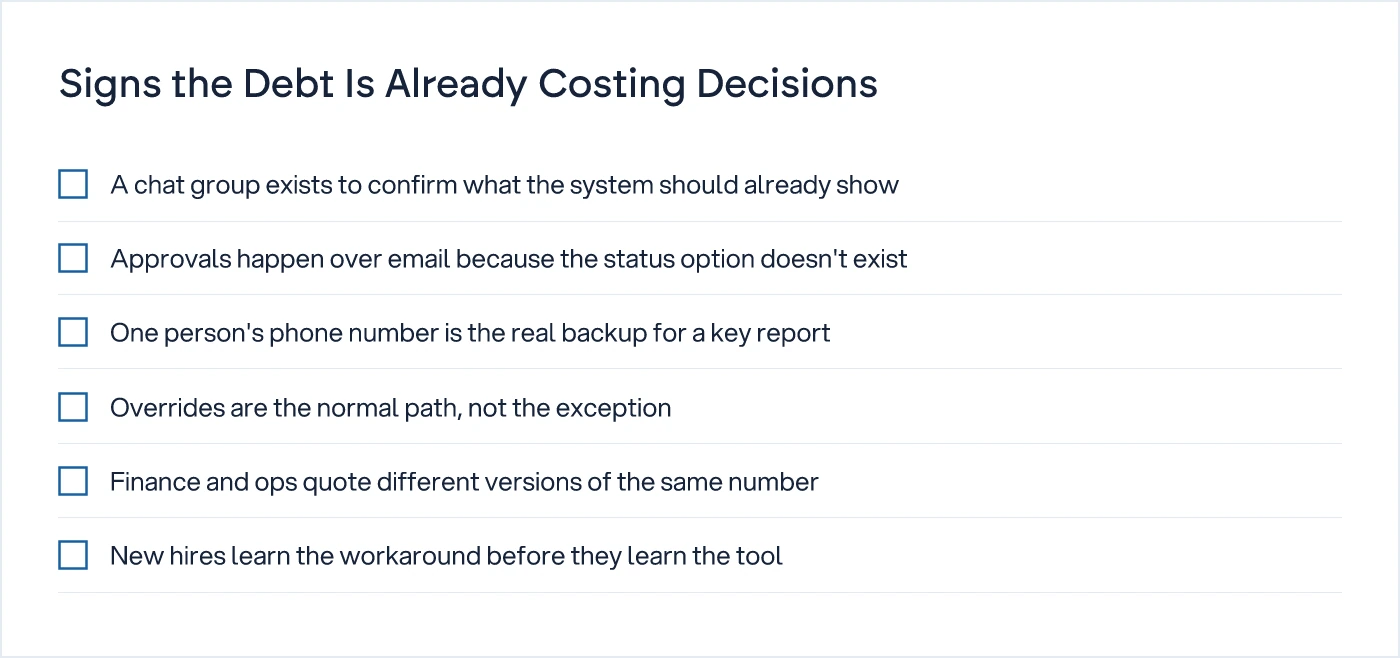
It means decisions the tool can no longer support, not code that looks bad in review. A production tracking tool built two and a half years ago, when the plant ran three shifts, has nothing wrong with it as code. It still runs. It still logs output. But the plant now runs a fourth, flexible overtime shift that doesn't fit the three-shift structure baked into the database schema. The supervisor keeps a paper log for that shift and transcribes it into the system the next morning. That transcription gap is the debt. It isn't a bug ticket. It's a decision, how much overtime to approve tonight, that now depends on a piece of paper instead of the system everyone else trusts.
This is the reframe technical leads need when they take a paydown request to the business. "The codebase is getting messy" doesn't move an owner. "The plant head can't see real-time overtime cost without calling the supervisor" does, because it names a decision and who makes it.
How do you tell code debt from decision-capability debt?
Code debt is friction for the engineering team. Decision-capability debt is friction for the person who has to act on the system's output. The same symptom can be read either way, and the business only funds a fix once it sees the second reading.
| Symptom seen on the floor | Looks like (code view) | Actually is (decision view) |
|---|---|---|
| Report takes three days to generate | Unoptimised query, no caching layer | No one can decide on reorder timing without it, so they wait or guess |
| Adding a new product variant needs a developer | Hardcoded dropdown, no config table | Sales can't quote a new SKU without a dev ticket, so they quote offline and reconcile later |
| Approval sits in an inbox for days | No workflow engine, routing is manual | The approver doesn't know it's waiting, so the plant head calls to chase it |
| Two systems show different stock figures | No single source of truth, duplicate writes | The planner can't trust either number, so they count manually before committing |
Every row in the right column names a decision and who makes it. That's the test. If you can't name the decision a piece of debt is interfering with, it probably belongs on a normal engineering backlog, not in front of the owner.
Why is this showing up two to three years after the tool was built?
Because the business changed and the tool's assumptions didn't move with it. Most internal tools are scoped against the process as it exists on day one, which is the right way to scope an MVP (see how to scope an MVP for an internal operations tool). The problem is nobody revisits those assumptions once the tool is live and the team moves to the next priority.
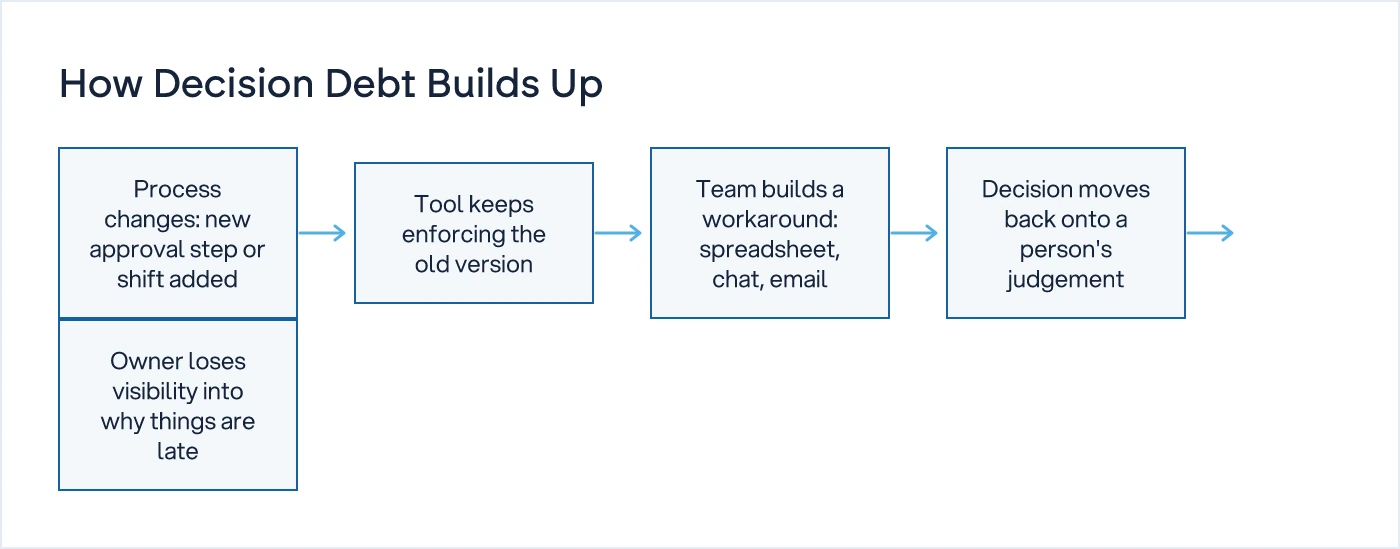
The pattern is almost always the same. The process changes first, usually quietly, a new approval step, a new shift pattern, a new customer category. The tool keeps enforcing the old version because nobody told it to do otherwise. The team doesn't stop working, so they build a workaround, a spreadsheet, a WhatsApp group, a side approval over email. The decision that used to run through the system moves back onto a person's judgement. And the owner, who commissioned the tool specifically to stop depending on people's memory, loses visibility into why things are late, without knowing the tool is the reason.
Access control debt follows the same shape. The org chart moves, a new regional head gets added, a role gets split, and the role-based permissions in the tool don't move with it (see role-based access control design from an org chart for how to build access around approvals rather than job titles in the first place). Two years in, half the overrides in the system exist because someone's role changed and nobody updated their access.
How do you decide which debt to pay down first?
You prioritise by how many decisions a piece of debt blocks and how often, not by how old or ugly the code is.
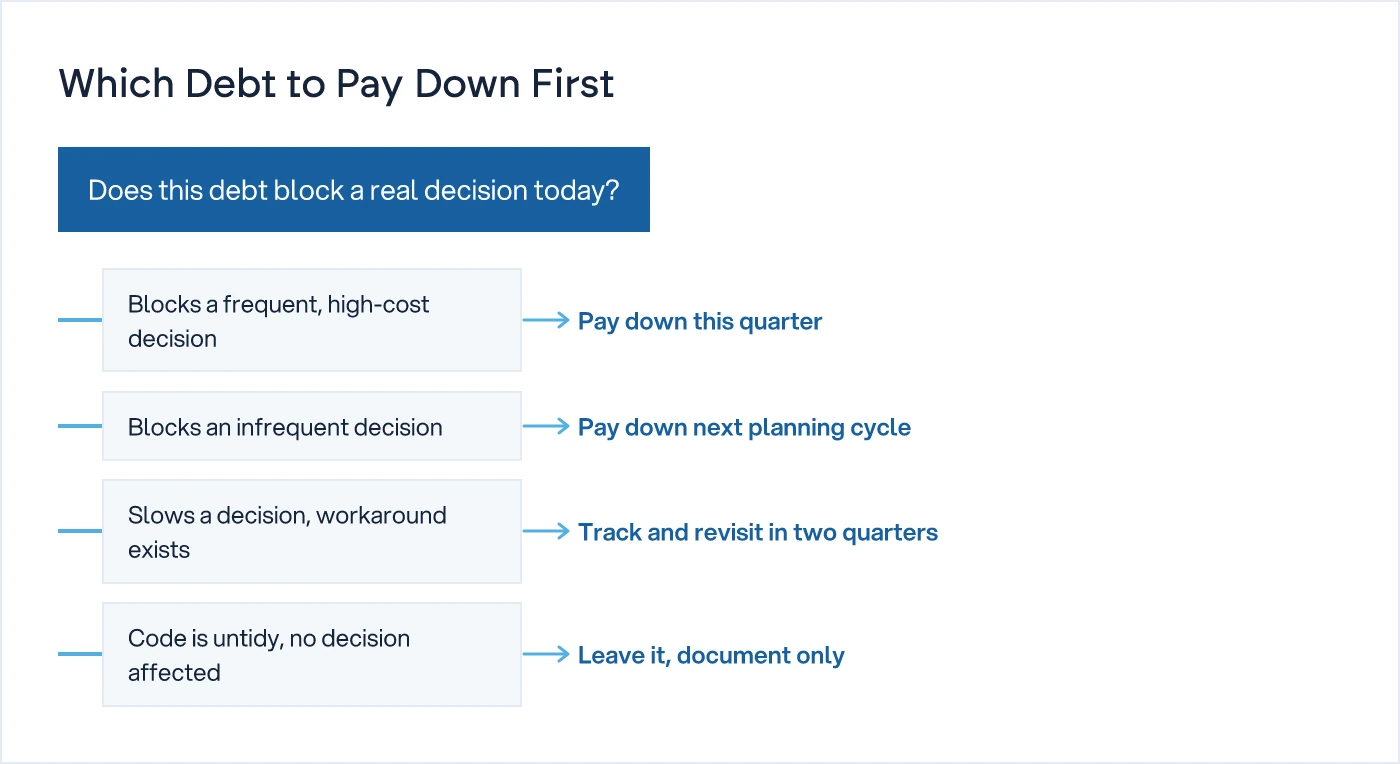
Start by listing every known workaround in the business, the spreadsheets, the WhatsApp groups, the "call so-and-so" steps. For each one, ask three questions: which decision does this support, how often does it happen, and what does the delay or the error in the current workaround actually cost. A workaround that happens twice a year and costs an hour isn't worth a sprint. A workaround that happens every day and causes the planner to double-count stock is.
The Pineapples.dev guide on mid-market technical debt makes a similar point about scoring debt against business impact rather than code metrics alone, and the StackFYI 2026 guide walks through a similar impact-versus-effort framing for prioritisation, which is worth reading if you want a second model to triangulate against (Pineapples.dev, technical debt for mid-market companies; StackFYI, tech debt management strategy guide).
How do you build the case to the business for paying it down?
You build it in the owner's language, not the engineering team's. "We need to refactor the overtime module" asks for budget against nothing the owner can picture. "The plant head currently approves overtime off a paper log because the system can't represent the fourth shift, and that's why last month's overtime cost came in 8% over what was approved" asks for budget against a number the owner already worries about.
Anupam Sinha's piece on getting management buy-in for technical debt strategy makes the point well: debt paydown gets funded when it's framed as removing a specific, recurring cost to the business, not as hygiene (Anupam Sinha, the technical debt strategy that actually gets management buy-in). The framing that works consistently is to name the decision, name who makes it today without the system, and name what it costs them to make it that way. If the answer needs a phone call, it's not a system. That line, said plainly to an owner, usually does more to justify a paydown sprint than any amount of code quality metrics.
What does a paydown plan look like that doesn't stop operations?
It looks like a phased rollout against a defined list of decisions, not a rewrite. You don't take the production tracking tool offline to rebuild the shift model. You add the fourth shift type alongside the existing three, run both for a defined period, and retire the paper log once the supervisor trusts the new field. This is the same discipline used when moving off a legacy ERP module by module rather than switching everything at once (see migrating off a legacy ERP without stopping the shop floor), and it applies just as well to paying down debt inside a tool you're keeping.
Sequence the paydown against the decision list you built earlier, highest frequency and highest cost first. Each item gets a before state (the workaround), an after state (what the system will do instead), and a date the workaround is formally retired. Don't leave the old workaround available indefinitely, because it will quietly become the default again the first time someone is in a hurry.
The stack choice you made originally also affects how expensive this paydown is to execute. A stack your city can't hire for in three years makes every paydown sprint harder to staff, which is one more reason the original choice matters more than benchmark numbers (see how to choose a tech stack for business software).
What to do next
Before you write a single refactor ticket, list every workaround currently running alongside your internal tool, the spreadsheets, the group chats, the calls people make because the system can't answer. Against each one, write the decision it supports and who makes it. That list is your actual technical debt register. It will look nothing like your code quality report, and it's the one the business will fund.
We understand how your business actually works first, then we design the system. If you're trying to work out whether an ageing internal tool needs a rebuild or a targeted paydown, that's a scoping conversation worth having before either gets budgeted. You can see how we approach that kind of work on our custom software development page, and the wider set of posts on build decisions like this one sits in the Building Software hub.
Common questions
What is technical debt in an internal business application?
It's the gap between what the tool was built to handle and what the business now does. The code may be perfectly fine. The debt shows up as decisions, approvals, stock counts, overtime sign-offs, that the tool can no longer support, which pushes people back to spreadsheets, calls and paper logs to get the decision made.
How often should you review technical debt in an internal tool?
Tie the review to process change, not a calendar. Any time a new approval step, a new role, a new shift pattern or a new product category gets added to the business, check whether the tool still represents it. In practice this tends to surface a review every two to three quarters for an active operations tool.
Should you rewrite or refactor an ageing internal tool?
Refactor the parts tied to decisions that are currently blocked or routed around, and leave the rest alone. A full rewrite is rarely justified by debt alone. It's usually justified when the business itself has changed so much that the original scope no longer matches how the company operates.
How do you justify technical debt paydown to a non-technical owner?
Name the decision that's affected, who makes it today, and what it costs them to make it without the system, in hours, errors or delay. Owners fund the removal of a recurring cost they recognise. They don't fund code quality improvements they can't see the effect of.
Is technical debt different for internal tools vs customer-facing products?
Yes. Customer-facing debt usually shows up as slow pages, bugs or lost conversions, measurable in the product itself. Internal tool debt hides in workarounds that happen off the system entirely, a WhatsApp group, a paper log, a side spreadsheet, so it's easy for engineering to miss until someone asks why the numbers don't match.
Sources

Sanket Vanani
Founder & CEO
Sanket Vanani is a business strategist and entrepreneur focused on helping businesses build structured systems for sustainable growth. His work spans sales, operations, manufacturing, process improvement, and business scalability. Through his experience working closely with business owners and teams, Sanket focuses on turning founder-dependent businesses into process-driven organizations that can grow with greater clarity, consistency, and control.
Related reading

How to Choose a Tech Stack When the Business Has to Live With It
Stack choice isn't about frameworks. It's about who can maintain the system after the developer who built it leaves.
Role-Based Access Is Not a Feature, It's Your Org Chart
Generic admin/user roles cause permission sprawl at scale. Map access from real approval authority instead, before writing permission code.
How to Scope an MVP for an Internal Operations Tool
Internal MVPs succeed or fail on the decisions they remove from daily judgement, not the features they ship. Here's how to scope one properly.
Migrating Off a Legacy ERP Without Stopping the Shop Floor
A phased, parallel-run approach to ERP migration that keeps production running while the old system is retired in stages, not overnight.


