
Kaizen for Small Factories: Start It, Make It Stick
Start kaizen by picking one line, measuring four numbers daily, and running one 15-minute kaizen event a week. Kaizen fades when there is no simple data showing whether a change actually helped. Track output, rejection, downtime and on-time completion from day one, and review them weekly before picking the next issue.
Most small factories have tried kaizen once already. A consultant ran a workshop, the floor got repainted, a 5S board went up near the supervisor's desk, and for two or three weeks everyone pointed at the red and green zones with pride.
Then the board stopped getting updated. Nobody could say whether the changes had actually reduced rejections or improved output. The lines stayed painted because nobody wanted to be the one who admitted kaizen had quietly died.
This happens because kaizen was never connected to a number anyone checked daily. Continuous improvement needs proof of improvement, not just activity. Without daily data, kaizen becomes a poster on the wall. With it, kaizen becomes a habit.
What is kaizen, in plain words?
Kaizen is a method for improving work in small, continuous steps, decided and tested by the people doing the job, not handed down from head office.
The word comes from two Japanese characters, kai (change) and zen (good), usually translated as continuous improvement. It grew out of the Toyota Production System in post-war Japan and was carried to the rest of the world largely through Masaaki Imai's writing in the 1980s.
The kaizen process is deliberately small. A supervisor moving a tool rack two metres closer to a machine is kaizen. A plant-wide ERP rollout is not, even if someone calls it that in the kickoff meeting. Kaizen is a cycle you repeat weekly, not a project with a start and end date.
Many owners confuse kaizen with a suggestion box bolted onto the wall. A suggestion box collects ideas nobody is obliged to test. Kaizen tests one idea, on one line, within a week, and either keeps it or drops it based on what the numbers show.
What is the difference between kaizen, 5S and lean manufacturing?
5S is a housekeeping method, kaizen is a way of running small improvement cycles, and lean manufacturing is the larger system both sit inside.
| Term | What it actually is | What it looks like on the floor |
|---|---|---|
| 5S | A housekeeping discipline: sort, set in order, shine, standardise, sustain | Marked locations for tools, nothing left on the floor without a label |
| Kaizen | A repeated cycle of small changes, tested and measured | A 15-minute weekly huddle fixing one bottleneck at a time |
| Lean manufacturing | The wider system aimed at cutting waste in material, motion and waiting | Flow-based layout, pull-based scheduling, visual management boards |
Kaizen 5S programmes often get bundled together as one thing: a clean floor. They are related but not the same. 5S is a state; kaizen is a process. A factory can have a spotless floor with no kaizen running at all, and it can run kaizen without ever doing a formal 5S exercise.
The decision an owner needs to make early is which of the three to start with. Most factories do better starting with kaizen cycles on one line, not a plant-wide 5S rollout, because kaizen forces a weekly rhythm that 5S on its own does not require.
Why do kaizen efforts fade after the first few weeks?
Kaizen fades when nobody can see, in numbers, whether last week's change actually helped.
The usual pattern: a kaizen event is held, everyone agrees it felt useful, and two weeks later the line is back to its old habit because no one checks a number that proves otherwise. If the answer needs a phone call, it's not a system.
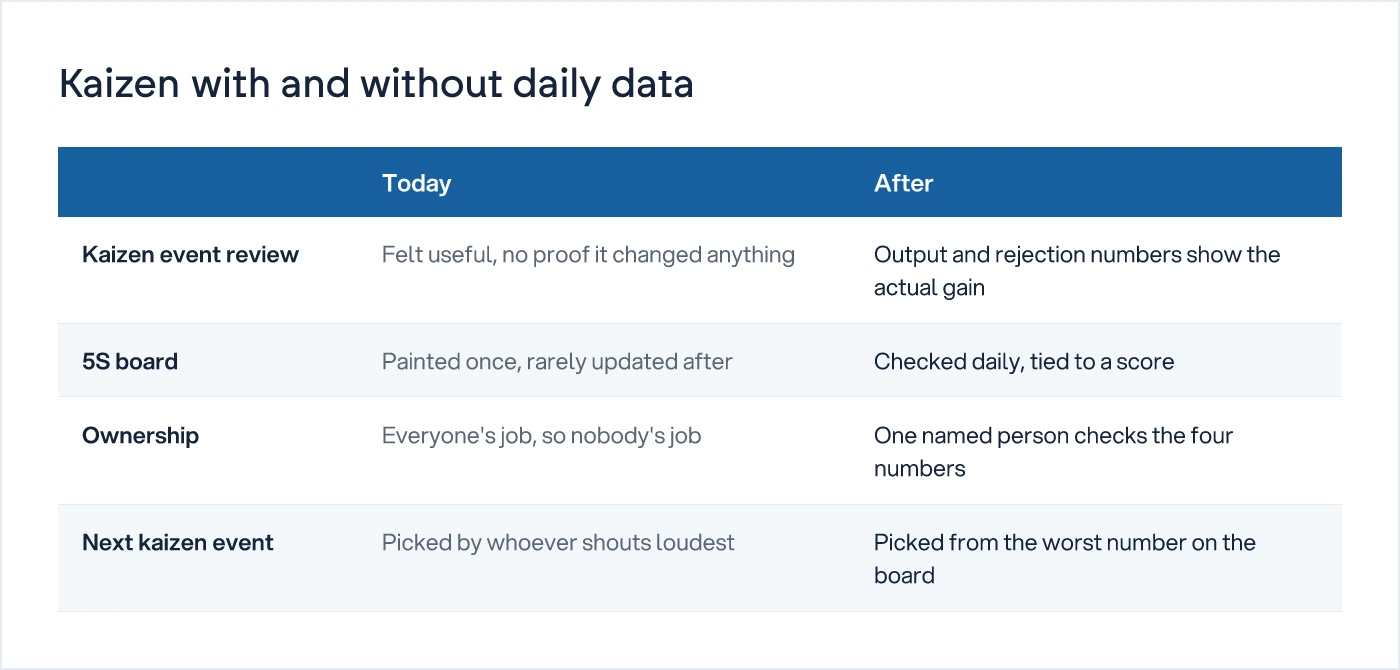
A 40-machine garment unit in Tamil Nadu once ran a kaizen event on thread-change downtime. The line felt faster afterwards. Three weeks later, nobody could say by how much, because downtime had only ever been logged as one total stoppage figure, never by reason, before the event. The improvement might have been real. It might also have been normal day-to-day variation. Without a baseline, there was no way to know.
The same pattern shows up in a steel fabrication unit running two shifts. A 5S event tidies the cutting yard, but if nobody times how long it takes to find an offcut before and after, the yard drifts back to clutter within a month, and the event is quietly written off as something that "didn't really work".
The fix is not more enthusiasm. It is a documented standard for the new method and a number that gets checked daily, the same discipline covered in our piece on running the business without the owner in the room.
What metrics should you track daily to keep kaizen alive?
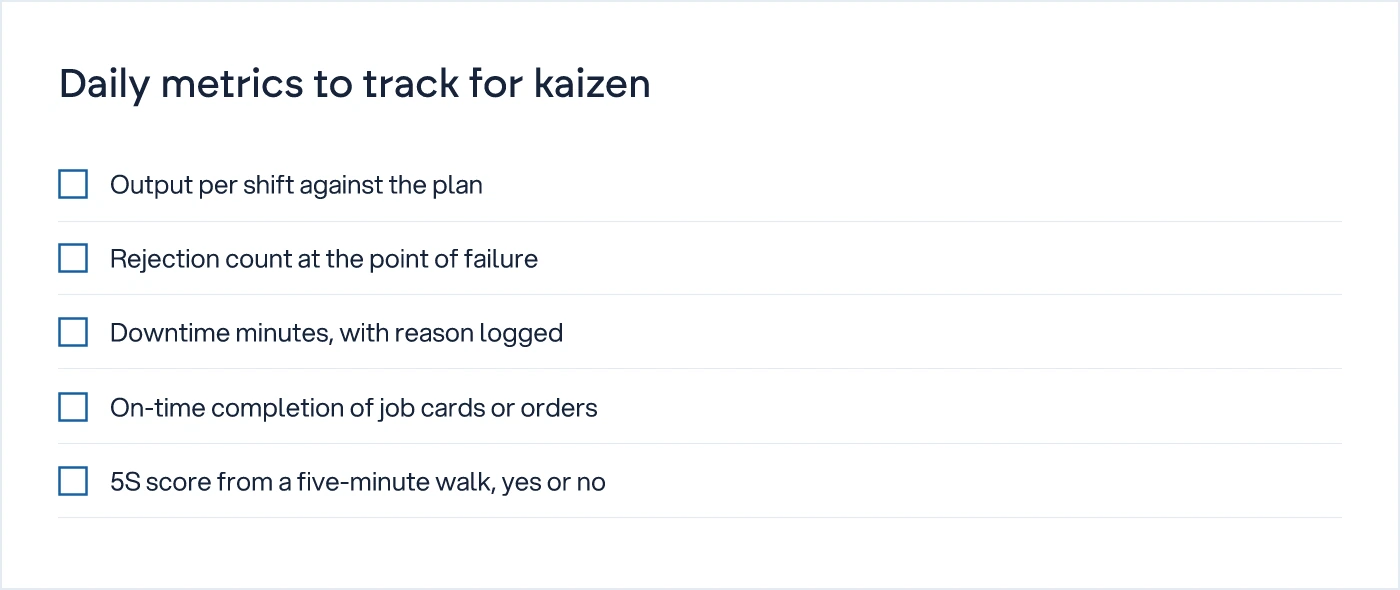
Four or five simple numbers, checked every day by one named person, are enough to tell whether kaizen is working.
Output and downtime numbers are only as useful as the plan they're measured against. If the production plan itself is built on guesswork, see capacity planning without a spreadsheet; fixing kaizen measurement will only expose a second, older problem.
Downtime and speed losses also sit inside a wider number that many plants already track badly. For what that number does and does not tell you, see OEE explained.
The plant head, not the shift supervisor, should decide who logs these four numbers. Supervisors running the line have a natural incentive to make their own shift look good on paper. A quality or planning clerk with no stake in the day's output figure gives a cleaner, more trustworthy number, even if it takes five extra minutes of walking the floor each evening.
Do not automate a bad process. If the job card itself is unclear about what 'done' means, digitising the tracking will just produce clean-looking wrong data faster than paper ever could.
How do you start kaizen in a small factory? A 30-day plan
Start with one line, four numbers and one small change a week, not a plant-wide programme on day one.
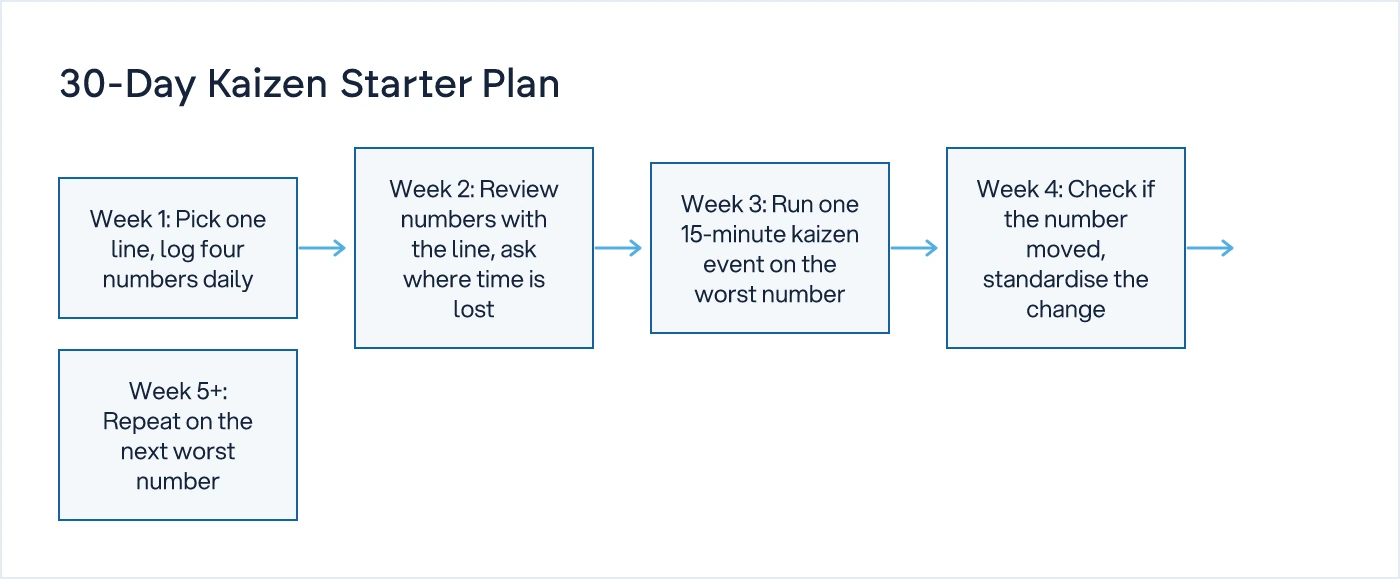
Week 1. Pick one line, not the whole plant. Choose the line with the most visible problem, whether that is rejection, late dispatch or constant breakdowns, so the first result is easy for everyone to notice. Assign a single person to log four numbers daily: output, rejection count, downtime minutes, and on-time completion of job cards. Paper or a shared sheet is fine for now.
Week 2. Review the numbers with the line at a short stand-up, no longer than ten minutes. Ask the operators where time is actually lost, rather than guessing from the office. Write down the worst number without arguing about the cause yet.
Week 3. Run the first kaizen event on the single worst number. Keep it to one change, one day, one owner. A CNC shop in the US might move raw stock closer to the machine to cut changeover walk time. A stitching unit in Vietnam might re-sequence thread colours to cut colour-change stoppages. Whatever the change, write it on the same sheet used for the daily numbers, with the date it started.
Week 4. Check whether the number moved. If it did, write the new method down as the standard and brief every operator on that line, not just the one who ran the shift during the event. If it did not, that is useful too: the event addressed the wrong cause, and the next one should target a different issue.
Week 5 onward. Repeat on the next worst number, same four metrics, same weekly cadence. Over three or four months, this turns into a visible list of small fixes, each one with a before-and-after number next to it, rather than a single big claim nobody can check.
This sequence works whether the line makes garments in a unit outside Ho Chi Minh City, auto parts near Pune, or packaged food in a plant outside Bangkok. The factory changes. The discipline of one number, one owner, one small change, does not.
Does kaizen need special software or training?
No special software is needed to start kaizen, and training can begin with one explained example rather than a formal certification.
Kaizen needs a notebook, a stopwatch and one supervisor willing to ask "why" four times when a line stops. A formal kaizen facilitator course helps once the habit is established, but it is not a prerequisite for week one. The common mistake is delaying the first kaizen event until someone has been "properly trained", which usually means it never starts at all.
Software becomes useful later, once the four numbers have been logged reliably on paper or a spreadsheet for a few months and the owner wants them visible without chasing a report every evening. At that point, the decision is not which app to buy, but whether the process behind the numbers is worth digitising as it stands, or needs redesigning first.
Kaizen sits alongside other shop floor habits such as rejection tracking, downtime logging and maintenance scheduling, all covered in our manufacturing operations coverage.
Kaizen does not need software to start. It needs one person willing to write down four numbers every day for a month. Once that habit exists, deciding what, if anything, to digitise becomes a much shorter conversation. We understand how your business actually works first, then we design the system, and sometimes that system stays a clipboard for longer than expected. When it is time to look at what to digitise, that is the conversation covered by our digital transformation service.
Common questions
What is kaizen in simple words?
Kaizen is a way of improving work through small, repeated steps, decided by the people doing the job rather than handed down from management. It comes from Japanese words meaning 'good change' and is usually translated as continuous improvement. It works best as a weekly habit, not a one-off project or event.
What is the difference between kaizen and 5S?
5S is a housekeeping method: sort, set in order, shine, standardise, sustain. Kaizen is a repeated cycle of small, tested improvements, which can include 5S but is not limited to it. A factory can have a tidy floor with no kaizen running, and can run kaizen without ever doing formal 5S.
How do you start kaizen in a small factory?
Pick one line, not the whole plant. Assign one person to log four numbers daily: output, rejection count, downtime minutes, and on-time completion. Review the numbers weekly, run one small kaizen event on the worst number, check if it moved, then standardise what worked before moving to the next issue.
How does data help kaizen?
Data turns kaizen from a feeling into a fact. Without a daily number, nobody can say whether an event actually reduced rejection or downtime, or whether the line just had a good week. With a baseline and a daily check, each kaizen event can be judged, kept, or corrected.
Why do most 5S and kaizen boards go quiet after a few weeks?
Because nobody owns checking them against a number. The event is held, people feel good, and then the board stops being updated since there is no daily figure proving the change worked or failed. Assigning one owner and one measurement fixes this faster than another workshop does.
Does kaizen need software or formal training to begin?
No. Kaizen can start with a notebook, a stopwatch and one person logging four numbers daily. Formal training or facilitator courses help once the habit is established, but waiting for training before starting is the most common reason kaizen never gets off the ground. Software is worth considering only after the habit is reliable.
Sources
- Kaizen — Wikipedia
- What Is Kaizen? Philosophy, Implementation & More — TWI Institute
- Kaizen Meaning in Japanese: The Philosophy of Small, Continuous Improvement — Yohaku

Sanket Vanani
Founder & CEO
Sanket Vanani is a business strategist and entrepreneur focused on helping businesses build structured systems for sustainable growth. His work spans sales, operations, manufacturing, process improvement, and business scalability. Through his experience working closely with business owners and teams, Sanket focuses on turning founder-dependent businesses into process-driven organizations that can grow with greater clarity, consistency, and control.
Related reading

Standard Operating Procedures: Run a Business Without the Owner
Owner dependency is a systems problem. Here is how standard operating procedures, roles and a simple tracker remove the owner from daily firefighting.

Garment Manufacturing Software: What to Digitise First
Before buying garment manufacturing software, find out which part of your textile flow actually leaks money. Usually it isn't the part owners assume.

Capacity Planning Without a Spreadsheet: Where It Breaks
Capacity planning breaks on bad data, not bad tools. The three numbers every manufacturer needs before planning a shift, a line, or a new order.

OEE Explained: What It Measures and What It Hides
OEE's formula takes ten minutes to learn and years to measure honestly. Here's where the number gets gamed, and what to track alongside it.


