
Garment Manufacturing Software: What to Digitise First
Digitise job work and process house tracking first, not design or dispatch. This is where challans go unreconciled, karigar payments get disputed, and stock goes missing between handoffs. Fix the flow that loses money daily before you touch design catalogues, sampling, or reporting dashboards.
Every textile owner has lived this week. A roll of grey fabric goes out to a process house for dyeing on Monday. It comes back Thursday, four metres short, and nobody can say whether the process house kept it, damaged it, or simply miscounted. The lot then goes to a job worker for embroidery, sits at a karigar's home for finishing, and reaches dispatch ten days later than planned. Through all of this, stock and payments are tracked in registers, loose challans, and WhatsApp messages to karigars who are owed money nobody has fully added up.
This is exactly the gap that search interest in garment manufacturing software is trying to close. Owners search that phrase, then find software built for factories with fixed bills of material and in-house production. Textile does not work that way. Before you evaluate any system, it helps to know which part of your own flow is actually bleeding money, because that is the part to digitise first.
What is the typical flow in a garment or textile manufacturing unit?
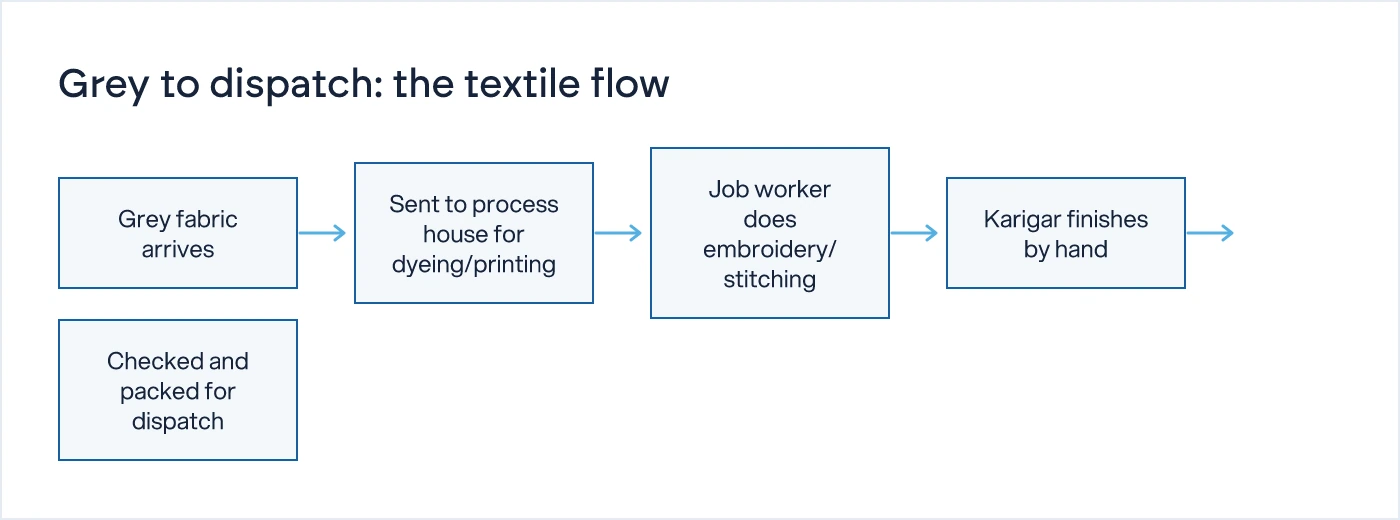
Grey fabric moves through several hands before it becomes sellable stock, and each handoff is a risk point, not just a production step.
A typical sequence: grey fabric arrives, goes to a process house for dyeing or printing, moves to a job worker for embroidery or stitching, goes to a karigar for hand finishing, gets checked and packed, then dispatched. At almost every stage, the unit doing the work is not your employee. It is a process house you pay by the metre, a job worker you pay by the piece, or a karigar paid on a running account. None of them sit inside your building, and none of them use your systems.
Layered on top of this is design-wise stock. The same grey fabric becomes ten different SKUs once colour, print, and size are applied. A saree or dress-material unit in a cluster like Surat can be tracking hundreds of colour-print-size combinations at once, each sitting in a different process at a different stage. A generic stock register cannot hold that structure. Most units solve it with separate notebooks per process house, per job worker, and per design, which is exactly why nobody can give a straight answer to "where is lot 4521 right now."
Where does the money actually leak in this flow?
Money leaks at the handoffs, not inside the processes themselves. A process house does not usually cheat you on purpose. The loss happens because nobody reconciled what went out against what came back, on the day it happened.
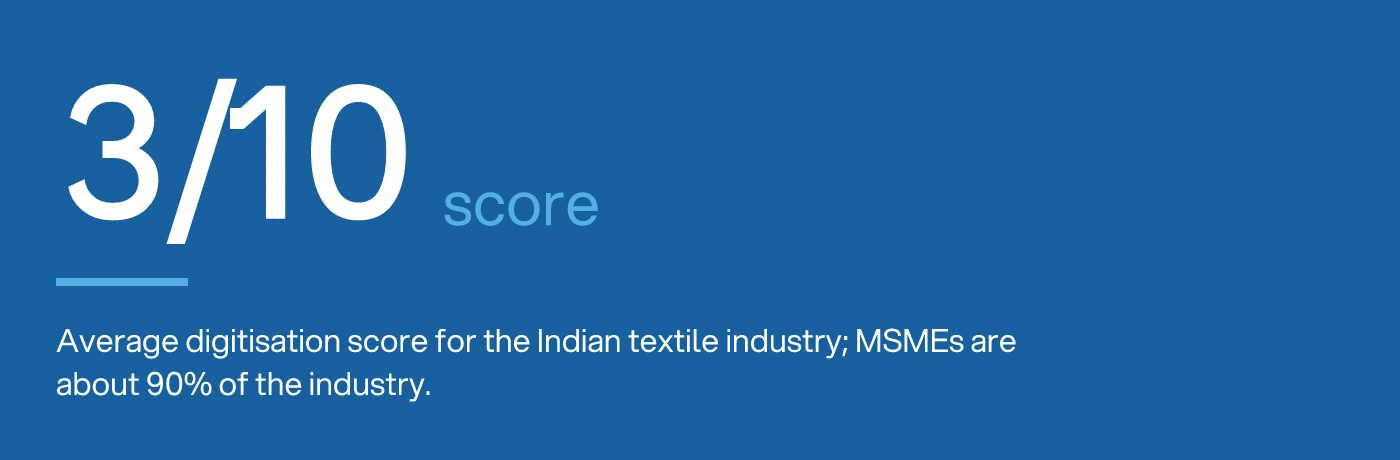
The Indian textile industry ranks about 3 out of 10 on digitisation, and MSMEs make up roughly 90% of the industry, according to Textile Excellence. That number matches what shows up on the ground: most units run job work and process house tracking on paper, and the gaps only surface when a karigar disputes a payment or a process house denies a shortage.
| Stage | What's tracked today | Where it leaks |
|---|---|---|
| Grey to process house | Delivery challan, handwritten | Shortages on return go unverified against issued quantity |
| Process house to job work | Second challan, often a photo on WhatsApp | No link back to the original lot, so losses compound silently |
| Job work to karigar | Verbal or a notebook entry | Running balance owed to the karigar exists in someone's memory |
| Finishing to stock | Manual tally by design | Design-wise stock is wrong, so sales promise stock that isn't there |
| Stock to dispatch | Invoice raised late, after physical packing | Billing delay pushes payment terms out by days the owner didn't plan for |
Each row by itself looks manageable. Stacked across a hundred lots a month, across several process houses and job workers, this is the actual cost of running textile operations on registers and WhatsApp. It isn't a reporting problem. It's unpaid or overpaid money sitting in a gap nobody owns.
Where does garment manufacturing software actually help first?
Digitise job work and process house tracking before anything else. This is the stage where real money is outstanding and invisible, which makes it the highest-value place to start.
In practice, this means three things working together: a digital challan that records exact quantity sent and a matching entry for exact quantity received, a running ledger per job worker and karigar that updates the moment a challan is raised or closed, and an automatic flag when a return is short, late, or doesn't match the original issue. None of this needs AI or a full ERP rollout on day one. It needs the handoff points captured accurately, in one place, the day they happen.
Design-wise stock visibility comes next, once job work is under control, because knowing what's owed and where it physically sits are two different problems. Dispatch and billing automation matter too, but they save time, not money that's already walked out the door. If you're also trying to plan capacity around these same job work cycles, the gaps usually trace back to the same unreliable inputs described in Capacity Planning Without a Spreadsheet: Where It Breaks.
Why do generic ERPs struggle with textile and garment flows?
Most manufacturing ERP software assumes a fixed bill of material, in-house production, and a vendor master that looks like a normal supplier list. Textile breaks all three assumptions.
A process house isn't quite a vendor and isn't quite a sub-contractor. You send them your own material, they add value, and you get back a transformed version of what you sent, sometimes with a yield loss that has to be explained, not just recorded. Job work needs a challan-in, challan-out structure with its own GST treatment, which most generic systems don't model cleanly. Karigars often work without GST registration, without a smartphone, and without any interest in logging into a system, which means the software has to work through a simple paper or SMS bridge on their end while still updating a live ledger on yours.
This is the real difference between generic manufacturing ERP software and a proper textile ERP. An ERP for the textile industry needs to natively handle job work challans, design-wise inventory by colour, print and size, and karigar ledgers that sit outside the formal vendor master, not bolted on as a workaround three customisations later. If you're comparing vendors on this basis, the broader evaluation questions in ERP Software for Manufacturing Buyers: The Checklist are a useful starting point, with textile-specific checks added on top.
How do you evaluate textile software before you buy?
Ask every vendor to show you job work and karigar tracking live, in a demo, before you look at anything else. If they can't, the product wasn't built for how your unit actually runs.
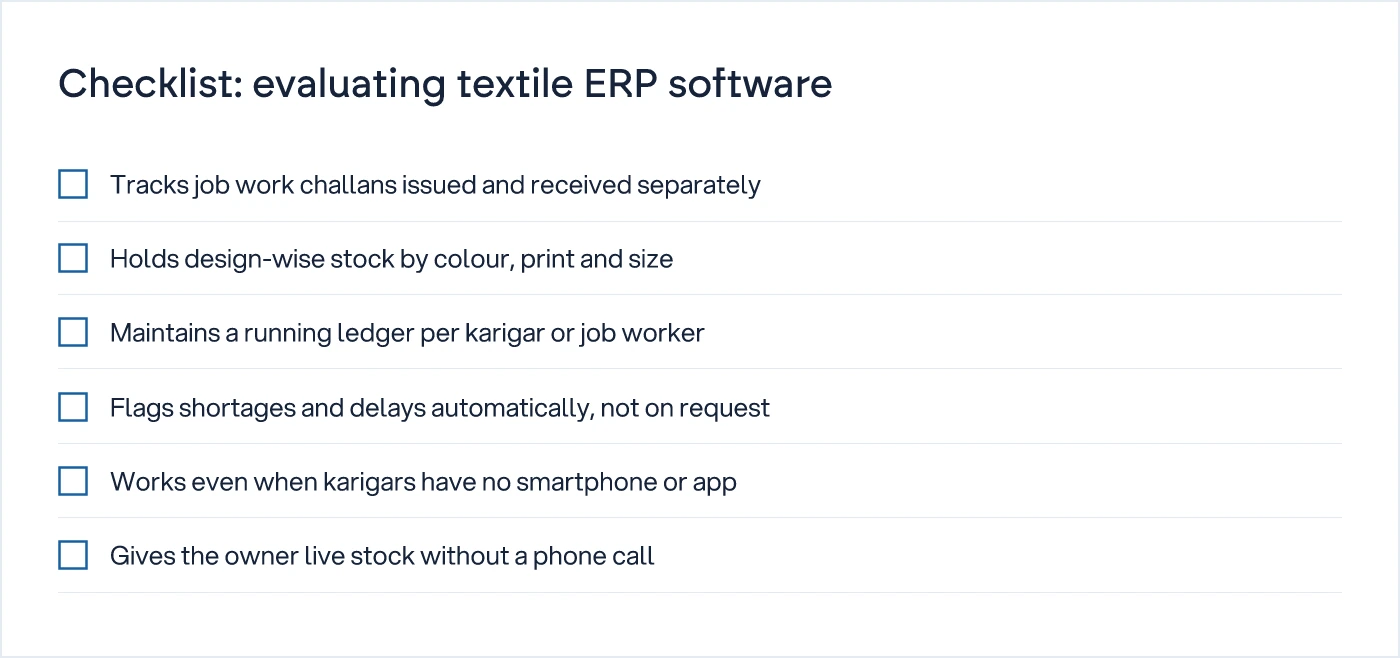
Watch specifically for whether the system forces every karigar onto a smartphone app. Most won't use it, and the workaround will quietly become another WhatsApp group within a month. A system built for textile should let the karigar stay on paper while someone in your office enters the challan once, and the ledger updates itself from there.
FAQ
What software do garment manufacturers use?
Garment manufacturers in India use a mix of generic manufacturing ERP software, textile-specific ERP built for job work and design-wise stock, and simple spreadsheet or register-based tracking. Larger units often run Tally or an ERP for accounting, layered with separate job work tracking because most mainstream systems don't model karigar ledgers or process house returns well.
What should a textile unit digitise first?
Digitise job work challans and process house reconciliation first. This is where quantities go unverified, payments to karigars sit undocumented, and shortages go unexplained. Design-wise stock visibility and dispatch automation matter, but they don't recover money that's already lost at the handoff stage, which is the costliest and most common gap.
Is ERP worth it for a small textile business?
It depends on where the losses are. If job work and karigar payments are already tracked accurately and the pain is reporting speed, a full ERP may be overkill. If challans, returns, and payments are in registers and WhatsApp, a focused system for that flow alone often pays for itself faster than a full ERP rollout would.
How do I track job work and karigars digitally?
Start with a digital challan for every issue and return, tied to the original lot number, not a fresh entry each time. Maintain one running ledger per karigar and job worker that updates automatically from these challans. The karigar doesn't need an app; someone in your office entering the challan once is enough to keep the ledger accurate.
What to do next
The honest first step isn't buying software. It's mapping exactly where your own flow loses metres, days, or rupees, because that answer is different for every unit, even within the same cluster. We understand how your business actually works first, then we design the system.
A free 30-minute call is the place to start that conversation, with no commitment attached. If the gaps run deeper than one call can untangle, an on-site SCAN (System Clarity & Actionable Needs) diagnostic maps the flow in detail before anyone recommends software. For more on fixing the operational basics before any software decision, the Manufacturing Operations hub covers the adjacent problems, from capacity planning to machine downtime, that textile units run into once the job work layer is under control.
Common questions
What software do garment manufacturers use?
Garment manufacturers in India use a mix of generic manufacturing ERP software, textile-specific ERP built for job work and design-wise stock, and simple spreadsheet or register-based tracking. Larger units often run Tally or an ERP for accounting, layered with separate job work tracking because most mainstream systems don't model karigar ledgers or process house returns well.
What should a textile unit digitise first?
Digitise job work challans and process house reconciliation first. This is where quantities go unverified, payments to karigars sit undocumented, and shortages go unexplained. Design-wise stock visibility and dispatch automation matter, but they don't recover money that's already lost at the handoff stage, which is the costliest and most common gap.
Is ERP worth it for a small textile business?
It depends on where the losses are. If job work and karigar payments are already tracked accurately and the pain is reporting speed, a full ERP may be overkill. If challans, returns, and payments are in registers and WhatsApp, a focused system for that flow alone often pays for itself faster than a full ERP rollout would.
How do I track job work and karigars digitally?
Start with a digital challan for every issue and return, tied to the original lot number, not a fresh entry each time. Maintain one running ledger per karigar and job worker that updates automatically from these challans. The karigar doesn't need an app; someone in your office entering the challan once is enough to keep the ledger accurate.
Sources
- Why is the Indian Textile Industry Shy of Digitization? — Textile Excellence
- Textiles & Apparel Sector — Invest India

Sanket Vanani
Founder & CEO
Sanket Vanani is a business strategist and entrepreneur focused on helping businesses build structured systems for sustainable growth. His work spans sales, operations, manufacturing, process improvement, and business scalability. Through his experience working closely with business owners and teams, Sanket focuses on turning founder-dependent businesses into process-driven organizations that can grow with greater clarity, consistency, and control.
Related reading
ERP Software for Manufacturing: A Process-First Buyer's Checklist
A 20-point, process-first checklist for choosing ERP software for manufacturing, before you talk to a single vendor.

Capacity Planning Without a Spreadsheet: Where It Breaks
Capacity planning breaks on bad data, not bad tools. The three numbers every manufacturer needs before planning a shift, a line, or a new order.

OEE Explained: What It Measures and What It Hides
OEE's formula takes ten minutes to learn and years to measure honestly. Here's where the number gets gamed, and what to track alongside it.

Why Your Preventive Maintenance Schedule Never Gets Followed
Preventive maintenance plans fail not from bad scheduling software but from unclear ownership of who stops the line. Here is the fix.


