
Why Your Preventive Maintenance Schedule Never Gets Followed
Preventive maintenance schedules fail because no single person owns the trigger to stop production and act on the due date. The plan sits in a file or a whiteboard, production pressure wins every time, and the decision to defer maintenance defaults to whoever feels least accountable that day.
Why does a preventive maintenance schedule not get followed?
Because the schedule tells you a machine is due for service. It does not tell you who has the authority to stop production and make that happen, and when nobody owns that decision, the machine keeps running until it breaks.
Most owners assume the problem is the tool. They had a wall calendar, then a spreadsheet, then a maintenance module inside their ERP, and the compliance rate barely moved. The schedule was never the weak link. The weak link is that preventive maintenance asks someone to choose downtime today over output today, and unless one named person is accountable for making that call, the call does not get made.
Who is supposed to trigger the maintenance call, and who actually does?
On paper, the maintenance schedule triggers the call. In practice, three different people believe someone else is responsible, and the machine runs past its due date.
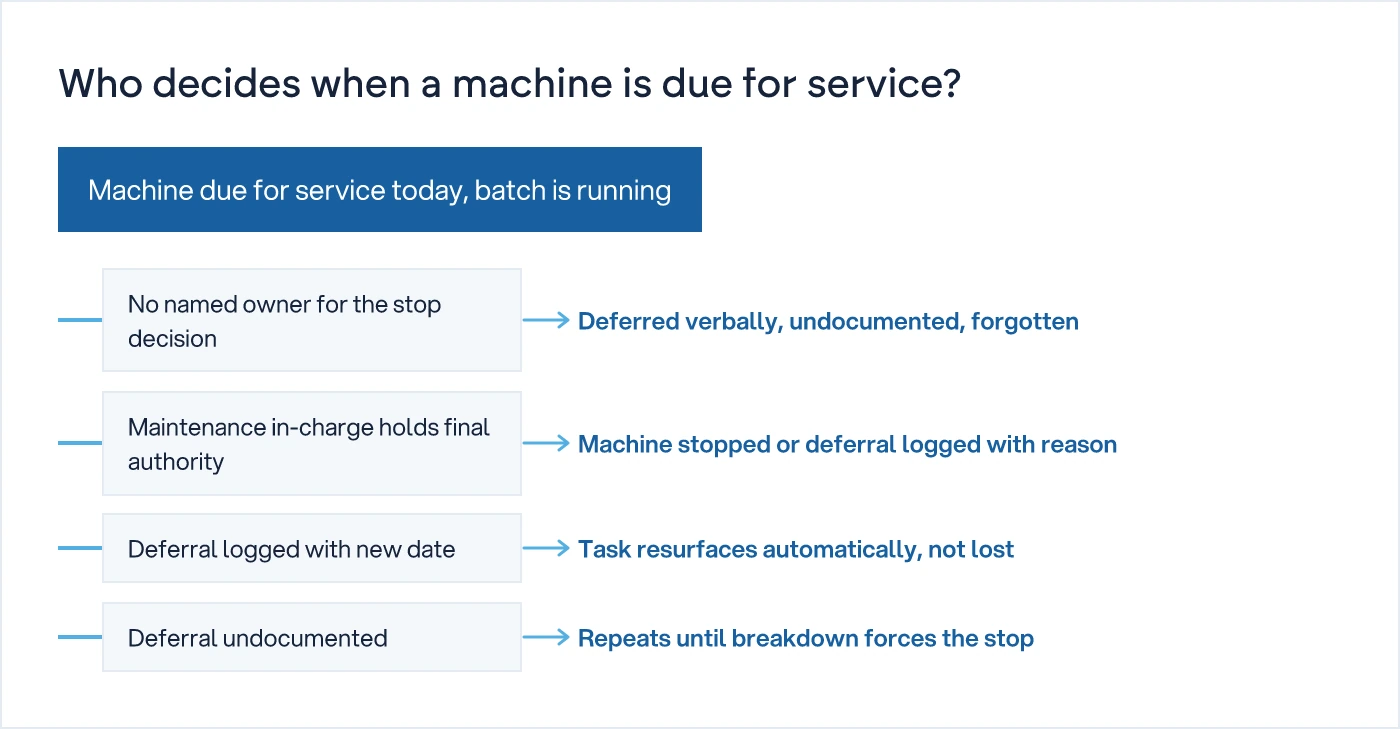
Here is the sequence that plays out on most shop floors. The machine is due for service on the 15th. The maintenance in-charge knows this, because it is on his list. But the machine is running a rush order that day, and the production supervisor needs the output. The maintenance in-charge raises it verbally, gets told "after this batch," and moves on to the next machine on his list. Nobody documents the deferral. Nobody escalates it. The batch after the rush order is also urgent. By the time the machine is free, three weeks have passed and the due date is forgotten, because it was never logged as missed, only quietly skipped.
This is not a discipline problem. It is a decision-rights problem. The maintenance in-charge can recommend a stop. He cannot enforce one. The production supervisor can decide to run the machine anyway, and in the absence of a rule that says otherwise, he will, because his targets are measured daily and the machine's condition is measured never.
What happens when the schedule lives in a file nobody opens?
The schedule becomes a record of intent, not a working system, and everyone stops treating it as binding.
A maintenance schedule in a spreadsheet or a paper register has one property that makes it fail silently: it does not interrupt anyone's day. The 15th arrives, the entry sits there unread, and nothing on the floor changes. Compare this to a rejection tracked at the point of failure, which is visible the moment it happens, as covered in why rejection tracking on the shop floor never sticks. Maintenance due dates need the same property: they must surface to someone who has to act, at the moment they become due, not at month-end when someone reviews the register.
This is also why digitising the existing schedule without changing who is accountable does not fix anything. Reliability Simplified's review of failed preventive maintenance programs makes the same point: most failures trace back to unclear task ownership and no follow-through on missed tasks, not to the absence of a scheduling tool (Reliability Simplified). A better-looking calendar does not create accountability. It just makes the missed date easier to find after the machine has already failed.
The ownership rule that fixes this
One person, not a department, should own the authority to stop a machine for scheduled maintenance, and that person should not be the one whose targets suffer if the machine stops.
In practice this means the maintenance in-charge, not the production supervisor, holds the final call on whether a machine due for service runs one more shift. The production supervisor can push back and can be heard, but the decision itself does not sit with him, because his incentive is always to keep the machine running. This single rule change resolves the standoff that plays out on almost every floor we have looked at: two people, both reasonable, both under pressure, and no rule about whose judgement wins.
Maintenance Planning Manager's research into missed PM tasks backs this from a different angle. Tasks get skipped most often when there is no defined escalation path for a deferred task, so the deferral becomes permanent by default rather than a documented, time-bound exception (Maintenance Planning Manager). If a task is deferred, it needs a new date, a reason, and a name attached to the decision, or it simply disappears from anyone's memory.
| Approach | Schedule-only | Ownership + visibility |
|---|---|---|
| Who decides to stop the machine | Unclear, defaults to production | Named maintenance owner, by rule |
| What happens on the due date | Entry sits unread | Surfaces as a task someone must close |
| Deferral handling | Undocumented, forgotten | Logged with new date and reason |
| Escalation if missed | None | Automatic flag after set threshold |
| Failure pattern | Repeat breakdowns on same machines | Deferrals visible before failure |
What visibility actually looks like on the floor
Visibility means the owner can see, without asking anyone, which machines are overdue and why they were deferred.
This does not require sensors or a large maintenance system. It requires a single view, updated daily, that shows every machine's due date, its current status, and who deferred it if it was deferred. If your team is already tracking downtime manually, as described in tracking machine downtime without an IoT budget, the same register can carry the maintenance due dates alongside the stoppage log. The two are connected: TeroTAM's review of repeat equipment failures found that machines with recurring breakdowns almost always had a documented history of skipped or delayed PM tasks preceding the failure, meaning the breakdown was predictable from the deferral pattern alone (TeroTAM).
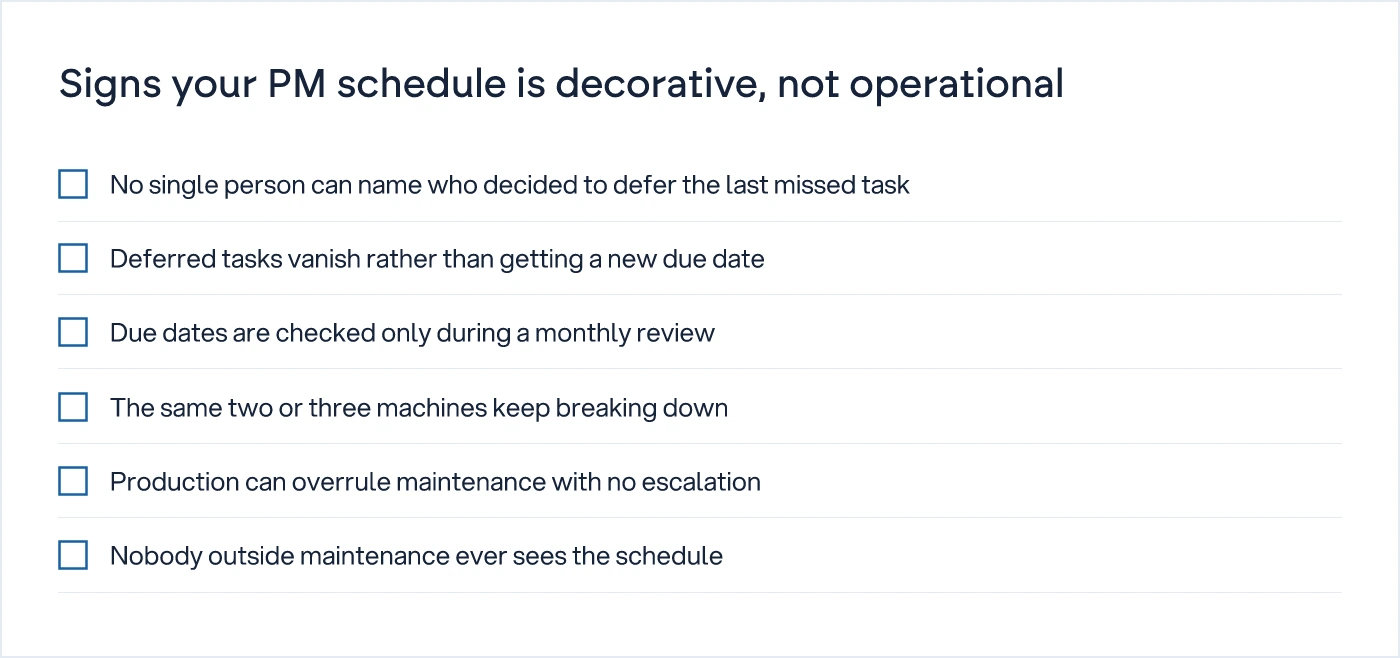
What changes once this view exists is not the schedule. It is that a missed date becomes visible to the owner within a day, not discovered three months later when the machine seizes on a Friday afternoon. Siemens' work on failing PM programmes describes this as the shift from a compliance record to an operational signal, where the data on missed tasks is used to flag risk before it becomes a failure, not just to audit after the fact (Siemens Asset Management).
Why this is not a scheduling software problem
Buying a better maintenance module will not fix a floor where nobody has the authority to enforce the plan it produces.
We understand how your business actually works first, then we design the system. That means before we touch a maintenance calendar, we sit with the maintenance in-charge and the production supervisor and settle the actual question: who wins when the schedule and the production target disagree on the same day. Once that rule exists, on paper, with a name against it, a simple daily view of due dates and deferrals does the rest. Do not automate a bad process. If the answer to "whose call is it" needs a phone call every time, the schedule was never a system, it was a suggestion.
What to do about it this month
Write down, machine by machine, who has the authority to stop it for scheduled service, and get that person's name signed off by whoever runs production. Then build a one-page daily view, not a new software purchase, showing due dates, status, and any deferral with a reason and a new date attached. Run it for four weeks before you decide whether you need anything more than that. If the pattern of deferrals repeats on the same two or three machines, that is where your next breakdown is coming from, and you will have seen it early enough to act. For a longer look at how maintenance scheduling fits into wider shop floor visibility, see our Manufacturing Operations hub, and if you want help building the ownership rule and the daily view around your existing team, our digital transformation service starts with exactly this kind of mapping before any system is built.
Common questions
Why does preventive maintenance schedule not get followed on the shop floor?
Because the schedule itself has no authority. It tells you a machine is due for service, but if no single person is accountable for stopping production to act on that date, the production supervisor's daily targets win every time, and the maintenance date gets quietly deferred without anyone logging it.
Who should own the decision to stop a machine for maintenance?
The maintenance in-charge, not the production supervisor. Production always has an incentive to keep the machine running, so the person who decides whether it stops for service should not be the one whose output targets suffer from the stoppage.
Does better maintenance software fix missed PM schedules?
Not on its own. A better calendar or module still relies on someone acting when a date is due. Without a named owner and a visible daily view of due dates and deferrals, a digital schedule fails the same way a paper one does, silently and without anyone noticing until the machine breaks.
What should happen when a maintenance task is deferred?
It should be logged with a new date, a reason, and the name of the person who made the call, not simply dropped from the list. Undocumented deferrals are the main reason PM tasks disappear permanently instead of being rescheduled.
How does this connect to machine downtime tracking?
Deferred maintenance is usually visible in downtime history before a machine fails. If you are already logging stoppages manually, adding maintenance due dates and deferral reasons to the same register gives you an early warning pattern without buying new equipment or software.
Sources
- Why Most Preventive Maintenance Programs Fail — Reliability Simplified
- Why PM Tasks Get Missed (and How to Stop It) — Maintenance Planning Manager
- Why Are Repeat Equipment Failures Still Common Despite Preventive Maintenance? — TeroTAM
- Why Your Preventive Maintenance Program Is Failing (and How to Fix It) — Siemens Asset Management

Sanket Vanani
Founder & CEO
Sanket Vanani is a business strategist and entrepreneur focused on helping businesses build structured systems for sustainable growth. His work spans sales, operations, manufacturing, process improvement, and business scalability. Through his experience working closely with business owners and teams, Sanket focuses on turning founder-dependent businesses into process-driven organizations that can grow with greater clarity, consistency, and control.
Related reading
Why Rejection Tracking on the Shop Floor Never Sticks
Rejection tracking fails when it's logged after the shift by someone with no stake in the number. Here's the fix, and who owns it.
Tracking Machine Downtime Without an IoT Budget
Before you buy sensors, learn what six weeks of manual downtime logging will tell you for free.


