
Where Your Working Capital Is Actually Stuck
Cash gets blocked well before receivables ageing shows it. Stock is dispatched but not invoiced, invoices are raised but not sent to the customer, or payments arrive but are never matched to an invoice. Each gap delays the day your payment clock even starts. A 30-minute dispatch-to-bank match shows exactly where.
Why is my cash blocked even though sales are good?
The order book is full, the sales team is busy, and the bank balance still doesn't move. That gap tells you the problem is not demand. It is somewhere in the five or six steps between an order being confirmed and the money actually landing in your account. For most distribution and trading firms, at least two of those steps are invisible to the owner, because nobody reports on them until something breaks.
Receivables ageing tells you what's overdue. It doesn't tell you what never got billed in the first place, or what got billed three weeks after it left the warehouse. That's the part most owners miss, and it's a different problem from the one covered in receivables ageing and bad debt. Overdue is a collections problem. Unbilled is an operations problem, and it's usually bigger.
Here's a sequence we see often. An order is confirmed on the 3rd. The warehouse picks and dispatches it on the 5th. But the invoice isn't raised until the 15th, because billing waits for the signed delivery challan to physically come back from the driver. Payment terms are 30 days from invoice date, not from dispatch date. So the real cash cycle isn't 30 days. It's 40-plus. Nobody sees the extra ten days because the system only starts the clock when the invoice is raised, not when the goods actually leave.
Where does cash actually get stuck between the sale and the bank?
Cash stalls at five or six identifiable points, and the earlier ones are the ones nobody tracks. Once you name each stage and who owns it, the leak stops being a mystery.
| Stage | What it looks like on the ground | Who owns the delay | How long before anyone notices |
|---|---|---|---|
| Picked, not dispatched | Goods packed, waiting on transporter or paperwork | Warehouse/dispatch team | Days, if anyone's counting |
| Dispatched, not invoiced | Goods gone, no invoice raised yet | Billing/accounts | Weeks, usually surfaces at month-end |
| Invoiced, not sent | Invoice sits in the system, hasn't reached the customer | Accounts/sales coordination | Weeks |
| Sent, not yet due | Normal credit period running | Nobody's problem yet, correctly | N/A |
| Overdue | Past due date, sitting in the ageing report | Sales/collections | Usually caught and tracked |
| Received, not reconciled | Payment sitting in the bank, not matched to an invoice | Accounts | Months, sometimes never |
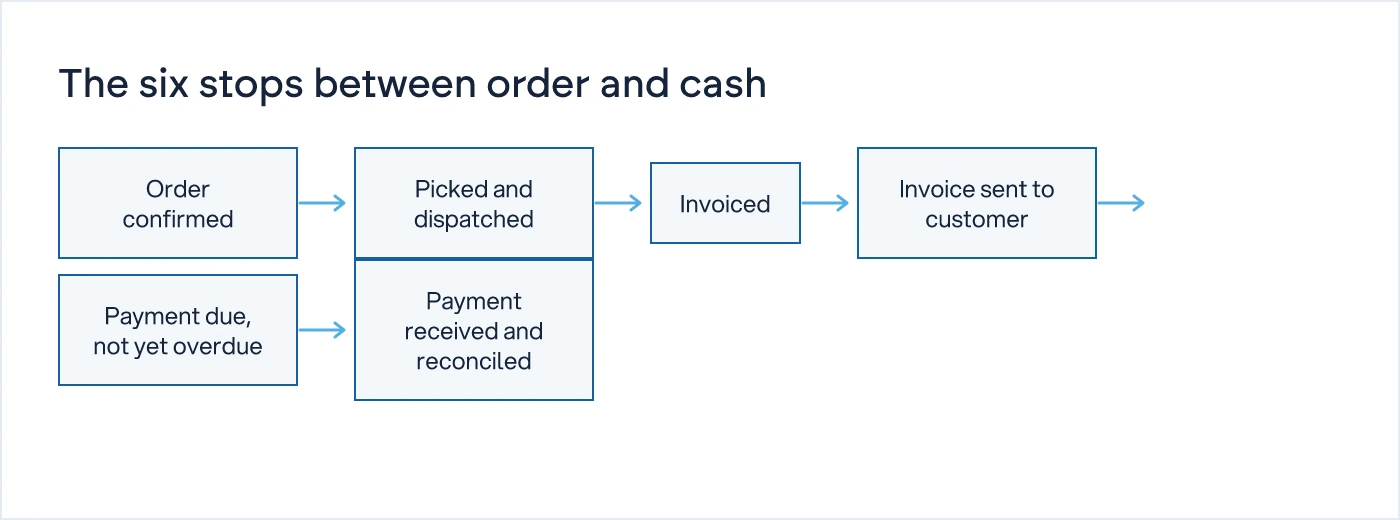
The last row surprises most owners. Money can already be in the account and still not count as "available" in any working sense, because nobody has matched it against a specific invoice. Analysts who look at working capital cycles rather than income statements describe this same pattern in businesses that show a healthy profit and still run tight on cash (GrifflePop Analytics).
What is unbilled stock and why does it silently block cash?
Unbilled stock is inventory that has left your warehouse but hasn't been converted into an invoice, which means it counts as neither inventory nor a receivable. It has left your stock report and hasn't reached your billing report. It exists in the gap between the two, and that gap is where a surprising amount of working capital sits without anyone deciding it should.
This is different from the problem covered in dead stock in the warehouse. Dead stock never moved. Unbilled stock moved, sometimes weeks ago, and the paperwork simply hasn't caught up. One is a demand problem. The other is a process problem, usually caused by one of a small number of habits: billing waits for a signed delivery challan to return physically, GST invoicing waits on a rate confirmation from someone in another department, or partial dispatches sit half-billed because the system expects the full order to ship before it lets billing proceed.
Run the maths on your own numbers. If you dispatch $10,000 (₹8 lakh) worth of goods a day and invoicing lags by five days on average, that's roughly $50,000 (₹40 lakh) sitting off both your inventory count and your receivables ledger at any given time, un-billed and un-collectable, because the invoice that would start the payment clock hasn't been raised yet.
Why does dispatch get held up even after the order is confirmed?
Dispatch usually stalls because of something upstream that has nothing to do with whether the goods are ready. A pending credit check, a missing PO copy, a rate that hasn't been confirmed in writing, a transporter slot that hasn't been booked. The goods can sit picked and packed on the floor for days while one of these small, unowned steps waits for someone to notice it.
A common version: a sales rep confirms an order verbally on a call. The warehouse won't release it without a formal purchase order, because the last few "confirmed" verbal orders were later disputed by the customer. Goods sit ready for four days waiting for a document that a five-minute phone call could resolve, except nobody has been told that chasing it is their job. If the answer needs a phone call, it's not a system, and this is exactly where that shows up: a delay with no owner, sitting between two departments who each assume the other is handling it.
How do you run a 30-minute blocked-cash diagnostic yourself?
You don't need new software to find this. You need three registers side by side: dispatch, billing, and bank. Pull the last 30 days and match them line by line.
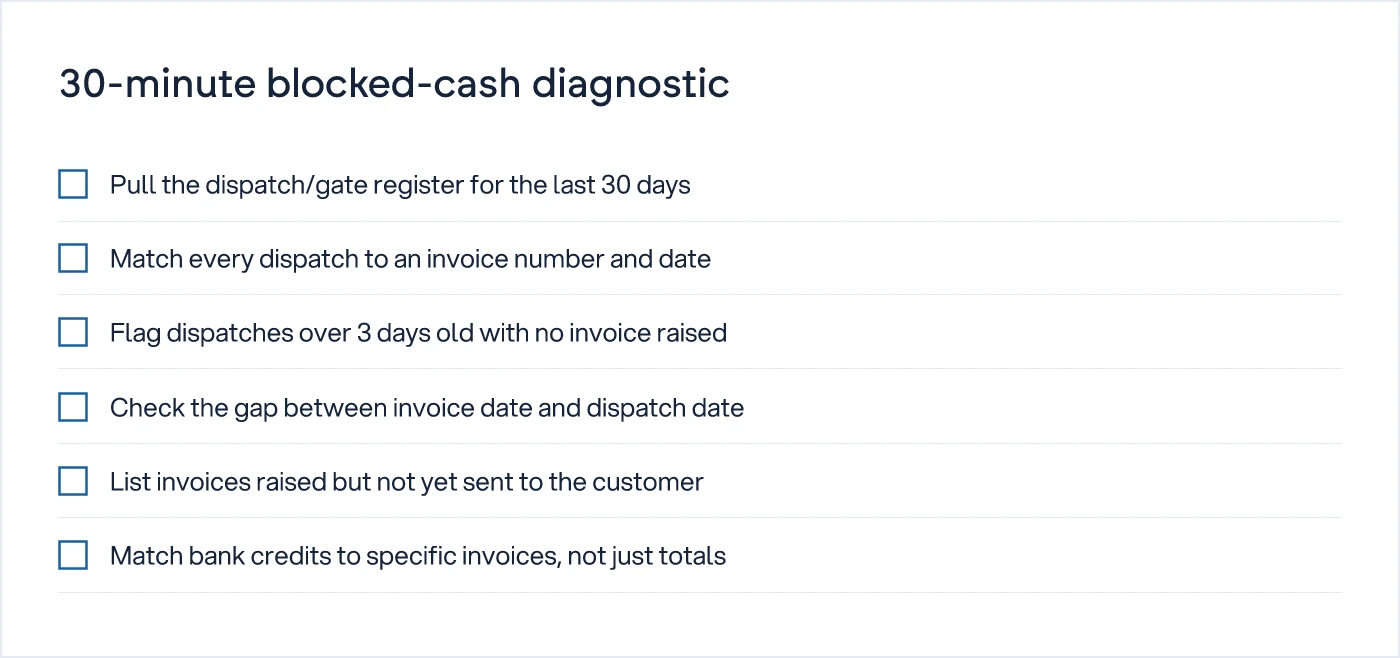
What usually turns up: a handful of dispatches with no invoice against them past three days, a run of invoices sitting "raised" in the system for a week before anyone actually sends them, and a few bank credits that were never matched to the invoice they were paid against. None of these show up in a receivables ageing report, because ageing only starts counting once an invoice exists and has been logged as sent.
Do this monthly and you'll catch the pattern. Do it weekly, the same way ageing should be tracked, and you'll catch it before it becomes a cash crunch instead of a line item.
What should change once you find the gap?
The fix is rarely more software bolted onto the existing process. It's usually a rule change: billing starts the moment goods are dispatched, not when the signed challan returns. Invoices are sent to the customer the same day they're raised, not batched for end of week. Payments are reconciled against an invoice number within 48 hours of clearing, not left for month-end. We understand how your business actually works first, then we design the system, because automating a billing process that waits on a paper challan just makes the delay faster to repeat, not shorter to close. Do not automate a bad process. Fix the sequence, then decide what, if anything, needs to be built around it.
If you want a structured look at where your own cycle is leaking, the starting point is mapping the actual sequence of events for ten recent orders, not the sequence the org chart assumes. Our digital transformation service begins with exactly that mapping before any system gets touched. You can browse more on the operational side of distribution and trading in the distribution, trading and wholesale operations hub.
Common questions
Why does my P&L show profit but my bank account is empty?
Profit is recorded when a sale happens; cash arrives later, if the invoicing and collection steps are tight. If dispatch, billing or reconciliation lag by even a few days each, the accrual and the cash position drift apart. Analysts who cover this gap directly describe the same accrual-versus-cash mismatch in profitable firms with no spare cash (BlackpeakCFO).
Is unbilled stock the same problem as dead stock?
No. Dead stock is inventory that hasn't moved in 180-365 days; it's a demand problem. Unbilled stock has already left your warehouse, sometimes weeks ago, but hasn't been invoiced yet; it's a paperwork and process problem. They need different fixes: dead stock needs a sales or clearance decision, unbilled stock needs a rule change in when billing starts.
How often should I check for unbilled dispatch?
Weekly, not at month-end. By month-end, the gap has usually compounded across four weeks of orders, and it's harder to trace which specific dispatch never got invoiced. A weekly match between the dispatch register and the billing register catches it while the paperwork trail is still fresh.
Does this problem still happen if I already use an ERP?
Yes, if the ERP only starts tracking from the invoice date. Most systems are built to report what's been billed, not what's left the building unbilled. The gap isn't a software gap, it's a process gap: someone has to own the rule that billing starts at dispatch, and someone has to check that it's actually happening.
What's the fastest thing I can fix once I find the gap?
Change the trigger for invoicing from "challan returned and signed" to "goods dispatched", and send invoices to the customer the same day they're raised rather than batching them. These are policy changes, not system builds, and they usually close the biggest part of the gap within a month.
Sources
- Profitable But No Cash? How to Prove Where the Money Is Going — GrifflePop Analytics
- Your P&L Shows Profit But Your Bank Account Is Empty — Here's Why — BlackpeakCFO
- Why Your Business Has Sales but No Cash — Moonmoot

Sanket Vanani
Founder & CEO
Sanket Vanani is a business strategist and entrepreneur focused on helping businesses build structured systems for sustainable growth. His work spans sales, operations, manufacturing, process improvement, and business scalability. Through his experience working closely with business owners and teams, Sanket focuses on turning founder-dependent businesses into process-driven organizations that can grow with greater clarity, consistency, and control.
Related reading
Setting Reorder Points When Demand Isn't Steady
Most reorder-point formulas assume steady demand. This one is built for distributors whose demand is lumpy and lead times swing.

Dead Stock: How Much Is Sitting in Your Warehouse
Dead stock isn't a stock problem. It's a decision no one owns. Here's how to find it and who should be signing off the write-off.
Receivables Ageing: Catching Bad Debt Before Month-End
Month-end ageing reports arrive too late for a trading business. Here is how to review receivables weekly and stop bad debt before it compounds.


