
Dispatch Planning: Why Trucks Leave Half Full and Late
Dispatch is delayed because the information it depends on, confirmed orders, allocated stock, ready invoices and a booked vehicle, arrives late and from four different departments. The warehouse loads last, so it absorbs every delay upstream of it. Fixing dispatch means fixing the cutoffs before the warehouse, not the loading process itself.
If you've ever watched a truck pull out half full at 7pm when it was supposed to leave full at 3pm, you already know the warehouse team isn't the problem. They loaded what was ready, when it was ready. The problem happened three hours and two departments earlier.
Most owners treat dispatch delay as a loading-floor issue. Add a shift, add a loader, buy a second forklift. None of it works for long, because the warehouse is the last stop in a sequence that started going wrong at the order desk.
Why is dispatch planning always delayed in distribution businesses?
Because dispatch depends on four separate decisions, made by four separate people, and none of them are timed against each other. The order cutoff, stock allocation, invoicing and vehicle booking all have to land before loading starts. In most distribution businesses, they don't. They trickle in through the afternoon, and the warehouse has no choice but to load against whatever is confirmed at the moment the truck has to leave.
This is why adding warehouse capacity rarely fixes dispatch delay. You can double the picking speed and still send a part-loaded truck, because the order list wasn't closed, the invoice wasn't raised, or the vehicle booked was the wrong size for the load that eventually materialised.
Where does the delay actually start?
It starts at the order cutoff, which almost no business actually enforces.
Here's a typical day at a mid-sized distributor. The stated cutoff for "today's dispatch" is 11am. In practice, the sales team keeps accepting orders until 2pm, because saying no to a customer feels worse than disrupting the warehouse. The warehouse starts picking at 11am anyway, against a list that's still changing. Accounts can't raise invoices until picking is confirmed, so invoicing backs up into the afternoon. Transport was booked the evening before, against an estimate of the day's volume, not the actual confirmed load. By the time loading starts, some invoices are still pending, the booked vehicle is the wrong size, and the only way to hit the day's dispatch window is to send out what's ready and carry the rest forward.
| Stage | Who decides | What usually happens | Effect on the truck |
|---|---|---|---|
| Order cutoff | Sales | Cutoff is announced but orders keep arriving past it | Loading plan is incomplete when picking starts |
| Stock allocation | Warehouse/inventory | Stock allocated without checking which orders ship today | Picked stock doesn't match the trucks actually leaving |
| Invoicing | Accounts | Invoices raised only after picking is done | Truck waits at the gate for paperwork |
| Vehicle booking | Logistics | Booked against yesterday's volume estimate, not today's confirmed load | Wrong-sized vehicle shows up for the actual load |
| Loading | Warehouse | Team loads whatever is ready and invoiced | Truck leaves part-full to meet the day's cutoff |
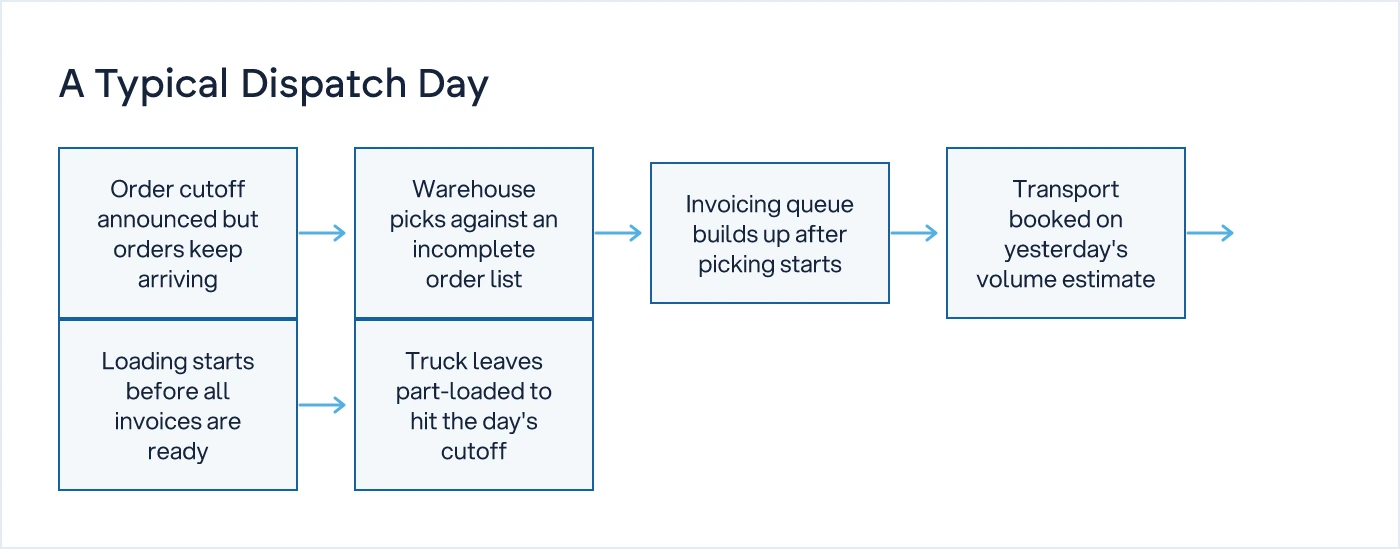
Every one of these handoffs is a place where the next department inherits a delay it didn't create. The warehouse just happens to be the last one holding it when the truck has to leave.
Why does loading late always mean loading light?
Because a late start doesn't give you a late finish, it gives you a smaller load.
Trucks run on fixed daily cutoffs set by the transporter, the customer's receiving window, or both. If loading starts two hours late, you don't get two extra hours at the other end, you get the same cutoff with less time to fill the vehicle. The warehouse team does the only sensible thing available to them: they load what's confirmed and invoiced, and send the truck out rather than miss the slot entirely. A consumer durables distributor running this pattern daily isn't losing efficiency on the floor. It's paying for full-truck capacity and using sixty or seventy percent of it, five days a week, because the confirmed load never arrives early enough to plan the vehicle against it.
This is also where transport cost and delivery reliability start fighting each other. Send the truck part-loaded and you've paid for empty space. Hold the truck for the rest of the order and you miss the customer's receiving window, which increasingly means a penalty, a rejected delivery, or a returned load.
Is this a warehouse problem or a sales and finance problem?
It's a sales and finance problem that shows up in the warehouse.
Sales owns the order cutoff and usually doesn't enforce it, because every individual order feels urgent to the person who sold it. Finance owns invoicing, and invoicing is sequenced after picking rather than in parallel with it, which means the last mile of every dispatch is a paperwork queue, not a physical one. Neither department sees dispatch delay as their problem, because by the time the truck is sitting half-loaded, it looks like a warehouse issue to everyone except the warehouse.
The same sequencing problem shows up in a related place: cash. If invoicing happens after dispatch instead of before it, stock has already left the gate before it's billed, which is one of the places working capital quietly gets stuck. We've written about that pattern separately in where cash actually gets blocked between dispatch and collection.
Stock allocation has its own version of the same issue. If the warehouse is allocating against an item master that still carries slow-moving or dead stock as "available," the picking list looks complete on paper and falls apart at the loading bay when half the listed stock turns out to be unsellable or already earmarked elsewhere. If this sounds familiar, it's worth checking how much dead stock is actually sitting in your warehouse before you fix dispatch timing, because loading against bad stock data will still produce part loads even with a perfect cutoff.
What should change before you touch the warehouse?
Four things, in this order, before any warehouse process gets redesigned.
First, the order cutoff needs an owner outside sales. The operations or logistics head sets the cutoff time and holds it. Sales can still take orders after the cutoff, but those orders go into tomorrow's dispatch, not today's, without exception and without a phone call to override it. If the answer needs a phone call, it's not a system.
Second, invoicing needs to run in parallel with picking, not after it. Most billing software can generate an invoice the moment a pick list is confirmed complete, before the physical loading finishes. That alone removes the single biggest paperwork delay at the gate.
Third, vehicle booking needs to move from "estimated the evening before" to "confirmed at cutoff." This usually means booking transport an hour later than feels comfortable, against the real order list instead of an average. It costs nothing and removes the wrong-sized-vehicle problem entirely.
Fourth, loading sequence needs to follow the delivery route, not the order in which stock was picked. A truck loaded in pick order means the last delivery on the route is buried at the front of the truck. A truck loaded in route order means the driver isn't unloading half the vehicle to reach one crate.
How do you know if this is happening to you?
You know by checking five things for one week, not by asking the warehouse manager.
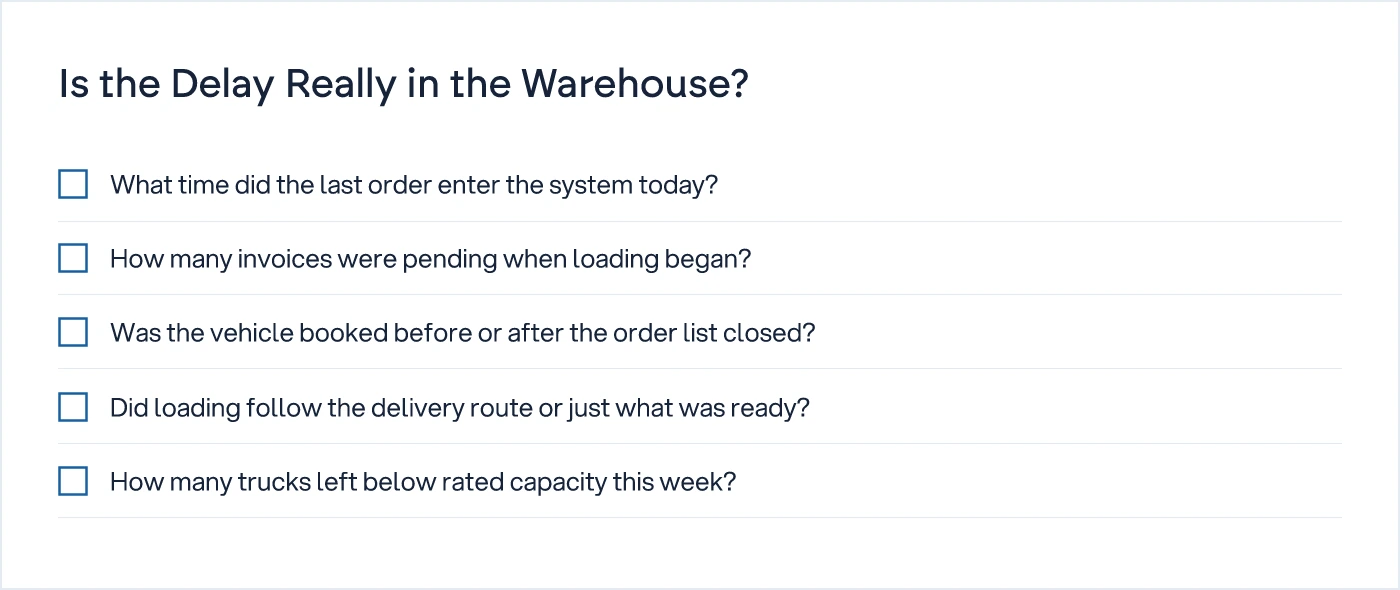
Run this for five working days before you decide where the problem actually sits. Most owners expect the warehouse to come out looking inefficient. What usually comes out instead is a cutoff that nobody enforces and an invoicing queue that starts two hours after it should.
This is also the point where receivables start compounding the same delay. If dispatch runs late and invoicing runs later, the ageing clock on that invoice starts from a date that was already avoidable. Worth reading alongside this: catching receivables ageing before it becomes bad debt.
The wider pattern here is one we see across distribution and trading businesses more broadly: visibility and timing problems across the order-to-cash cycle tend to cluster at the handoffs between departments, not inside any single department's process.
What to do next
Don't redesign the warehouse yet. For one week, track four timestamps against every dispatch: when the order list actually closed, when the last invoice for that day's dispatch was raised, when the vehicle was booked, and when loading actually started. Lay the four timelines side by side. The gap between "cutoff announced" and "cutoff actually closed" is usually the single largest number on the sheet, and it belongs to sales, not the warehouse.
We understand how your business actually works first, then we design the system. If you want to map this sequence properly, including where your ERP or billing software is reinforcing the wrong handoff order, our digital transformation service starts with exactly this kind of process trace before any software changes.
Common questions
Why do trucks leave half full even when there's enough stock in the warehouse?
Because loading starts before the day's order list is finalised, so the warehouse loads what's confirmed and invoiced at that moment, not everything that was ordered. By the time the remaining invoices clear, the truck has already left to meet the day's dispatch window, and the leftover orders carry forward to the next day's load.
Is dispatch delay a warehouse efficiency problem?
Usually not. The warehouse is the last step in the sequence, so it absorbs delays that started with sales, stock allocation or invoicing. Adding staff or picking equipment rarely fixes it if the order cutoff isn't enforced and invoices are still being raised after loading begins.
What's the fastest fix for dispatch delays?
Give the operations or logistics head ownership of the order cutoff, not sales, and run invoicing in parallel with picking rather than after it. These two changes alone remove most of the paperwork and order-list delays that push loading to the end of the day.
How does dispatch delay affect transport cost?
A part-loaded truck means you're paying for capacity you didn't use, and tighter delivery windows often force an extra trip or premium freight to cover the orders that didn't make the original dispatch. Over a month, this shows up as higher transport cost per unit shipped, even though nothing in the rate card changed.
Who should own the dispatch cutoff decision?
The operations or logistics head, not sales. When sales owns the cutoff, it extends every day, because every late order looks urgent to the person who sold it. A cutoff that can be overridden by a phone call isn't a cutoff, it's a suggestion.
Sources

Sanket Vanani
Founder & CEO
Sanket Vanani is a business strategist and entrepreneur focused on helping businesses build structured systems for sustainable growth. His work spans sales, operations, manufacturing, process improvement, and business scalability. Through his experience working closely with business owners and teams, Sanket focuses on turning founder-dependent businesses into process-driven organizations that can grow with greater clarity, consistency, and control.
Related reading
Where Your Working Capital Is Actually Stuck
Good sales don't guarantee cash. Trace the real leaks: unbilled dispatch, unsent invoices, and payments sitting unreconciled.
Setting Reorder Points When Demand Isn't Steady
Most reorder-point formulas assume steady demand. This one is built for distributors whose demand is lumpy and lead times swing.
Dead Stock: How Much Is Sitting in Your Warehouse
Dead stock isn't a stock problem. It's a decision no one owns. Here's how to find it and who should be signing off the write-off.
Receivables Ageing: Catching Bad Debt Before Month-End
Month-end ageing reports arrive too late for a trading business. Here is how to review receivables weekly and stop bad debt before it compounds.


