
Logistics Companies in Dubai: Running Operations Beyond Google Sheets
A logistics company in Dubai moves beyond Google Sheets by replacing manual rate quoting, dispatch confirmation and vendor reconciliation with a system that captures job cost, status and margin in one place. This cuts owner dependency and gives the team and customers visibility without a phone call.
You have thirty people, a few trucks or a yard, a WhatsApp group for every customer, and a Google Sheet someone updates between calls. Dispatch gets confirmed by phone. Rates get quoted from memory. At month-end, nobody is quite sure which jobs made money.
This is a normal stage for logistics companies in Dubai between ten and thirty staff, and it shows up the same way across logistics operations in the UAE and Saudi Arabia. Sheets and WhatsApp are not the problem by themselves. The problem is what they cannot do: hold a decision, track a cost, or tell you where a shipment stands without a phone call to someone who knows.
This guide covers where the Sheets-and-WhatsApp model breaks, what logistics and supply chain management should actually track, and what to systemise first, in the order that gets a freight or logistics operation from 30 people to 100 without the owner personally holding every decision.
Why do logistics companies in Dubai outgrow Google Sheets?
Spreadsheets work when one person can hold the whole operation in their head. Past roughly 25 to 30 people, no one person can, including the owner.
At ten people, the owner knows every job, every customer and every vendor rate personally. At thirty, sales, dispatch, warehouse and accounts are each updating their own sheet, and none of the four talk to each other. A rate changes in one sheet and nobody tells the person invoicing.
Cross-border and multi-modal work makes this worse than it would be in a single-location trading business. A sea-to-land shipment touches a transporter, a customs broker, a warehouse and a customer, each with their own update, usually sent by WhatsApp and never copied into the sheet that matters.
What does owner dependency look like in a logistics business?
It looks like every rate, every vendor payment and every customer exception routing through the owner's phone, even once the business has grown well past what one person can approve in a day.
A customer calls for an urgent rate. Sales checks three different sheets and cannot confirm vendor availability. Sales calls the owner on WhatsApp. The owner checks with the transporter directly. Three hours later, a rate goes out, and the job's margin is not known until someone reconciles it weeks later.
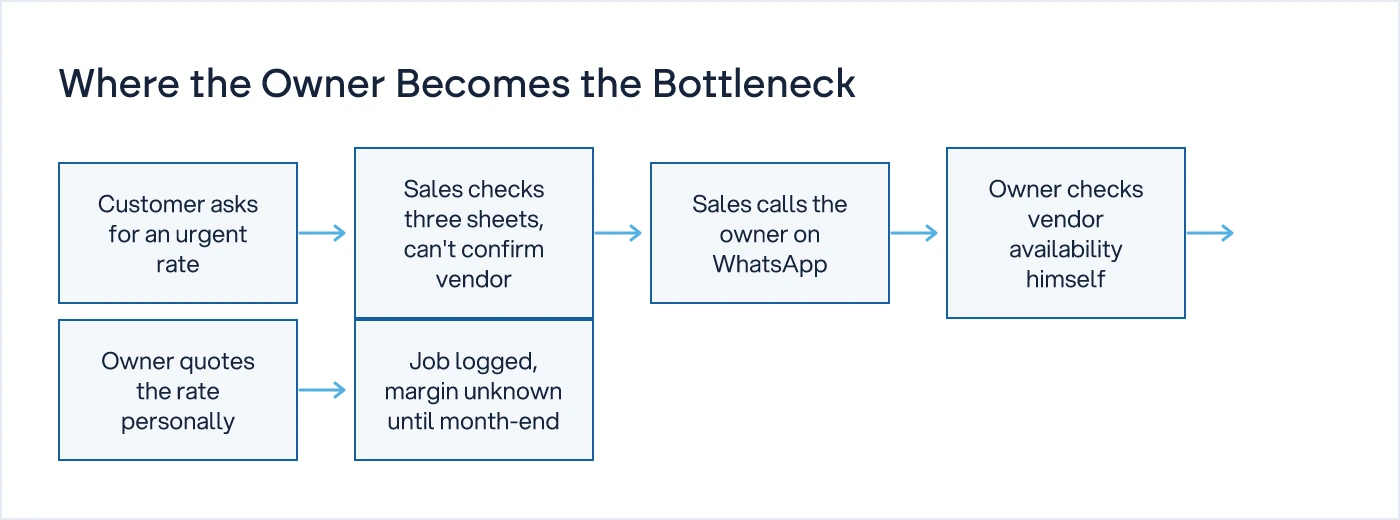
Multiply that sequence by fifteen jobs a day and the owner is not running the business. The owner is the business's only working memory.
How does customer and vendor communication break down on spreadsheets?
Spreadsheets hold data. They do not hold conversations, so every rate change, delay or exception still has to be chased down by phone.
A customer wants shipment status. Ops checks the sheet, finds it was last updated that morning, and calls the driver to find out where the load actually is. On the vendor side, finance often cannot tell what a transporter has invoiced against what was actually agreed, so payment follow-up happens over the same WhatsApp threads as everything else.
That gap between what was promised and what was invoiced is exactly where cash gets stuck. The pattern is covered in more detail in where your working capital is actually stuck.
Why does team coordination fall apart past 30 people?
More people means more sheets, and more sheets means more versions of the truth, right when coordination needs to tighten, not loosen.
Sales promises a pickup window without checking vehicle availability. Dispatch plans a route around a job that was already cancelled in a different sheet. The warehouse loads the wrong order because the picking sheet was never synced with the dispatch sheet. None of this is anyone's fault individually. It is what happens when coordination depends on everyone checking the same six sheets at the same time, which nobody does.
The mechanics of this, and why trucks end up leaving half full and late, are covered in dispatch planning: why trucks leave half full and late.
What does real-time visibility actually mean on the ground?
It means anyone authorised, staff or customer, can see where a shipment is and what it is costing, without calling the one person who knows.
A spreadsheet shows a static entry someone typed in. It does not show live state: picked up, in transit, held at customs, delivered, invoiced, paid. This is the point where cloud ERP software becomes relevant, not as a category to chase for its own sake, but as the thing that holds status, cost and stock in one place instead of across six sheets and three WhatsApp groups.
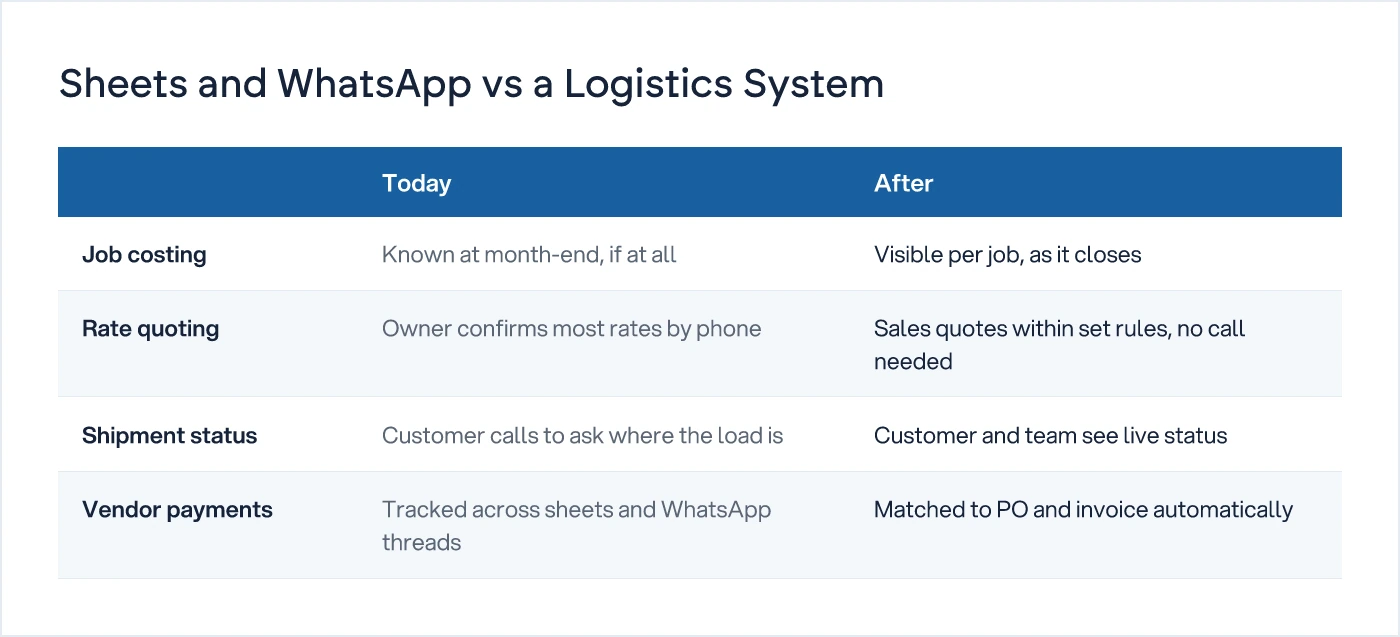
If the answer needs a phone call, it is not a system. It is a workaround that has been running long enough to feel permanent.
Which KPIs and profit margin per job should you be tracking?
The one number most Sheets-run logistics companies cannot produce on demand is profit per job, because the cost and the revenue sit in different places and nobody reconciles them until month-end.
| KPI | What it tells you | Why spreadsheets usually miss it |
|---|---|---|
| Profit margin per job | Whether a shipment actually made money after vendor cost, fuel, tolls and demurrage | Vendor bills land days later, in a different sheet |
| On-time dispatch rate | Whether promised pickup and delivery windows are being met | No timestamp capture, relies on memory |
| Vendor cost variance | Whether the quoted vendor rate matches the actual invoice | Nobody reconciles the PO to the invoice automatically |
| Receivables by customer | Who owes what, and for how long | Updated manually, usually stale by the time it is checked |
| Fleet or vendor utilisation | Whether capacity is sitting idle or overbooked | No single view across jobs and vehicles |
Margin leakage on quoting is often an access problem as much as a pricing one. Who can actually change a rate without checking with the owner is covered in pricing control: who can actually change a price.
What should you systemise first?
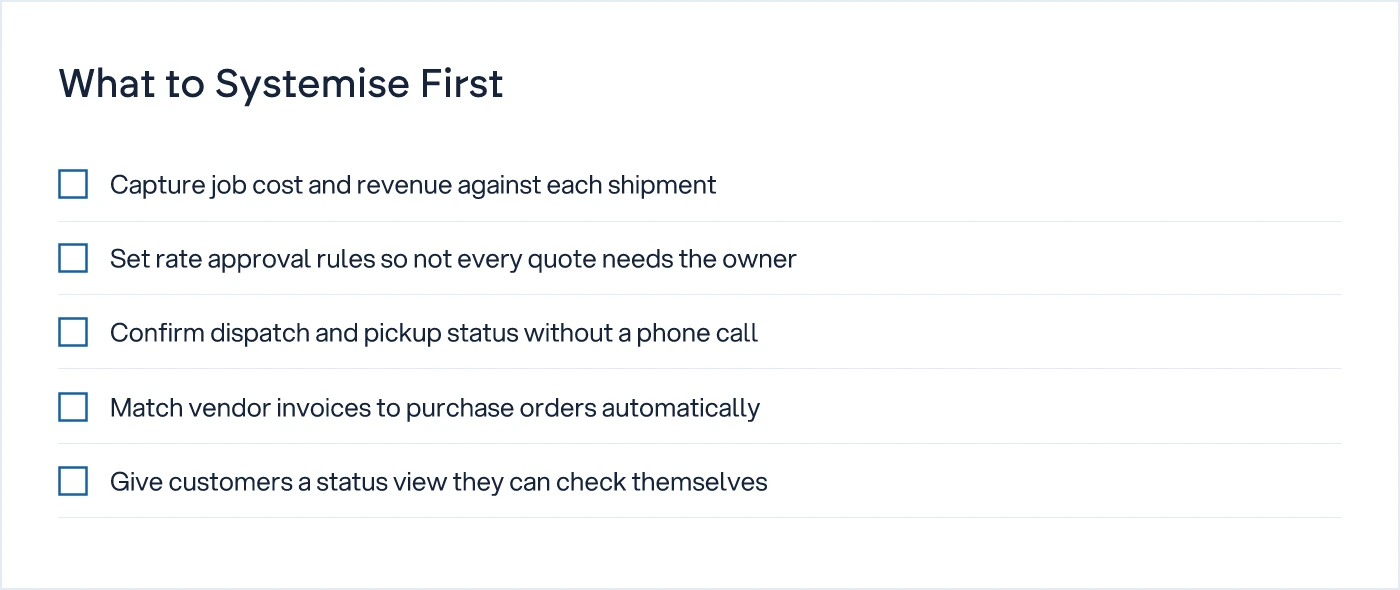
Not everything. The first thing to systemise is whatever currently needs the owner's personal judgement the most times a week.
For most logistics companies in this size range, that order looks like: capture cost and revenue against each job as it moves, set rate approval rules so routine quotes do not need the owner, confirm dispatch and pickup status without a phone call, match vendor invoices to purchase orders automatically, and give customers a status view they can check themselves.
Do not automate a bad process. If rate approval today means whoever shouts loudest gets a discount, building software around that only makes the discounting faster and harder to see.
How do you move from spreadsheets to a system without disrupting live operations?
You do not replace everything in one go. You map how the business actually runs, find the two or three points where decisions and information are genuinely blocked, and build or configure around those first.
This is the approach behind a system ThetaSol built for a UAE logistics company of around thirty employees that was running its entire operation on Google Sheets. Cost calculations that used to take a spreadsheet and a phone call were streamlined into the system itself. Operational efficiency roughly doubled, the same team handled more volume, and the owner's time stopped being the thing every job waited on.
We understand how your business actually works first, then we design the system. That starts with a free 30-minute call to hear how your operation actually runs day to day, not with a feature list. For businesses that want a structured, on-site look at where decisions and information are actually getting stuck before any build begins, that is what SCAN (System Clarity & Actionable Needs) is for.
For more on running a distribution or logistics operation with visibility instead of guesswork, see the Distribution, Trading and Wholesale Operations hub, or look at how a digital transformation service approaches this kind of move for a growing business.
Common questions
How do small logistics companies in Dubai manage operations?
Most run on Google Sheets for job records, WhatsApp for customer and vendor updates, and the owner as the person who approves rates and chases exceptions. It works while headcount is small and the owner can personally track most jobs. It stops working once there are too many jobs and vendors for one person to hold in memory.
When should a logistics company stop using spreadsheets?
Around 25 to 30 staff, when job cost and status start living in different sheets that no longer stay in sync, and the owner is being called for decisions that should not need them. If you cannot tell a job's margin without a phone call, that is the signal, not a specific headcount.
What should logistics software track?
Job status from pickup to delivery and invoicing, cost against each job including vendor and fuel charges, rate quotes against approval rules, vendor invoices matched to purchase orders, and receivables by customer. The goal is one place to see margin and status per job, not a separate sheet for each function.
How can a logistics owner reduce dependency on themselves?
Set clear rate approval rules so routine quotes do not need sign-off, give the team a shared view of job status and vendor cost, and build in exception alerts so only genuine problems reach the owner. This moves the owner from approving everything to reviewing what actually needs a decision.
Sources
- Global Freight Forwarding and Logistics Solutions — LBX Logistics
- Freight Forwarding & Logistics Company UAE — AlKhoori Cargo

Sanket Vanani
Founder & CEO
Sanket Vanani is a business strategist and entrepreneur focused on helping businesses build structured systems for sustainable growth. His work spans sales, operations, manufacturing, process improvement, and business scalability. Through his experience working closely with business owners and teams, Sanket focuses on turning founder-dependent businesses into process-driven organizations that can grow with greater clarity, consistency, and control.
Related reading
Dispatch Planning: Why Trucks Leave Half Full and Late
Dispatch delays aren't a warehouse problem. They start upstream, in sales, invoicing and vehicle booking, and the warehouse just absorbs the damage.
Pricing Control: Who Can Actually Change a Price
Margin leakage isn't a pricing problem. It's an access control problem. Here's how to define who can discount, who approves, and who owns the master list.
Where Your Working Capital Is Actually Stuck
Good sales don't guarantee cash. Trace the real leaks: unbilled dispatch, unsent invoices, and payments sitting unreconciled.
Setting Reorder Points When Demand Isn't Steady
Most reorder-point formulas assume steady demand. This one is built for distributors whose demand is lumpy and lead times swing.


