
Documentation Debt: What Happens When SOPs Go Stale
When an SOP is not updated, people quietly stop following it and build their own workaround. The gap between the written process and the actual process widens until an audit, a new hire, or an error exposes it. By then the real process exists only in someone's head, and fixing it costs more than writing it did the first time.
You wrote the SOP eighteen months ago. A consultant helped, or your ops head sat down for a week and documented how purchase approvals work, how shift handover happens, how a customer complaint gets logged. It was good work. It is now sitting in a folder nobody opens.
Meanwhile, the actual process has moved on. The approval limit in the document says ₹50,000. The real limit, the one your finance manager enforces, is ₹1,50,000, because nobody updated the document after the last review. A new supervisor joined four months ago and was never told the SOP exists, so he does things the way the previous supervisor showed him verbally, which is close but not identical. Three people now do the same job three slightly different ways, and none of them matches the paper.
This is documentation debt. It behaves exactly like technical debt in software: it does not cost you anything on the day you skip the update. It costs you later, at the worst possible moment, with interest.
What happens when SOPs are not updated?
The process does not freeze. It keeps changing, just without anyone writing down what changed. The SOP becomes a historical record of how things used to work rather than an instruction for how things work now.
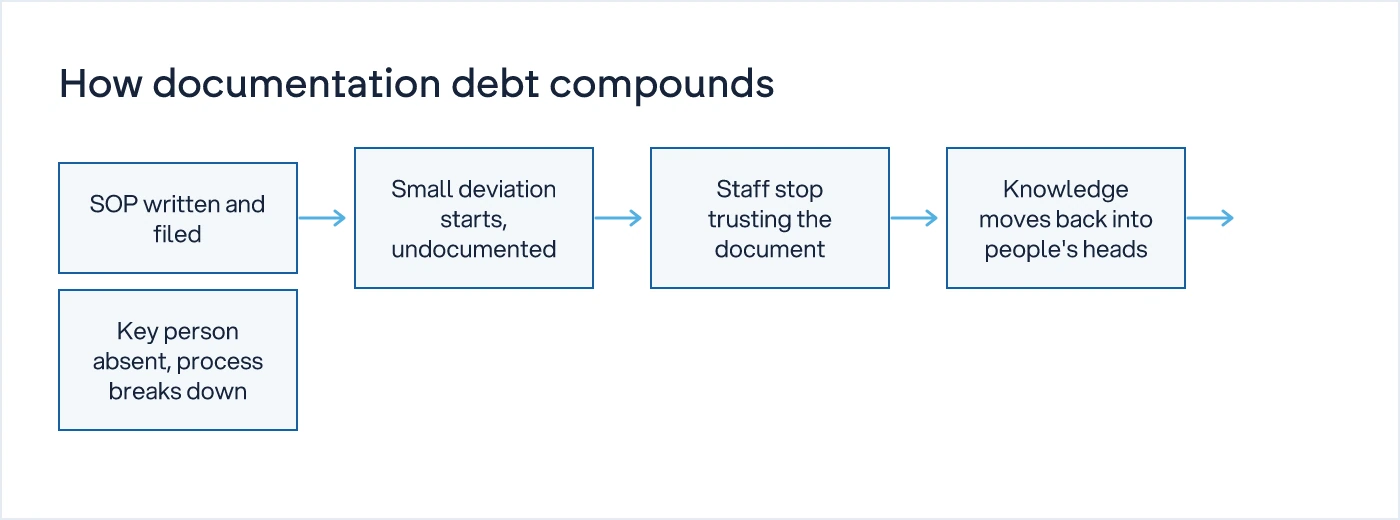
Three things happen in sequence, and they are predictable:
First, small deviations accumulate. Someone finds a faster way to check a vendor's credit, or a shortcut around a step that was always redundant. Nobody updates the document because updating it feels like paperwork, not work. The deviation becomes the new normal for that person, but not for the next person who reads the old SOP.
Second, the SOP loses authority. Once people notice the document does not match reality, they stop trusting it entirely, including the parts that are still correct. A new joiner reads it, follows it literally, gets corrected by three different colleagues in three different ways, and concludes the document is decorative. From that point, the SOP exists for the audit file, not for the floor.
Third, the real process becomes dependent on specific people again. This is the expensive part. The entire reason you wrote SOPs was to stop the business from depending on who happens to be in the building. An unupdated SOP quietly reverses that. The knowledge of how things actually work moves back out of the document and into the heads of two or three experienced staff. The day one of them is on leave, sick, or leaves the company, you are back to firefighting, exactly where you started before you wrote the SOP.
Why do SOPs go stale in the first place?
SOPs go stale because nobody owns the update, not because the original document was wrong. Writing an SOP is a project with a start and an end date. Keeping it current is an ongoing responsibility, and most businesses assign the first and skip the second.
A few specific causes show up repeatedly:
The process changed for a good reason, informally. Someone found a better way to do something, it worked, it stuck, and nobody circled back to the document because updating a document was never anyone's job description.
The person who wrote the SOP left. The original author understood why each step existed. Their replacement does not, and has no instinct for when the document needs revising because they never fully understood it in the first place.
The review was a one-time event, not a recurring one. The SOP was written, approved, filed, and never scheduled for a second look. Without a date on the calendar, review simply does not happen. External research on SOP governance makes the same point: documents without a defined review cycle degrade predictably over time, not randomly (Trainual, Why SOPs Go Stale).
The approval cycle itself became the bottleneck. In regulated and quality-sensitive industries, some businesses build such a heavy sign-off process around any SOP change that staff stop proposing changes at all, because getting a one-line update approved takes ninety days. The document stays technically current on paper and practically abandoned on the floor (Leucine, The 90-Day SOP Trap).
How is documentation debt like technical debt?
Both are decisions to defer a fix now in exchange for a larger cost later, and both compound silently until something forces the issue.
In software, technical debt is the shortcut a developer takes to ship faster: a quick fix instead of a proper one, a workaround instead of a rebuild. It works, until three more features get built on top of that shortcut, and now rewriting it properly means touching everything above it too.
Documentation debt works the same way. Skipping one SOP update is cheap on the day you skip it. But the next person who touches that process builds their own adjustment on top of the outdated version, and the person after that builds on top of theirs. By the time someone finally sits down to fix the document, they are not updating one step, they are reconciling three or four years of undocumented drift, and nobody fully remembers which change happened when or why.
| Debt type | What gets deferred | Where the cost shows up | Who pays |
|---|---|---|---|
| Technical debt | Proper code structure | System breaks under load or new feature | Developer rewriting it later |
| Documentation debt | Updating the SOP after a process change | Audit, new hire, or key person's absence | Whoever is left holding the actual process |
| Approval debt | Sign-off process for small changes | Staff stop requesting updates entirely | The business, in lost process control |
The fix for both kinds of debt is the same discipline: smaller, more frequent updates rather than one large rewrite every few years. An SOP that gets a five-minute correction every quarter stays usable. An SOP left untouched for three years needs a full rewrite, and by then nobody is confident they remember every informal change that needs capturing.
What is the trigger rule for when an SOP must be revisited?
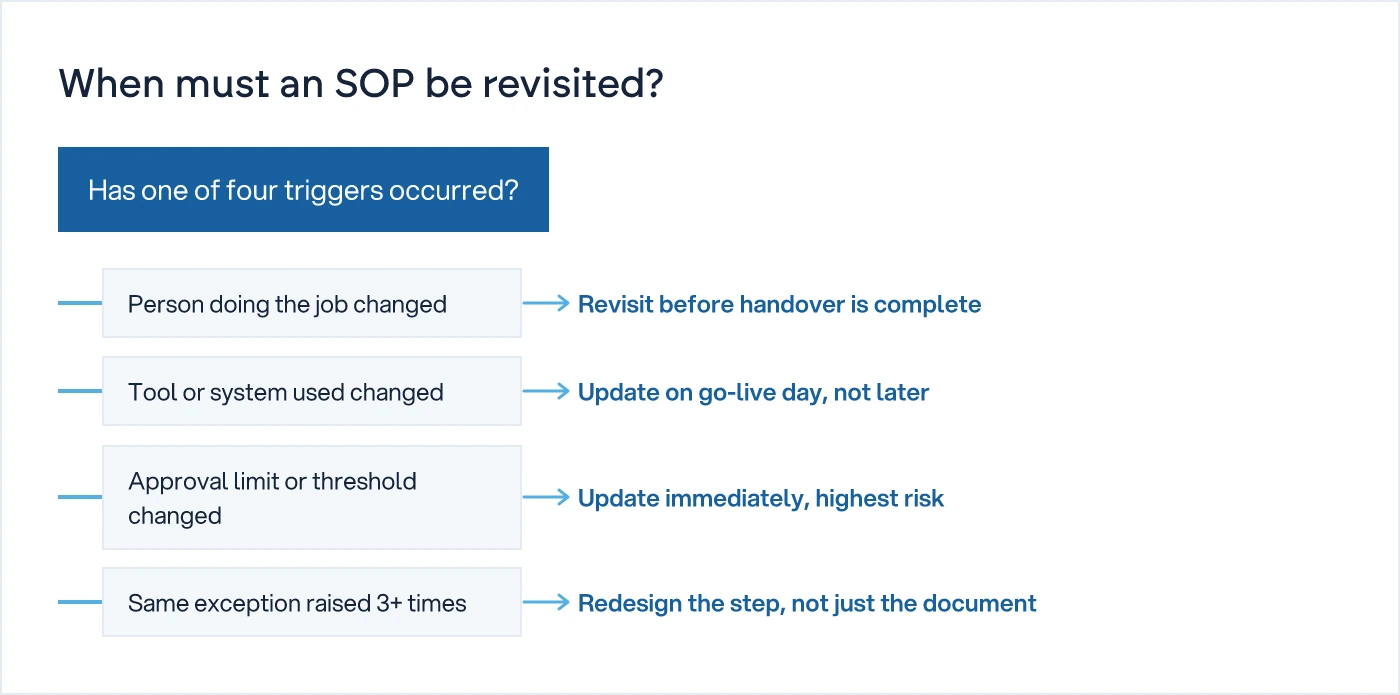
An SOP needs revisiting the moment any one of four things changes, not on a fixed annual date. Calendar-based review ("we'll look at it every January") catches drift too late, because most of the damage happens in the months between reviews.
The four triggers:
The person doing the job changes. Any time a role changes hands, whether through promotion, resignation, or reassignment, the incoming person should read the SOP against what they are actually told to do, out loud, with their supervisor. Mismatches surface immediately.
The tool used to do the job changes. If the process now runs through a new software system, a new machine, or even a different spreadsheet template, the SOP referencing the old tool is obsolete the day the new tool goes live, not whenever someone remembers to update it.
An approval limit or threshold changes. The moment a credit limit, a discount band, a purchase value, or an escalation threshold is revised, the SOP documenting the old number becomes actively misleading rather than just outdated. This is the highest-risk trigger because it directly affects who can approve what.
Exceptions to the process start repeating. If the same "special case" gets raised three times in a quarter, it is not an exception any more. It is the process, and the SOP that does not account for it is wrong, not incomplete.
Industry writing on SOP maintenance backs the same conclusion from a different angle: SOPs that are reviewed only on a fixed schedule, rather than in response to real triggers, are consistently found to be out of date the moment anyone actually checks them against practice on the floor (Stern Stella, Your SOPs Are Already Out of Date).
Who decides when an SOP needs updating?
The supervisor running the process day to day decides when a trigger has occurred, and the department head approves the revision, not a central documentation team sitting apart from the work. If the person closest to the floor has to escalate every minor correction to a committee, the same approval-cycle problem returns: updates pile up, and the SOP drifts further from reality while waiting for sign-off.
A workable split: the supervisor flags the trigger and drafts the change in plain language. The department head checks it against budget, authority limits, and any compliance requirement, and approves within the week, not the quarter. Anything larger, a full process redesign rather than a one-line correction, goes to whoever owns that function. This keeps small updates fast and keeps larger changes from being rubber-stamped without scrutiny.
This is also where the review needs to ask a harder question than "is the document accurate." If the process itself has drifted because the original design was wrong, updating the SOP to match the workaround is the wrong move. Do not automate a bad process, and do not formalise one either. The trigger is a prompt to ask whether the step should exist in its current form at all, not just whether the paperwork matches the floor.
What should you check this week?
Pick the three SOPs your business depends on most and test each one against a real transaction from the last fortnight. Walk the actual sequence of events, not the document, and mark every point where what happened differs from what is written. That gap list is your real documentation debt, and it is usually smaller and more specific than owners expect.
If the gap is in approval limits or authority levels, our related piece on purchase order approval levels sets out how many sign-offs a process actually needs. If the gap is that your spreadsheets have quietly become the real system because the SOP never caught up, this piece on when Excel stops working is worth reading next. And if the SOP in question is the shift handover itself, we've written separately about what should actually be written down at handover.
We understand how your business actually works first, then we design the system, which is also why we treat SOP drift as a visibility problem before it is a documentation problem. If the gap between the paper and the floor is wide enough that you are not sure which version is correct anymore, that is the conversation worth having before you rewrite anything. You can read more about how we approach this kind of audit on our digital transformation services page, or browse the rest of our writing on business systems, SOPs and visibility.
Common questions
How often should an SOP be reviewed?
Not on a fixed annual schedule alone. Review it the moment one of four triggers occurs: the person doing the job changes, the tool used changes, an approval limit changes, or the same exception gets raised three or more times in a quarter. A calendar review once a year is useful as a backstop, but most drift happens between those dates.
What is documentation debt?
Documentation debt is the gap between what your SOP says and what your team actually does, built up over time because small process changes were never written down. Like technical debt in software, it costs nothing on the day it's created but compounds until a new hire, an audit, or a key person's absence exposes how wide the gap has grown.
Who should be responsible for updating SOPs?
The supervisor running the process should flag when a trigger occurs and draft the correction, and the department head should approve it within days, not months. Routing every small update through a central documentation committee is usually what causes SOPs to go stale in the first place, because updates pile up waiting for sign-off.
Should I rewrite an outdated SOP or start over?
Check first whether the drift happened because the written process was never followed, or because the real process genuinely improved and the paper didn't catch up. If staff built a better workaround, update the SOP to match it. If the drift is people quietly avoiding a bad step, redesign the step itself rather than documenting the workaround as official.
What's the real cost of an unupdated SOP?
The immediate cost is low, which is why it gets ignored. The real cost shows up later: a new hire trained on an inaccurate document, an audit that finds the paper and the practice don't match, or the business becoming dependent again on the one or two people who know how things actually work, which undoes the point of writing SOPs at all.
Sources

Sanket Vanani
Founder & CEO
Sanket Vanani is a business strategist and entrepreneur focused on helping businesses build structured systems for sustainable growth. His work spans sales, operations, manufacturing, process improvement, and business scalability. Through his experience working closely with business owners and teams, Sanket focuses on turning founder-dependent businesses into process-driven organizations that can grow with greater clarity, consistency, and control.
Related reading
How Many Approval Levels Should a Purchase Order Have?
A rule for sizing PO approvals to value and risk, not hierarchy, and the uncomfortable truth about approvals that protect a person, not the business.
When Excel Stops Working: The Real Signs You've Outgrown It
The real sign you've outgrown Excel isn't file size or crashes. It's the same sheet being edited by different people for different reasons.
What Belongs on Your First Management Dashboard
Most first dashboards fail because they show everything measurable. Start from the decision you make every week, not the data that's available.
Shift Handover: What Should Actually Be Written Down
A task list tells the next shift what happened. It won't tell them what to do. Here's what a handover report actually needs to say.


