
How Many Approval Levels Should a Purchase Order Have?
Most purchase orders need two approval levels at most: one that checks the value against budget, one that checks the vendor and terms. A third level is justified only above a value where a wrong call genuinely hurts the business. Beyond that, extra approvals usually protect a person, not the company.
A purchase order for ₹3,000 worth of cleaning supplies sits for four days because it needs the same three signatures as a ₹3 lakh machine part. Meanwhile the ₹3 lakh order clears in an hour because the requester walked it to the director's desk in person. This is what happens when approval levels are set by habit, not by value and risk.
Most businesses add approval levels the way they add staff: one at a time, after one bad experience each. A vendor overcharged once, so a second signature got added. A wrong part got ordered once, so a technical sign-off got added. Nobody ever took the whole chain out afterwards and asked whether it still made sense together, or whether it was built for a company half this size.
What does a purchase order approval level actually protect against?
A good approval level checks one specific thing a bad decision could have cost you: wrong budget, wrong vendor, wrong terms, or wrong timing. That's it. Not "someone senior should look at this," but a named risk that this specific check catches.
When you can't name the risk a level catches, it isn't protecting the business. It's either duplicating a check someone else already did, or it's there for a reason that has nothing to do with the purchase itself. We'll come back to that second case, because it's the one owners rarely say out loud.
How many approval levels should a purchase order actually have?
Most purchase orders need one or two levels. A third is only justified above a value where getting it wrong would genuinely hurt the business, not just embarrass someone.
Level one checks whether the spend is within budget and whether the requester is buying what they're supposed to buy. This can usually sit with the department or budget owner. Level two checks the vendor and the commercial terms, usually finance or procurement. For most routine, repeat-vendor purchases, that's enough. A third level, typically the owner or a director, should only trigger above a value threshold you've deliberately set, or for a new vendor, a new category of spend, or a capital item.
The table below is indicative. Your numbers will depend on your turnover, margins and how much cash a wrong order ties up, not on what a template says.
| PO value band (indicative) | What needs checking | Approval levels | Who approves |
|---|---|---|---|
| Up to ₹25,000 | Budget availability | 1 | Department / budget owner |
| ₹25,000 – ₹2,00,000 | Budget + vendor terms | 2 | Budget owner + finance/procurement |
| Above ₹2,00,000 or any capital item | Budget + vendor + strategic fit | 3 | Budget owner + finance + owner/director |
| New vendor, any value | Vendor verification | +1 extra check | Finance or procurement adds a one-time check |
Notice what this table does not do: it does not add a level because of who the requester reports to. A production head and a junior buyer go through the same number of checks for the same value and risk. Hierarchy decides who you report to. It should not decide how many people have to sign a purchase order.
How do you decide the right value threshold for your business?
Set the threshold at the point where a wrong decision would cost you more than the delay is worth. That's the whole rule.
A 12 crore auto-components manufacturer we worked with had five approval levels for anything above ₹50,000, a number set when the company was a third of its current size and ₹50,000 was a real risk. Years later, ₹50,000 was a routine consumable order, and the five-level chain was adding four to five days to orders that used to take an afternoon. The fix wasn't a new approval tool. It was resetting the threshold to match current turnover and letting routine, repeat-vendor orders clear in one step.
If you've never written down your own thresholds, start with the first five SOPs every growing business should document. Approval limits are usually one of the first five, because they're the process that stalls hardest when the usual approver is unreachable.
When does an approval step exist to protect a person, not the business?
This is the uncomfortable one. An approval step exists to protect a person when removing it wouldn't change a single outcome, only the sense of safety for whoever signs it.
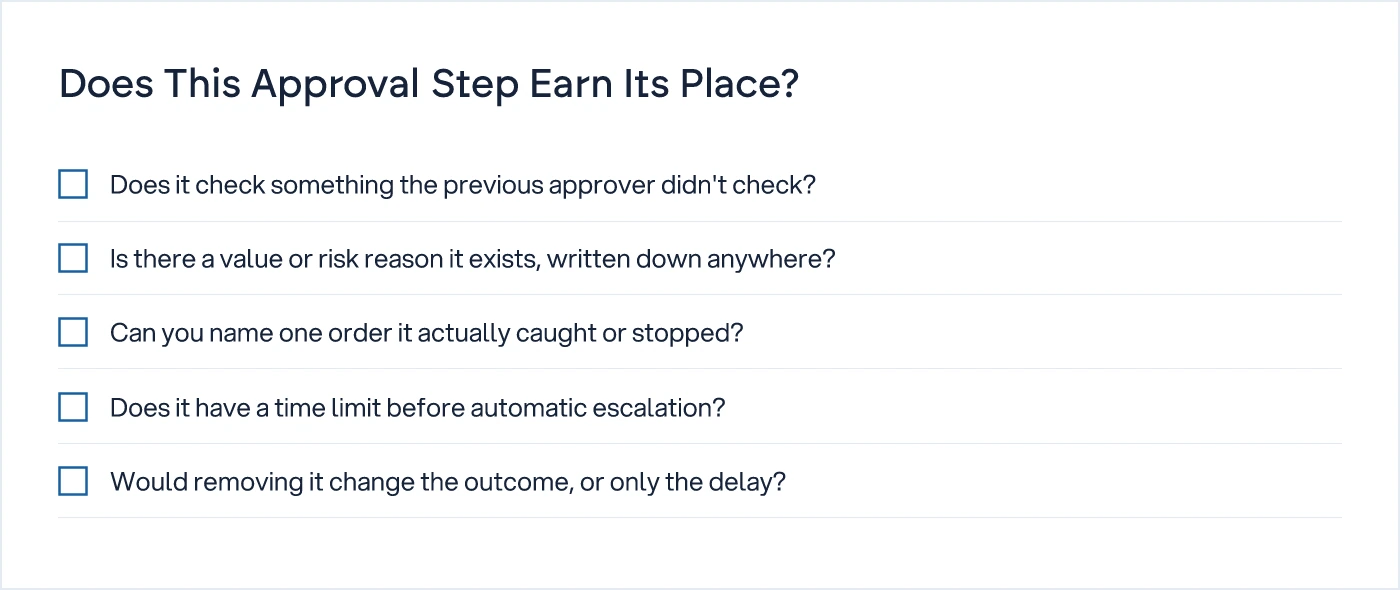
Ask this about every step: what does this approver know, or check, that the previous one didn't? If the honest answer is nothing, the step exists so that if something goes wrong later, someone can point to their signature and say they weren't the one who missed it. That's not control. That's insurance bought with everyone else's time.
The plant head who signs every PO above ₹10,000, not because they verify anything but because they want their name on it, is a common version of this. They travel three days a week. Every order above ₹10,000 waits for them regardless of urgency, vendor history, or risk, because the signature has become about covering a position, not checking a decision.
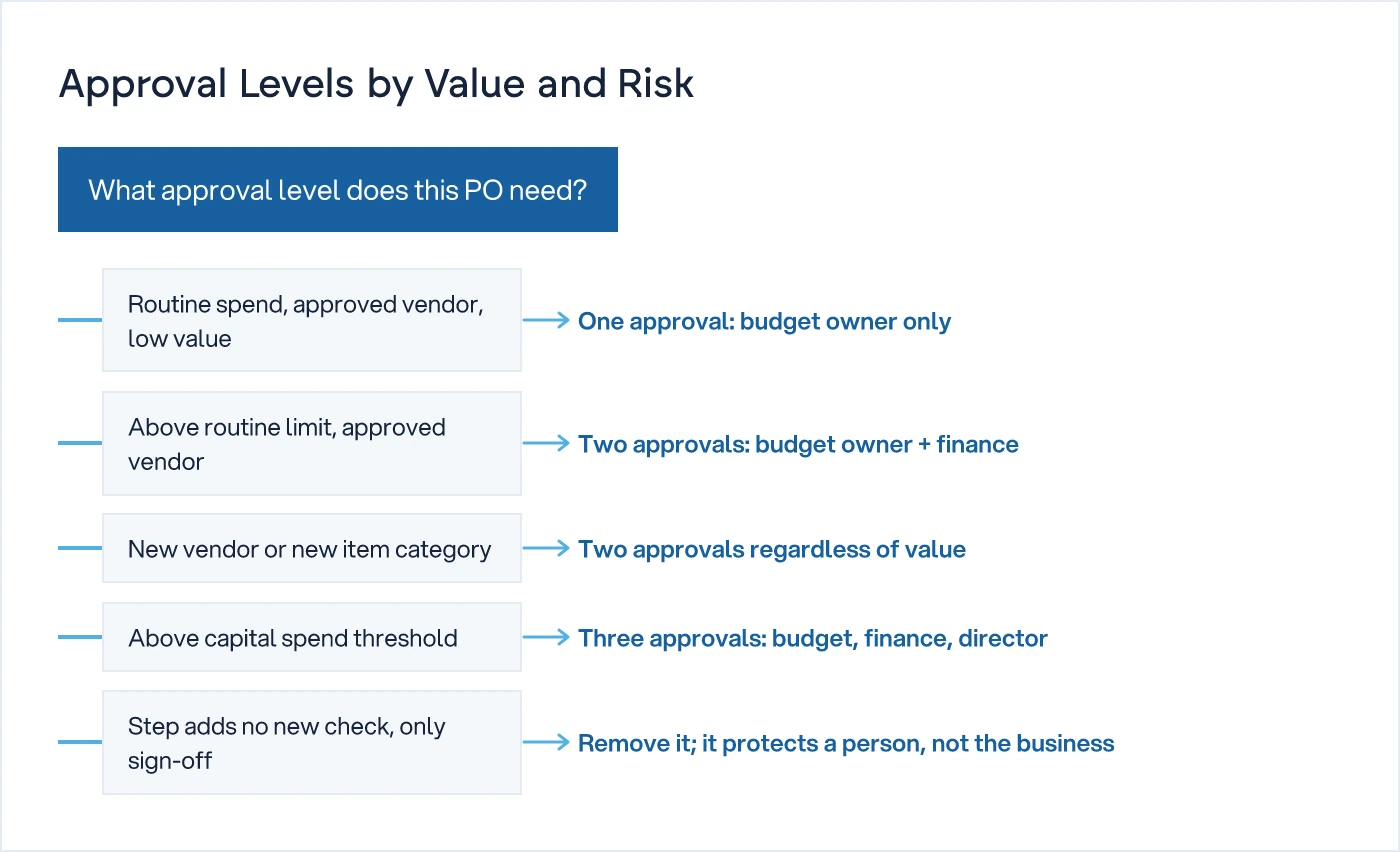
The fix isn't to remove accountability. It's to separate it from the approval. If the plant head needs visibility into large purchases, give them a weekly report of everything above the threshold, not a signature queue that blocks the business while they're travelling. What belongs on your first management dashboard covers how to give someone visibility without making them a bottleneck.
What happens when there are too many approval levels?
Delay becomes a bigger risk than the one the approvals were meant to prevent. Vendors learn how long your PO cycle takes and price accordingly, because they know you can't react quickly. Urgent orders start going around the system entirely, a phone call to a vendor to start work before the paperwork catches up, which is exactly the informal workaround an approval chain was meant to prevent in the first place. If the answer to "is this order approved" needs a phone call to find out, it's not a system, it's a chain of people hoping someone else remembers.
This is also where businesses that have outgrown spreadsheets feel it hardest. A PO sitting in someone's inbox for sign-off is no more visible than one sitting in an Excel file waiting for someone to update a column. When Excel stops working describes the same symptom from a different angle: nobody can say, without asking a person, where something actually stands.
How do you redesign an approval chain that has grown out of control?
List every current approval step, what it checks, who approves it, and how long it typically takes. Most owners have never done this on paper, only in their head.
Once it's written down, run each step through the checklist below. Keep what earns its place. Merge steps that check the same thing twice. Remove any step whose only function is a name on a signature.
We do not automate a bad process. If your current approval chain has five levels because of history rather than risk, digitising it just makes the delay faster to measure, not shorter to live with. The redesign has to happen before the system does.
This sits within approval workflows, one part of a wider set of problems around visibility and control as a business grows past founder-led decision making. You'll find the rest of that ground covered in Business Systems, SOPs and Visibility.
What to do next
Pull your last twenty purchase orders, regardless of value. Write down, next to each one, how many approvals it actually needed versus how many it actually got, and how many days it sat waiting at each stage. You will see the pattern within twenty rows: which levels check something real, and which ones exist because nobody has ever questioned them. That list is the starting point for the redesign, not a new approval tool.
We understand how your business actually works first, then we design the system. If you want help mapping your actual approval chain, value by value, and rebuilding it around risk rather than habit, that's part of our digital transformation work.
Common questions
How many approval levels should a small business purchase order have?
Usually one. A single budget-owner approval is enough for routine, low-value, repeat-vendor orders in a small business. Add a second level only once order values rise enough that a wrong call would hurt cash flow, or once you start dealing with vendors you haven't worked with before.
Should every purchase order need owner approval?
No. Owner approval should be reserved for orders above a value threshold you've set deliberately, or for new vendors and capital spend. If the owner is signing off on stationery and raw material alike, the signature has stopped meaning anything and has become the slowest step in the process.
What is a reasonable approval threshold for a growing business?
There's no universal number. Set it at the value where a wrong decision would cost more than the delay is worth, based on your own turnover and margins, and revisit it as the business grows. A threshold set three years ago is almost always too low for the business you run today.
How do you stop approval delays without losing control?
Separate visibility from approval. Someone senior doesn't need to sign every order to stay informed; they need a regular report of everything above a set value. Reserve actual sign-off for the orders that carry real risk, and let routine, repeat-vendor orders clear without waiting for a travelling approver.
Is one approval level ever enough for a purchase order?
Yes, for low-value, routine, repeat-vendor spend where the budget owner already knows the vendor and the price. One level is enough as long as someone, somewhere, is still reviewing the pattern of spend periodically, even if not approving each individual order.
Sources

Sanket Vanani
Founder & CEO
Sanket Vanani is a business strategist and entrepreneur focused on helping businesses build structured systems for sustainable growth. His work spans sales, operations, manufacturing, process improvement, and business scalability. Through his experience working closely with business owners and teams, Sanket focuses on turning founder-dependent businesses into process-driven organizations that can grow with greater clarity, consistency, and control.
Related reading
When Excel Stops Working: The Real Signs You've Outgrown It
The real sign you've outgrown Excel isn't file size or crashes. It's the same sheet being edited by different people for different reasons.
What Belongs on Your First Management Dashboard
Most first dashboards fail because they show everything measurable. Start from the decision you make every week, not the data that's available.
Shift Handover: What Should Actually Be Written Down
A task list tells the next shift what happened. It won't tell them what to do. Here's what a handover report actually needs to say.
The First Five SOPs Every Growing Business Should Write
Owners who try to document every process at once give up. Start with the one that stalls when you're unreachable, then follow this five-SOP sequence.


