
Shift Handover: What Should Actually Be Written Down
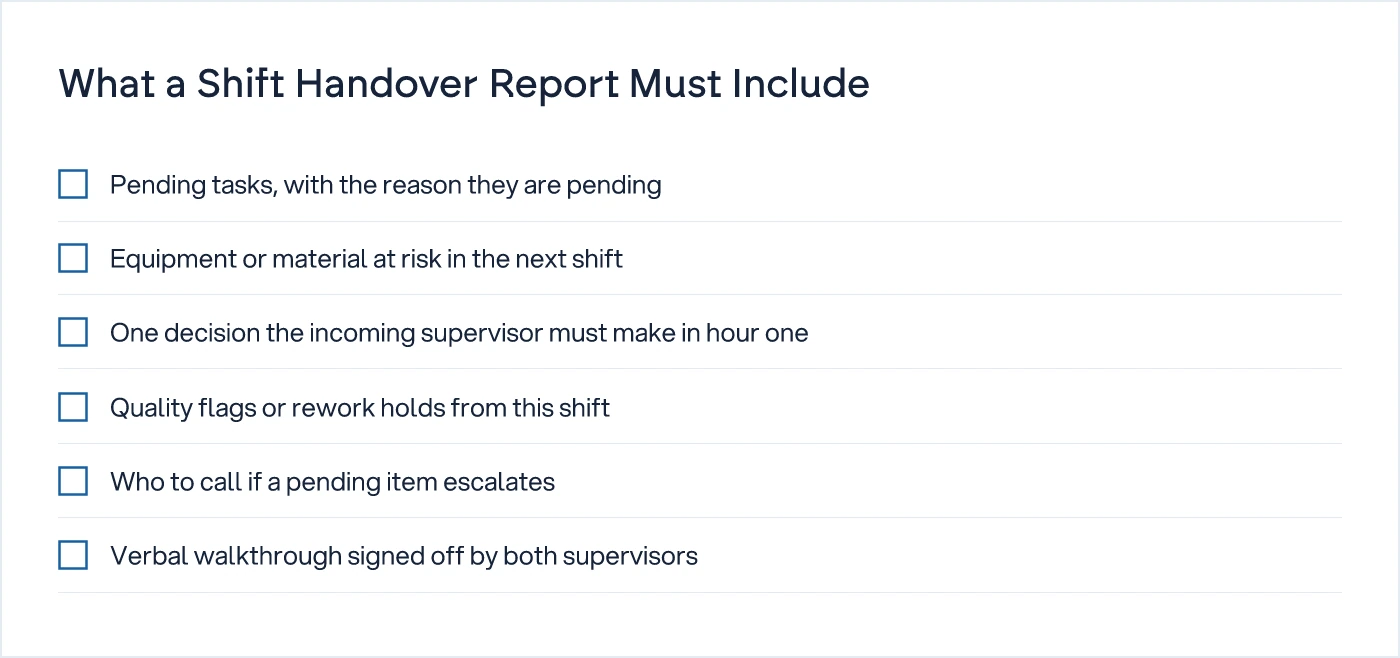
A shift handover report should answer three things: what is pending and why, what could go wrong before the next check-in, and what decision the incoming supervisor must make in the first hour. A list of tasks completed tells the next shift what happened. It does not tell them what to do next.
Why does a "tasks completed" list fail the next shift?
Because it answers the wrong question. It tells the incoming supervisor what the plant did in the last eight hours. It does not tell them what to watch for in the next eight.
Here's a sequence that plays out in almost every multi-shift plant at some point. Night shift logs: 47 pieces produced, Machine 3 running fine, no issues. The supervisor goes home. Forty minutes into the day shift, Machine 3 stops. Turns out the bearing had been making a grinding noise since around 4am. The night operator heard it, mentioned it to nobody in writing, and the shift ended before it became a problem on his watch. The day supervisor now has a stopped line, a missing maintenance history, and a phone call to make to someone who is already asleep.
Nothing on the handover sheet was wrong. It just wasn't the right information. "Machine 3 running fine" was true at the time it was written. It stopped being true an hour later, and nobody's report was built to carry that kind of signal forward.
What should a shift handover report actually contain?
Three things, in this order: what's pending and why, what's at risk before the next handover, and what decision the incoming supervisor has to make in the first hour. Everything else is optional detail.
Pending, with the reason. Not "Job order 214 incomplete." Instead: "Job order 214, cutting stage incomplete, die change was due at shift end, operator on this job goes home at 6am too." The reason tells the next supervisor whether they can pick it up in five minutes or whether it needs a decision.
At risk, not just broken. This is the part almost every handover sheet skips, because at-risk items feel like admitting something isn't under control. A compressor whose pressure has been dropping steadily for an hour isn't a problem yet. It's information the next supervisor needs to check it by a certain time, before it becomes a stoppage on their shift instead of a warning on yours.
One decision, named. Every shift ends with at least one thing that genuinely needs a call, not a task. Should shipment 118 be held for a quality recheck or released as-is? Should the second extruder be restarted now that the part has arrived, or does it wait for the maintenance supervisor to inspect it first? Write the decision as a decision, not buried in a paragraph of notes. Name who is meant to make it, if it isn't the incoming supervisor themselves.
| What to write | Question it answers | Example entry |
|---|---|---|
| Pending | What's not finished, and why | Job order 214, cutting stage incomplete, die change was due, next operator unavailable until 8am |
| At risk | What could go wrong before the next handover | Compressor pressure dropping for the last hour, recheck by 6am |
| Decision required | What must be decided in the first hour, and by whom | Hold shipment 118 for QC recheck or release as-is, plant head to confirm by 9am |
| Contact | Who to call if a pending item escalates | Maintenance, Ramesh, extension 204 |
This is close to what hospitals have run for decades under structured handoff formats like SBAR: situation, background, assessment, recommendation. Nursing shift changes carry the same risk a plant does, a patient or a machine that looks stable can turn within the hour, and the entire discipline exists to force that forward-looking information into writing. FreshRN's guide to nursing report handoff is written for a hospital floor, but the structure, what's pending, what's changing, what needs a decision, translates directly to a shop floor.
Who fills this in, and when?
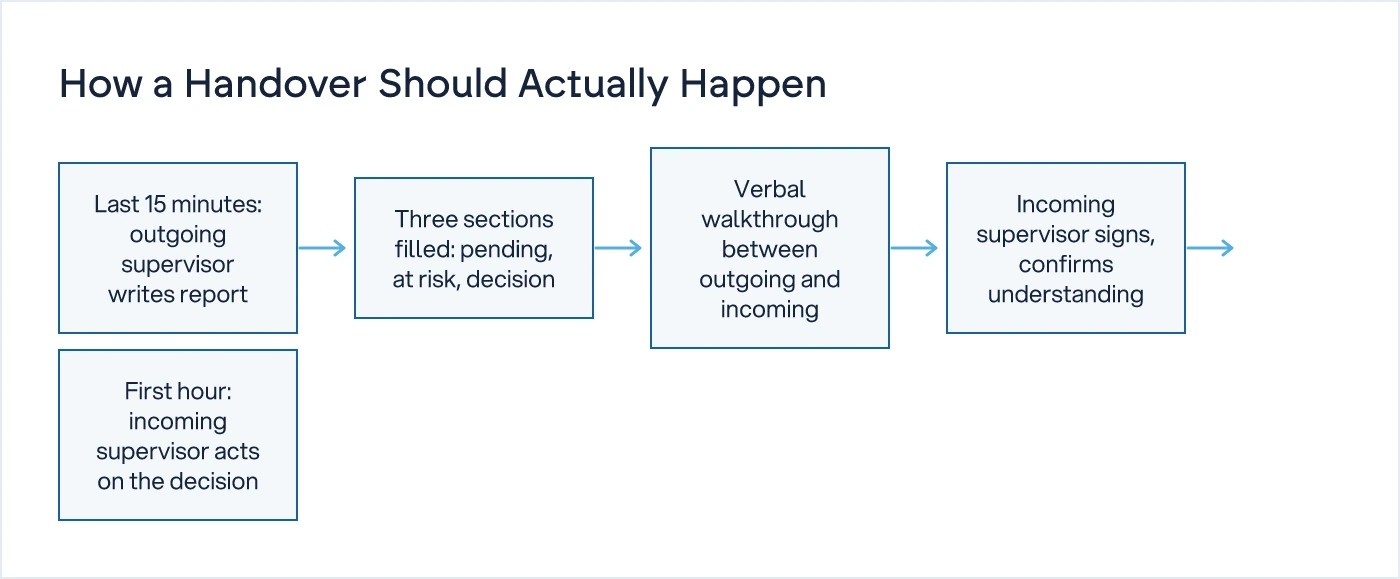
The outgoing supervisor, in the last fifteen minutes of the shift, in writing, before the verbal handover happens. Not after. Not from memory the next morning when someone asks.
The order matters. If the verbal conversation happens first and the written report gets filled in as an afterthought, the report becomes a summary of what was already said, and the pending, at-risk and decision items get watered down to whatever the outgoing supervisor remembers to mention out loud. Written first, verbal second, means the incoming supervisor is reading before they're listening, and can ask the questions the sheet raised rather than the questions they happen to think of on the spot.
This is also where a lot of plants lose the thread when they're hiring supervisors faster than they can train them. A handover format that lives in one experienced supervisor's head works fine until that supervisor is on leave, and the person covering for them has never seen how it's supposed to be done. If the answer needs a phone call, it's not a system. A written format, used the same way on every shift, is what lets a two-week-old supervisor hand over as reliably as a two-year one.
What happens in the first hour when this is missing?
The incoming supervisor spends it finding out what they actually walked into, instead of acting on it. That's the real cost. It's not that the handover sheet is missing, most plants have one. It's that the sheet answers "what happened" when the person reading it needs "what do I do now."
The pattern is almost always the same: something goes wrong within the first hour or two of a new shift, the incoming supervisor calls the outgoing one to ask what they meant by a line on the sheet, and the outgoing supervisor is now fielding plant calls on their own time. Multiply that across three shifts and a plant with rotating supervisors, and handover quality quietly becomes the single biggest driver of how much firefighting the plant head has to absorb personally.
How do you get new supervisors to do this well, fast?
By making the format identical across every shift and every supervisor, so nobody is inventing their own version of "pending" and "at risk" under pressure at the end of a twelve-hour shift. That's a decision the plant head makes once, not something left to individual style.
Start on paper. A single-page format with the three sections, pending, at risk, decision required, filled in by hand and signed by both supervisors at the change of shift, will tell you within two weeks whether the format itself is right before anyone thinks about digitising it. Don't automate a bad process. If supervisors are leaving the "decision required" box blank, or filling "at risk" with vague notes like "keep an eye on things," that's a training gap the software won't fix.
Once the format is genuinely working on paper, digitising it earns its place: a shift handover that's filled on a tablet, timestamped, and visible to the plant head without a phone call is a very different thing from a WhatsApp message that says "all ok, nothing pending." That's the kind of visibility question we work through in our digital transformation service, where the software is built around a handover process that's already proven itself on the floor, not around a feature list.
Handover is one of five or six processes most growing plants are running on habit rather than a written standard. If you haven't yet mapped which ones stall the moment the usual person is unreachable, that's the starting point in The First Five SOPs Every Growing Business Should Write. We understand how your business actually works first, then we design the system. For more on building this kind of operational visibility across the plant, see Business Systems, SOPs and Visibility.
What to do this week
Take tomorrow's handover sheet, whatever format is currently in use, and check it against three questions: does it name something pending with a reason, does it flag anything at risk before the next shift, and does it name one decision for the incoming supervisor to make in the first hour. If it's missing even one of those, that's the gap to close before anything else about handover gets touched.
Common questions
What should be included in a shift handover report?
Three things: what's pending and why it's pending, what's at risk of going wrong before the next handover, and what single decision the incoming supervisor must make in the first hour. A list of completed tasks can sit alongside these, but on its own it isn't a handover report, it's a log.
Who should write the shift handover report, and when?
The outgoing supervisor, in the last fifteen minutes of their shift, in writing, before the verbal handover conversation happens. Writing first forces the pending, at-risk and decision items to be specific rather than summarised from memory during a rushed corridor conversation.
How is a shift handover different from a daily production report?
A production report looks backward, output, downtime, rejections for the shift that just ended. A handover looks forward, it exists purely to tell the next supervisor what to watch and what to decide in their first hour. Plants that merge the two usually lose the forward-looking part.
Why do new supervisors struggle with handover quality?
Because handover format is usually undocumented, it lives in how the senior supervisor happens to do it. A new supervisor copies the visible habits, like ticking off tasks, without knowing the format is supposed to flag risk and force a decision. A written, identical format across all shifts fixes this faster than experience alone does.
Should shift handover be digitised or kept on paper?
Start on paper. Run the three-section format by hand for two to three weeks and see if supervisors actually fill in the pending, at-risk and decision sections properly. Digitise once the format is proven, so the software captures a working process rather than locking in a broken one with a nicer interface.
Sources

Sanket Vanani
Founder & CEO
Sanket Vanani is a business strategist and entrepreneur focused on helping businesses build structured systems for sustainable growth. His work spans sales, operations, manufacturing, process improvement, and business scalability. Through his experience working closely with business owners and teams, Sanket focuses on turning founder-dependent businesses into process-driven organizations that can grow with greater clarity, consistency, and control.
Related reading

The First Five SOPs Every Growing Business Should Write
Owners who try to document every process at once give up. Start with the one that stalls when you're unreachable, then follow this five-SOP sequence.


