
What Is Digital Transformation? A Plain-Words Guide
Digital transformation means redesigning how work and decisions move through your business, not buying new software. In a factory, it means a purchase order gets approved without ten follow-up calls, not that the same slow approval now happens on a screen. Technology only matters once the process itself is fixed.
What is digital transformation in simple words?
Digital transformation means changing how work moves through your business, not changing what screens your team looks at. The digital transformation meaning most owners search for is simpler than the definitions written for large corporations.
Take a purchase order. On paper, it goes from the store to the purchase manager, then to you for approval, then back to the store. If that file sits on your desk for two days because you were travelling, the process is broken, no matter what it is written on. Scanning the same PO into a PDF and emailing it does not fix that. It just moves the same delay onto email.
Most owners first hear the term from a software salesperson, which is why it gets confused with buying a system. The confusion is understandable. A new ERP or ordering portal is visible, billable and easy to demonstrate in a meeting. A redesigned approval sequence is none of those things, even though it is the part that actually saves time. That mismatch is why so many projects deliver a new screen and the same two-day wait.
Digital transformation in business starts with one broken handover, not a company-wide rollout. It asks who should decide, what information they need to decide, and why the file is waiting instead of moving. Software is useful here only once that sequence is settled. Until then, you are digitising a problem, not solving it.
We understand how your business actually works first, then we design the system. That order matters more than it sounds. A system built around an unexamined process inherits every delay the paper process had, just with better fonts.
What is the difference between digitisation, digitalisation and digital transformation?
Digitisation converts paper to data. Digitalisation uses that data to run an existing task faster. Digital transformation redesigns the process the task sits inside, including who decides and when.
| Term | What it means | Shop floor example |
|---|---|---|
| Digitisation | Converting paper or manual records into digital form | Job cards typed into Excel instead of handwritten on a clipboard |
| Digitalisation (sometimes written digitalization) | Using digital tools to run an existing task without redesigning it | Job card status updates automatically when a machine stops, but the follow-up call to the supervisor still happens |
| Digital transformation | Redesigning the process itself, including the decision points | Production plan reshuffles automatically when a machine goes down, and the plant head is alerted before the shift ends, not the next morning |
Most software projects in manufacturing stop at digitalisation. They make an old process faster without asking whether the process should exist in that form. Do not automate a bad process. If a purchase order needs three verbal confirmations before it is trusted, putting it on a screen will not remove the need for those three calls.
The practical way to tell the three apart is to ask what happens to the delay, not the paperwork. Digitisation moves the record from paper to a file. Digitalisation moves the task from slow to fast. Only transformation moves the decision from one person's desk to a rule that most orders can clear without. If a project only achieves the first two, it is worth finishing, but it should not be sold internally as the third.
What are examples of digital transformation in manufacturing and trading?
The clearest digital transformation examples sit in the handovers between departments, not inside any single department's screen.
1. Production planning. A textile unit in Gujarat or an apparel exporter near Riyadh often runs production planning on a whiteboard or a shared spreadsheet. Transformation means the plan updates when raw material is confirmed, and the floor supervisor sees the change without a phone call.
2. Purchase order approval. A distributor in Dubai approving fifteen purchase orders a day cannot read each one closely. Transformation sets rules for what needs his approval and what does not, so the ones that reach him are the ones that matter.
3. Dispatch and logistics. An auto-components manufacturer often prepares the delivery challan after the truck has already left, because the dispatch clerk and the accounts team work from separate files. Transformation links stock movement, challan and invoice into one sequence, so the paperwork follows the truck instead of chasing it.
4. Credit control. A trading company extending credit to fifty buyers usually has one person, often the owner, checking each limit from memory. Transformation defines the rule (payment history, outstanding days, order size) so most orders clear without reaching the owner's desk.
5. Stock and inventory. A hardware trading business with a warehouse in Jebel Ali and a counter in town often finds the two stock counts disagree by the time anyone checks. Transformation means both locations work from the same number, updated as goods move, not reconciled once a month.
Notice what all five examples have in common. None of them describe a feature. Each one describes a decision that used to need a person and now needs a rule, and a handover that used to need a phone call and now needs a trigger. That is the test to apply to any project proposal before it starts: does it remove a decision bottleneck, or does it just move the bottleneck onto a newer screen.
Is digital transformation only about technology?
No. Technology is the smallest of the three changes; people and process carry most of the weight.
People decide the rules: who approves a credit limit, who signs off a production change, who gets alerted when a machine stops. Process defines the sequence those decisions follow and where the handover points are. Technology's job is narrower than most owners expect. It records the decision, enforces the rule, and removes the need for a follow-up call.
A credit approval system that still requires someone to ring the owner for every order has not been transformed. It has only moved the paperwork. If the answer needs a phone call, it's not a system. The test is not how modern the screen looks. It is whether the same decision now happens without you in the room.
This is also why the order of work matters. Deciding the rule (who can approve what, up to what value, under what condition) is a management decision, not a technical one. It needs the owner, the finance head and whoever owns the risk to agree on it before a developer writes a line of code. Skip that step and the software will faithfully automate an argument that was never settled.
How do you know if your business needs digital transformation?
If decisions wait on one person, or the same information gets typed into three different registers, the business needs it.
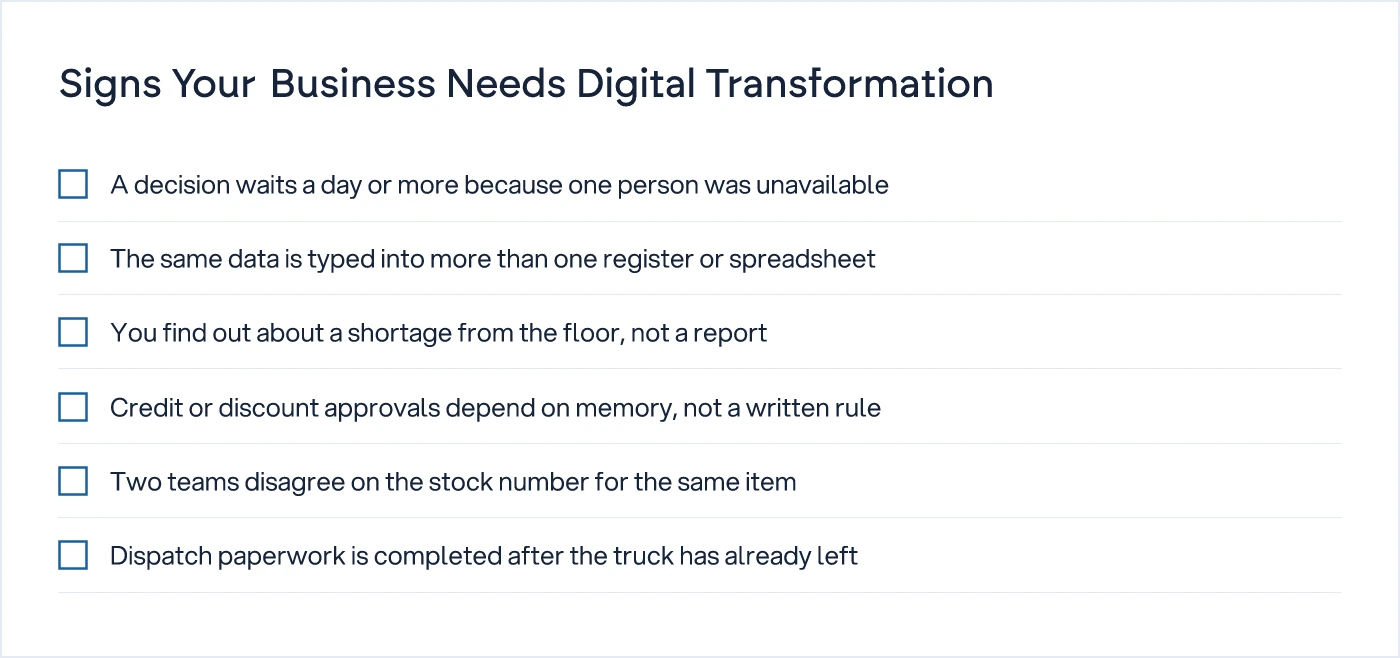
A few patterns are worth checking against your own week. Does a purchase order, a credit approval or a dispatch release ever sit for a day because you were travelling. Does your purchase or sales team keep a personal Excel sheet that does not match the official one. Do you find out about a stock shortage from the production floor instead of from a report. Each of these is a process gap, not a technology gap, and it is worth naming before any software is chosen.
A simpler version of the same check: count how many times in a typical week someone says "let me call and check" before answering a question that should already have an answer on file. Every one of those calls is a process that depends on a person's memory instead of a recorded rule. That is the gap worth closing first, regardless of what system eventually records the answer.
This pattern of decisions routing through one person is covered in more detail in why the business can't run without the owner. If you want to put a number on what the delay is costing each month, start with how to calculate the cost of firefighting. And if you are trying to judge whether now is the right moment to start, read when is the right time to start digital transformation.
The starting point is never the whole business. Pick one process, usually the one that causes the most follow-up calls in a typical week, and work out why it stalls before deciding what to build. The Digital Transformation for Growing Businesses hub has more on how that first process gets chosen, and the digital transformation service page sets out how we work through it with a business before any software decision is made.
Common questions
What is digital transformation in simple words?
Digital transformation means redesigning how work and decisions move through your business, so information reaches the right person without delay or follow-up calls. It is not about buying new software or putting paper on a screen. A process that still needs three phone calls to move forward has not been transformed, regardless of what system records it.
What is the difference between digitisation, digitalisation and digital transformation?
Digitisation converts paper records into digital form, such as typing job cards into a spreadsheet. Digitalisation uses that data to run an existing task faster, like auto-updating a job card's status. Digital transformation goes further and redesigns the process itself, including who decides what and when, rather than just speeding up the old steps.
What are examples of digital transformation in manufacturing?
Common examples include production plans that adjust automatically when a machine breaks down, purchase orders that route only the exceptions to the owner, dispatch paperwork that follows stock movement instead of trailing behind it, credit limits that clear against defined rules, and stock counts that match across warehouse and counter in real time.
Is digital transformation only about technology?
No. Technology is usually the smallest part of it. People decide the rules, such as who approves a credit limit or signs off a production change. Process defines the sequence and handover points those decisions follow. Technology's role is to record the decision and remove the need for a follow-up call, not to replace the thinking behind it.
Sources
- What is Digital Transformation? — Salesforce
- What Is Digital Transformation? — Syracuse University iSchool

Sanket Vanani
Founder & CEO
Sanket Vanani is a business strategist and entrepreneur focused on helping businesses build structured systems for sustainable growth. His work spans sales, operations, manufacturing, process improvement, and business scalability. Through his experience working closely with business owners and teams, Sanket focuses on turning founder-dependent businesses into process-driven organizations that can grow with greater clarity, consistency, and control.
Related reading
When Is the Right Time to Start Digital Transformation?
Revenue and headcount thresholds don't tell you when to start. Being the approval bottleneck does. Here's how to spot it before FY planning locks your budget.
Owner Dependency: The Real Reason the Business Can't Run Without You
Owner dependency isn't a delegation problem. It's a visibility gap: the owner sees across departments, nobody else does. Here's how to fix that before succession.
What Actually Happens When We Audit Your Operations
Before software gets built, we shadow one process and trace a decision end to end. Here's the exact audit sequence.
What Firefighting Actually Costs You Each Month
A simple formula to price the cost of pending approvals and delayed dispatches, using numbers you already have, no consultant needed.


