
When Is the Right Time to Start Digital Transformation?
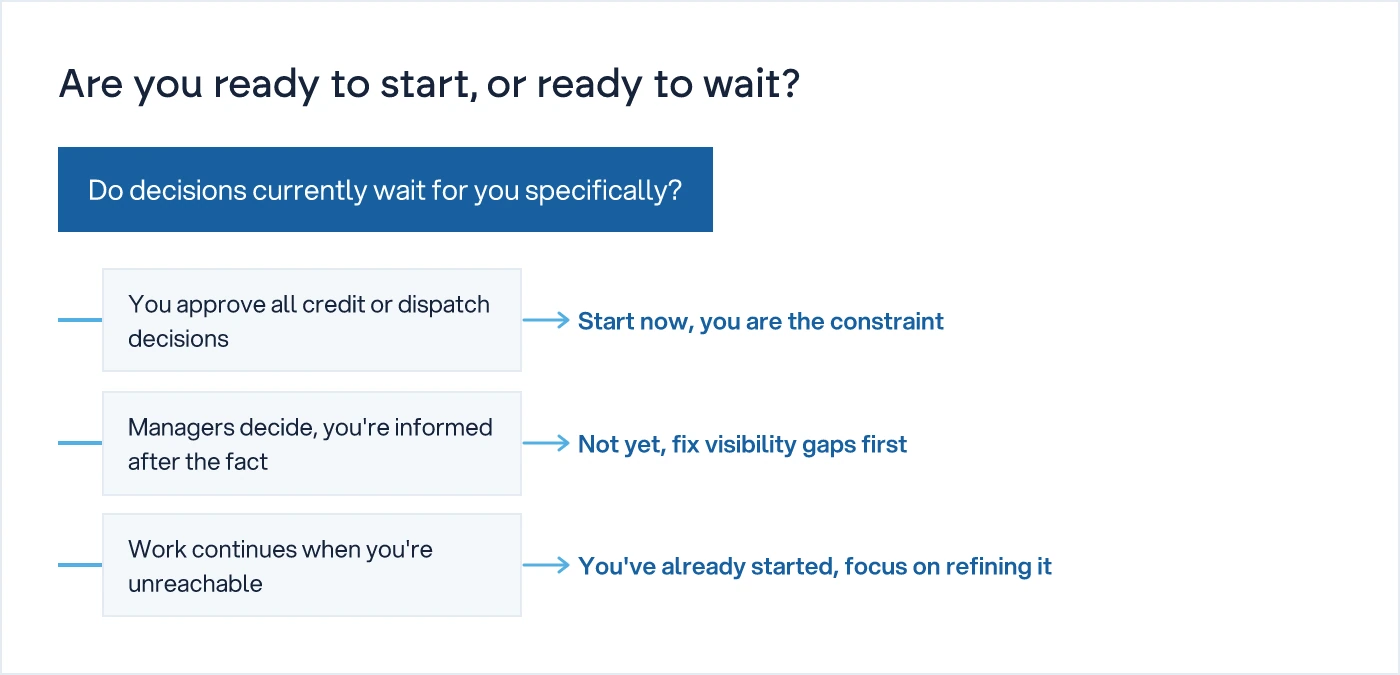
There's no revenue or headcount figure that signals readiness. The real trigger is when you're the one approving credit limits, dispatch holds or purchase orders that a manager should be deciding, and the business slows down the moment you're unreachable. That's the signal to start, not a turnover target.
Every financial year, the same question comes up in board rooms and owner's cabins: is this the year we fix the systems, or do we wait until things are "stable enough"? Most owners answer it by looking at a number. Turnover crossing $2 million. Headcount crossing 50. A competitor going digital first. None of these are the actual signal.
Numbers are comforting because they're external and measurable. A turnover target gives you permission to act without admitting anything is broken internally. But readiness isn't about permission, it's about where decisions currently sit, and that has nothing to do with the calendar or the balance sheet.
What's the real signal that it's time to start?
The signal is that you have become the approval step for decisions other people should be able to make and see for themselves. If a sales manager can't release an order without your sign-off on credit, if dispatch waits for you to approve a replacement for damaged goods, if your production planner texts you to decide which of two urgent orders goes first, the business isn't waiting on information. It's waiting on you.
This has nothing to do with company size. A 15-person shop can hit this point. A 200-person plant can avoid it for years if decisions are pushed down with the right visibility. The number that matters isn't revenue or headcount. It's how many decisions per week can only move when you're physically present.
Why don't revenue or headcount thresholds work as triggers?
Because they measure the wrong thing. Revenue tells you the business is growing. It says nothing about whether the people running it can see what they need to see, or whether they're still routing everything through you out of habit or necessity.
We've seen owners of $8 million (₹65 crore) manufacturing businesses running three shifts with almost no bottleneck, because plant heads and dispatch leads have clear authority and clear numbers in front of them. We've also seen $1.5 million (₹12 crore) businesses where the owner is copied on every WhatsApp approval because nobody else has the full picture. Size didn't decide which one needed to act.
| Signal owners often use | What they assume it means | What it actually tells you |
|---|---|---|
| Turnover crosses a target figure | "We're big enough now to justify systems" | Nothing about whether decisions are stuck with you |
| Headcount crosses 40-50 | "We need process because we can't manage informally" | Team size, not decision flow, is the wrong measure |
| A competitor digitises first | "We're falling behind" | Pressure to act, not evidence you're ready |
| You're the one approving things a manager should decide | "This is just how the business runs" | The actual point where transformation should start |
What does owner-as-bottleneck look like on the ground?
It looks ordinary, which is why owners miss it. A sales rep gets a customer asking for a small credit extension. He doesn't have authority to approve it, so he calls you. You're in a supplier meeting, so it waits four hours. The customer places the order with someone else in the meantime, or the rep chases you twice more before you're free.
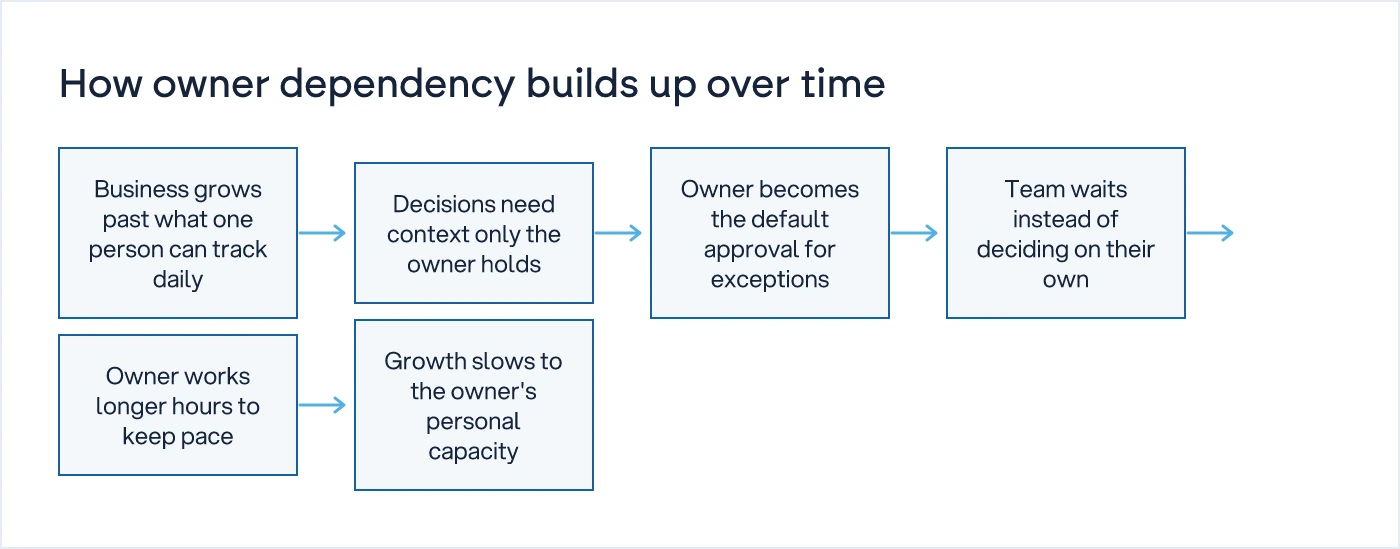
Separately, dispatch has a consignment ready but the packing doesn't match what the customer confirmed on call. Nobody except you spoke to that customer, so dispatch holds the truck until you're reachable. Multiply this by every function that only sees its own slice of the order, sales sees the quote, production sees the job card, dispatch sees the packing list, and you're the only person who sees all three. That's not a staffing problem. It's a visibility problem, and it's the reason owner dependency builds up quietly over years rather than arriving all at once.
The same pattern shows up in purchasing. A stores executive flags that raw material stock is running low, but the purchase order needs your sign-off because the last three vendor rate revisions went through you directly. He waits. Production doesn't wait for the flag, it waits for the actual material, so a line stoppage that could have been avoided a week earlier gets discovered only when the shift supervisor calls looking for stock that isn't there.
Is financial year planning the right time to decide?
Yes, but only as a checkpoint, not as the trigger itself. FY planning is when budgets, targets and org changes are already on the table, so a decision to invest in process visibility fits naturally into that conversation rather than disrupting mid-year operations. But the underlying condition, decisions stuck at your desk, doesn't wait for April or January. If it already exists, FY planning is simply the moment you formalise the decision to fix it, not the reason it needs fixing.
What happens if you start too early or wait too long?
Starting before you understand why decisions get stuck usually means automating the bottleneck rather than removing it. A system that still requires your approval for every credit exception or dispatch hold just makes the same delay look digital. Do not automate a bad process. The software runs faster, but the queue at your desk doesn't shrink.
Consider a mid-sized textile unit that built an approval workflow app for credit limits before figuring out why every exception routed to the owner. The app worked exactly as built: every credit exception still landed in the owner's queue, just on a screen instead of a phone call. Nothing about who could approve what had changed. Three months in, the owner was still the one clearing the queue every evening, only now it looked like a system rather than a habit.
Waiting too long has a different cost. Every manager you hire gets trained into the existing pattern of asking you first, because that's what "how we work here" looks like to them. Adding senior people doesn't reduce your involvement, it just adds more people waiting on you. The delay compounds instead of resolving itself with scale, which is the opposite of what most owners expect.
How do you decide which process to fix first?
You find it by tracing where decisions actually get stuck, not by guessing which department feels the most chaotic. This is usually the difference between an owner's gut sense of "production is a mess" and what actually shows up when someone shadows a real order from enquiry to dispatch. That's the exercise behind what happens in a digital transformation audit: watching one real sequence of events rather than scoring the business against a checklist.
It also helps to put a number on what the current delay costs. If a credit approval or dispatch hold routinely waits three to four hours for you, and that happens six times a week, you can work out the monthly cost in lost hours and missed dispatch windows using the method in what firefighting actually costs you each month. That figure usually settles the FY budget conversation faster than any pitch for new software.
What should you do about this before the new financial year starts?
Start by counting, for one week, how many times someone calls, messages or waits for you to decide something a manager should have the authority and the information to decide alone. Write down what they were waiting for, not just how often it happened. That list is your starting point, and it will tell you more about readiness than any revenue projection will.
Most owners who run this exercise are surprised by where the decisions cluster. It's rarely spread evenly across departments. Usually two or three categories, credit exceptions, dispatch holds, and urgent order sequencing, account for most of the interruptions. That concentration is useful: it tells you exactly which process to redesign first, rather than trying to fix everything at once.
If that list is longer than you expected, the right move isn't to buy software. It's to understand how the approvals, the information and the decisions actually flow today, before anything gets built or changed. That's the starting point of Digital Transformation for Growing Businesses, and it's where our digital transformation service begins, with your operations as they actually run, not as the org chart says they should.
Common questions
Should we wait until turnover crosses a certain figure before starting digital transformation?
No. Revenue growth doesn't tell you whether decisions are stuck with you or flowing to the right people. A smaller business where managers have clear authority can be more ready than a larger one where the owner still approves every exception. Watch how decisions move, not what the turnover figure says.
Is digital transformation only worth it for large manufacturers?
No. The trigger is owner dependency, not company size. A 15-person operation where the owner approves every credit exception and dispatch hold needs this as much as a 200-person plant with the same pattern. Smaller businesses often benefit sooner because the cost of one delayed decision is a larger share of total output.
What if the team resists giving up the habit of asking the owner first?
This is common and it's usually not resistance to change, it's uncertainty about who is now accountable if a decision goes wrong. The fix is giving managers clear authority backed by the information they need to see, not just permission. That's a process design question, and it's worth working through before any software gets built.
How long before we see results after starting?
It depends on how many decisions currently route through the owner and how quickly authority and visibility can be handed to the right people. The audit stage identifies which processes are causing the most delay first, so early results usually show up in the specific bottleneck you fixed first, not across the whole business at once.
Is financial year planning the right moment to raise this internally?
It's a good moment because budgets and priorities are already being decided, so this fits naturally into that conversation. But don't wait for FY planning if the bottleneck already exists day to day. The calendar is a convenient checkpoint for approving the decision, not the reason to make it.
Sources

Sanket Vanani
Founder & CEO
Sanket Vanani is a business strategist and entrepreneur focused on helping businesses build structured systems for sustainable growth. His work spans sales, operations, manufacturing, process improvement, and business scalability. Through his experience working closely with business owners and teams, Sanket focuses on turning founder-dependent businesses into process-driven organizations that can grow with greater clarity, consistency, and control.
Related reading
Owner Dependency: The Real Reason the Business Can't Run Without You
Owner dependency isn't a delegation problem. It's a visibility gap: the owner sees across departments, nobody else does. Here's how to fix that before succession.
What Actually Happens When We Audit Your Operations
Before software gets built, we shadow one process and trace a decision end to end. Here's the exact audit sequence.
What Firefighting Actually Costs You Each Month
A simple formula to price the cost of pending approvals and delayed dispatches, using numbers you already have, no consultant needed.


