
The True Cost of an ERP Implementation, Beyond the Licence
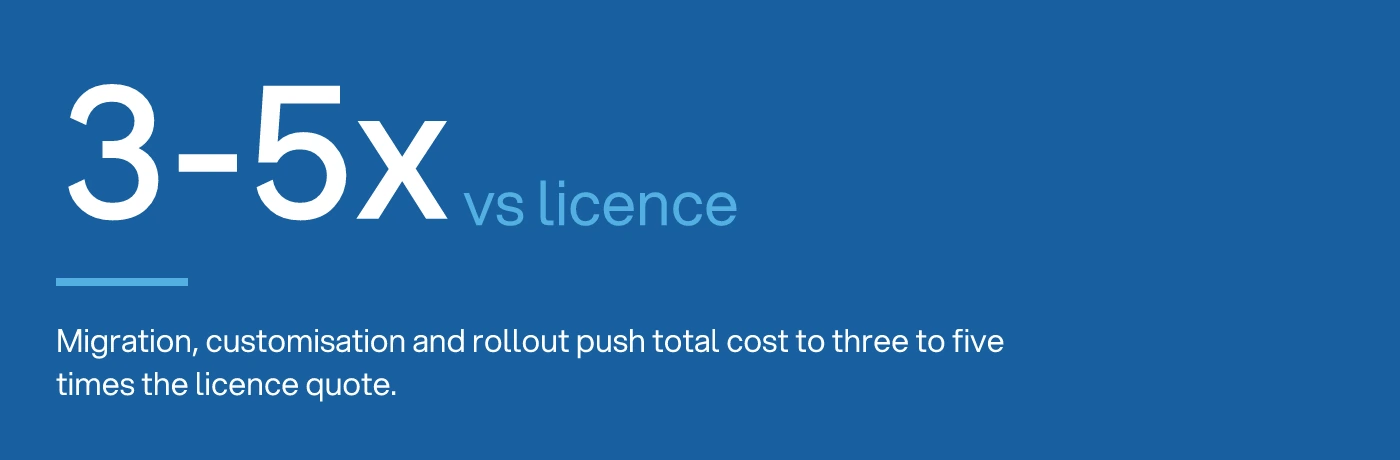
Licence fees are usually 15-25% of what an ERP implementation actually costs. The rest goes to data migration, customisation drift from forcing the system to match real workflows, and revenue lost to downtime during rollout. A $50,000 licence quote regularly becomes a $200,000-$400,000 project by go-live.
Why does the licence quote never match the final invoice?
Because the licence quote answers one question, and the buyer needs it to answer five. A licence fee tells you what the software costs to use. It does not tell you what it costs to make that software reflect how your business actually runs, how much of your team's time gets pulled into the project, or how much output you lose while the switch happens.
Most overseas buyers benchmarking India-based implementation partners this budgeting cycle are comparing licence quotes side by side, the way you would compare quotes for a piece of equipment. That is the wrong comparison. An analysis of over 500 ERP implementations found total project costs ranging from $150,000 to $750,000, depending on scope and company size, with licence fees making up a modest slice of that range (dollarpocket.com). The rest is decided by three things the licence quote does not mention: data migration, customisation drift, and operational downtime.
How much does data migration actually add to the budget?
Data migration usually adds 15-20% of total project cost, and it is almost never sized correctly at the quoting stage because nobody has actually looked at the data yet.
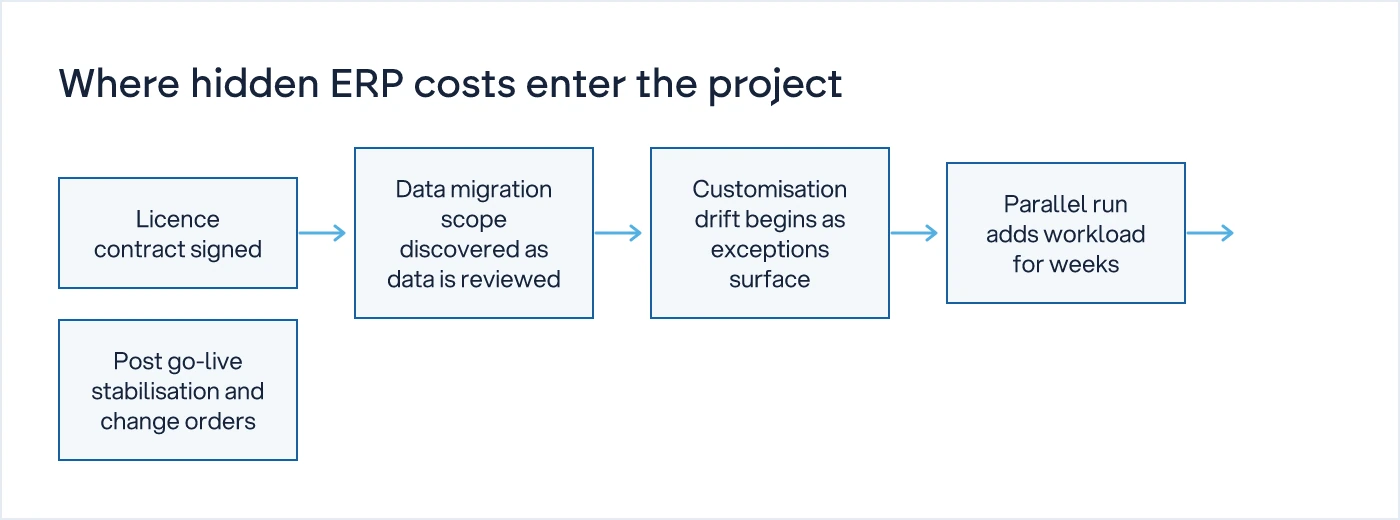
Here is the sequence that plays out on most projects. The vendor quotes migration as a fixed line item, based on the assumption that the client's existing data is clean, structured, and sitting in one system. Then the implementation team opens the export files from the old accounting package, the standalone inventory sheet the warehouse manager keeps, and the CRM three sales reps update inconsistently. None of it maps cleanly to the new system's data model. Customer records are duplicated under different spellings. Stock counts in the warehouse sheet do not match the accounting ledger. Historical job costing lives in someone's personal spreadsheet, not in any system at all.
At this point, the migration scope grows, and it grows after the contract is signed, which is the worst possible time for a buyer to discover it. The vendor doing the migration is not the party who decides how much data cleansing is needed. That decision sits with whoever owns the data quality on the client side, usually the finance controller for financial data and the plant or warehouse head for operational data, and that decision needs to happen before the licence is signed, not during implementation.
What is customisation drift and why does it blow past the original scope?
Customisation drift is what happens when a standard ERP module gets modified, one exception at a time, until it no longer resembles the vendor's original product, and each modification adds cost that was never in the original quote.
It starts small. The standard sales order form does not capture the job-work costing your business actually runs on, so a field gets added. Then a workflow gets added around that field. Then someone realises the standard reporting module cannot report against the custom field, so a custom report gets built. Six months in, the client is paying for ongoing customisation work that was never itemised in the original scope, and the vendor's day rate is doing the same job the licence fee was supposed to cover.
The reason this keeps happening is not bad vendors. It is that the original scoping exercise looked at a feature list, not at the process. A feature list tells you the client wants a sales order module. It does not tell you that 30% of sales orders in this business are job-work orders with a completely different costing logic, which is exactly the kind of process exception covered in Five Signs Off-the-Shelf ERP Won't Fit Your Process. If that exception is not identified before the contract is signed, it gets identified during implementation, and by then it is a change order, not a scoping conversation.
The decision that prevents this drift is simple to name and hard to act on: someone has to sit down before signing and map every process exception that carries real money, not just the happy-path workflow. That is a business decision, made by whoever owns the process, not a technical decision made by the implementation team.
How much revenue is lost to downtime during rollout?
Downtime during cutover rarely appears as a line item on the quote, but it shows up on the P&L, usually as reduced output during the weeks the team is running the old and new systems in parallel or learning the new one cold.
A parallel run, where both the legacy system and the new ERP are kept live simultaneously to catch errors before full cutover, is the safer option, and it is also the option that quietly doubles the workload on finance and operations staff for several weeks. The alternative, a hard cutover with no parallel run, is faster but riskier: if the new system has a gap nobody caught, the business finds out during a live order, not during testing.
Either way, someone on the plant floor or in the finance team is doing double entry, chasing errors, or waiting on a support ticket instead of doing their normal job. That is a real cost. It does not show up on an invoice, but it shows up in missed shipments, delayed invoicing, and overtime. Buyers comparing licence quotes almost never ask the vendor how they price for this, because the vendor has no reason to raise it. The buyer has to ask directly: what is the cutover plan, how long is the parallel run, and who is covering operational continuity during that window.
How do India-based implementation partners compare to domestic vendors on total cost?
The headline day rate is usually lower with an India-based partner. The total cost gap is usually smaller than buyers expect, because the categories that actually decide the budget, migration, customisation, and downtime, scale with the complexity of the client's process, not with the partner's location.
What does differ by partner is how much of that hidden cost gets surfaced before the contract is signed versus discovered during implementation. A partner who runs a proper discovery phase, mapping the actual process before writing a line of configuration, will quote higher upfront and drift less. A partner who quotes fast off a feature list will quote lower upfront and drift more, and the drift is billed at whatever their change-order rate happens to be. For a US or GCC buyer who cannot sit in the room during discovery, the way to test this before signing is to ask for the discovery deliverable itself: what does it look like, how long does it take, and what decisions does it force before the contract is finalised.
| Cost category | Typical share of total project cost | What decides the size of this cost |
|---|---|---|
| Licence / subscription | 15-25% | Number of users and modules licensed |
| Data migration | 15-20% | Data quality and number of legacy systems |
| Customisation | 20-30% | Gap between the standard workflow and the real process |
| Implementation and training services | 15-25% | Partner day rate and hours booked |
| Downtime / productivity loss during rollout | Rarely quoted, often the largest unbudgeted item | Cutover approach and length of parallel run |
Benchmarks on per-user and per-company-size cost bands are published by vendorbenchmark.com and by erpimplementation.eu, and both point the same direction: the licence line is the easiest number to compare across vendors and the least useful one for deciding the actual budget.
How should a buyer structure the budget before signing?
Build the budget around a five-year total cost of ownership, not a year-one licence quote, and get the migration and customisation scope defined by a discovery exercise before that number is finalised.
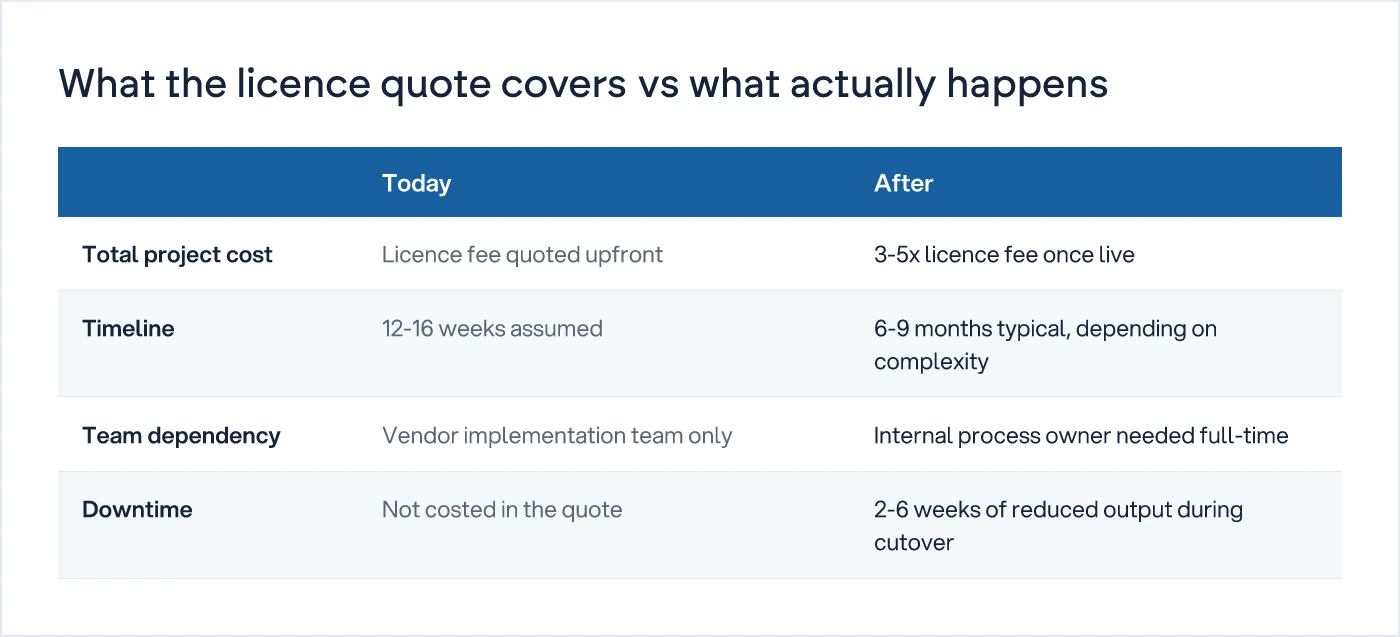
A TCO view forces the license, migration, customisation, support, and internal time costs onto one page, which is the only way to compare an India-based partner against a domestic vendor honestly. Tools like the erp-software.org TCO calculator exist specifically because the sticker price and the real five-year number are rarely close. Before you sign anything, ask for three things in writing: the discovery deliverable that maps your process exceptions, the data migration scope based on an actual look at your data (not an assumption about it), and the cutover plan with its expected downtime window. If a vendor cannot produce these before the contract stage, that absence is the answer to how the budget will behave after go-live.
We understand how your business actually works first, then we design the system. If you are weighing a custom build against an ERP for this reason, the comparison is covered in more depth on our ERP vs Custom Software hub, and if you want a partner who scopes the process before quoting the software, that is the starting point of our custom software development engagement.
What to do next
Before you shortlist another vendor, ask the current frontrunner for a written data migration assessment and a written list of process exceptions they found during discovery. If they have not run discovery yet, treat every number in their quote as provisional, because it is.
Common questions
What percentage of an ERP project cost is the licence fee?
Licence or subscription fees typically make up 15-25% of the total project cost. The remainder is spread across data migration, customisation, implementation and training services, and productivity loss during rollout, most of which are not itemised in the initial quote a buyer receives.
Why does data migration cost more than the original quote?
Migration is usually quoted before anyone has actually reviewed the data. Once the implementation team opens the legacy files, they typically find duplicate records, mismatched stock counts across systems, and historical data that lives only in spreadsheets. Cleaning this up before it can be migrated is where the scope, and the cost, expands.
How much does downtime during ERP rollout actually cost a business?
It depends on the cutover approach and rarely appears as a line item on the quote. A parallel run, where old and new systems run together for several weeks, doubles the workload for finance and operations staff during that window. A hard cutover is faster but carries the risk of live errors. Either way, ask the vendor directly what the cutover plan is before signing.
Are India-based ERP implementation partners actually cheaper overall?
Day rates are usually lower, but total cost depends more on how much hidden cost gets surfaced before the contract than on where the partner is based. A partner who runs proper discovery before quoting will have a higher upfront number and less drift later. Ask for the discovery deliverable before comparing prices.
What is customisation drift in an ERP implementation?
It is the pattern where a standard module gets modified one exception at a time, field by field and workflow by workflow, until the cost of ongoing customisation exceeds what was scoped in the original contract. It happens when the original scoping was based on a feature list rather than a mapped process.
Sources
- Real ERP implementation costs from 500+ projects: $150K-$750K average — dollarpocket.com
- ERP Implementation Cost Benchmarks: What Enterprises Actually Pay — vendorbenchmark.com
- ERP Implementation Cost 2026: Complete Budget Breakdown by Company Size — erpimplementation.eu
- ERP TCO Calculator — True 5-Year Cost (2026 Guide) — erp-software.org

Sanket Vanani
Founder & CEO
Sanket Vanani is a business strategist and entrepreneur focused on helping businesses build structured systems for sustainable growth. His work spans sales, operations, manufacturing, process improvement, and business scalability. Through his experience working closely with business owners and teams, Sanket focuses on turning founder-dependent businesses into process-driven organizations that can grow with greater clarity, consistency, and control.
Related reading
Five Signs Off-the-Shelf ERP Won't Fit Your Process
Five process exceptions, from job-work costing to multi-unit pricing, that show when ERP customisation stops working and custom software fits better.


