
Fixed Price or Time and Material: Which Fits Your Project
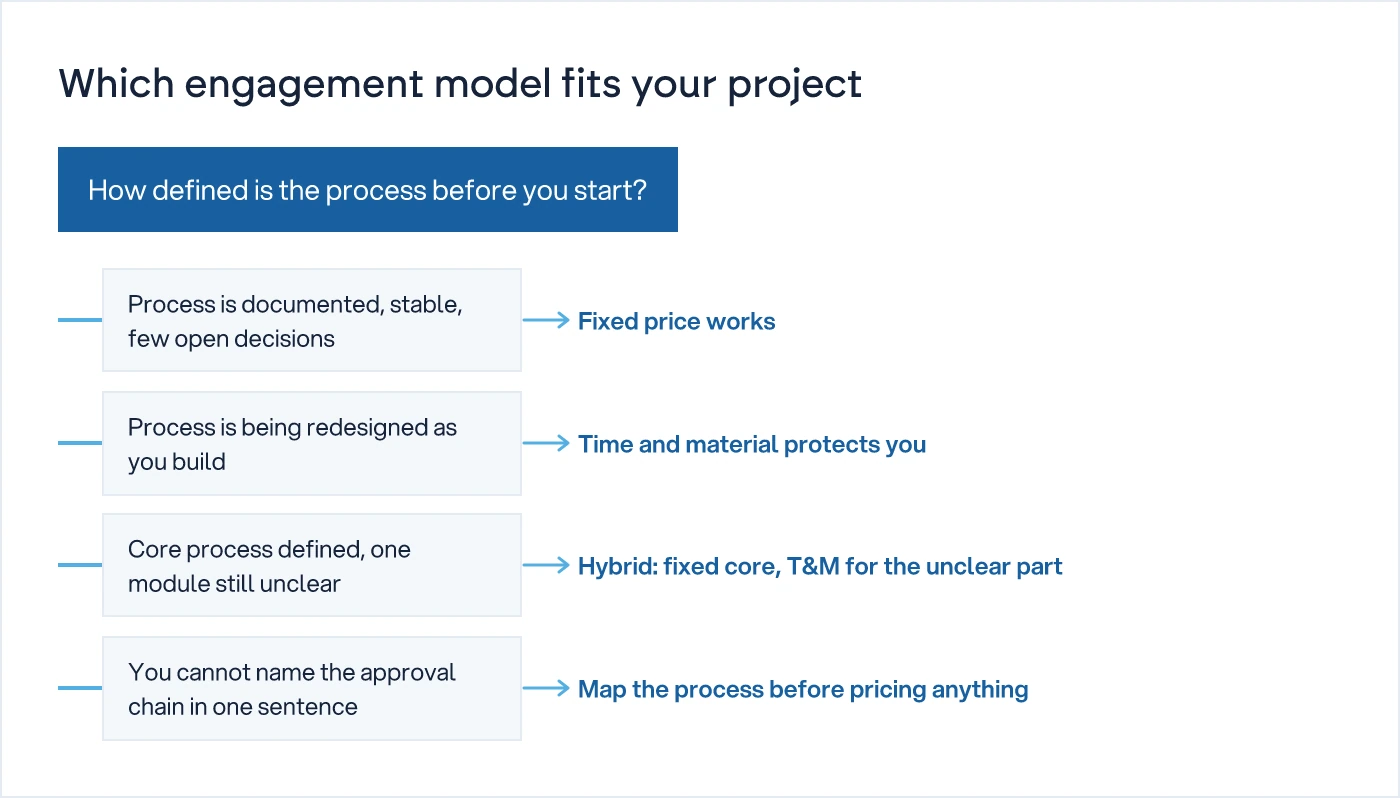
Fixed price works when the process you are automating is already defined, stable and unlikely to change mid-build. Time and material works when the process itself is still being worked out as the build proceeds. The right question is not which model feels safer. It is how well-defined the work actually is.

Every India-based partner you shortlist will offer fixed price first. It sounds safer. A number, a scope document, a delivery date. For a buyer in the US who cannot walk the floor and watch the team work, that number feels like the only thing they can hold onto before signing.
It is also, often, the wrong choice. Not because fixed price is bad. Because it is being applied to work that is not yet defined enough to price.
What is the actual difference between fixed price and time and material?
Fixed price means you agree a scope and a cost before work begins, and the vendor absorbs the risk of effort running over. Time and material means you pay for the hours and resources actually used, and you absorb the risk of effort running over.
That is the whole mechanical difference. Everything else, the trust question, the control question, the "what if scope changes" question, follows from where the risk sits.
Here is the part most comparisons skip. The risk only sits correctly if the thing being priced is actually known. If a vendor fixes a price for a process nobody has mapped, they are not absorbing risk. They are guessing, and padding the guess, and you are paying for the padding without knowing it.
Why do India-based partners default to fixed price?
Because it is the easier sell, not because it is the right model. A fixed number closes deals faster with buyers who are evaluating a partner they cannot visit. It also shifts the uncomfortable conversation, "we don't actually know how your approval process works yet", to after the contract is signed instead of before.
The partners worth working with will tell you this directly, early. If a vendor quotes a fixed price within the first call, before asking who approves a purchase order above a certain value, or what happens when a quality check fails on the shop floor, they are pricing a guess. The number will move. It always moves. It just moves after you have already committed.
How do you know if your process is well-defined enough for fixed price?
Ask whether you can describe it in one paragraph, start to finish, with no "it depends." If you can, fixed price is viable. If you cannot, you need to find out why before you price anything.
Take two examples from the same manufacturing business. Order-to-dispatch: the sales team raises an order, production confirms a date, the warehouse packs against a checklist, the vehicle leaves with a signed delivery note. Every step is known, every exception has a known owner. That can be priced.
Now take a new vendor-approval workflow the business wants to introduce because the current one is three people on WhatsApp deciding who gets paid first. Nobody agrees yet who should approve what value, whether finance or the plant head has final say, or what happens when a vendor disputes a rejected invoice. That is not a build problem. That is a decision the business has not made. Pricing it fixed means pricing a guess at someone else's unmade decision.
Do not automate a bad process. If the process is not settled, the first job is to settle it, not to price the software around it.
What happens when a fixed-price project meets an undefined process?
The contract starts generating change requests almost immediately, and each one becomes a negotiation instead of a build decision. The vendor quoted against an assumption. The business discovers the assumption was wrong in week three. Now every clarification is billed as a change order, trust erodes, and the project slows down exactly when it should be speeding up.
This is the pattern buyers describe when they say an India-based partner "nickel and dimed" them after a clean-looking fixed quote. It is rarely dishonesty. It is a fixed price applied to an undefined process, and the gap surfacing as change requests instead of as an honest "we don't know yet" at the start.
When does time and material actually protect the buyer?
It protects you when the business process is being redesigned at the same time as the software, because you are paying to discover the right answer, not paying a premium for someone else's guess at it. This is normal for a first phase of transformation work, not a sign of a badly run vendor.
If the plant head has not yet decided whether quality rejections need one sign-off or two, that decision will get made during the build, through conversation with the people who actually reject stock. A fixed price locks in an answer before the right people have discussed the question. Time and material lets the cost track the real work, phase by phase, with you reviewing effort and direction at agreed checkpoints rather than finding out at the end that assumptions diverged from reality.
The trade-off is real: T&M needs a buyer who reviews progress regularly, not one who signs a contract and checks back in three months. If that oversight is not realistic for you, say so to the partner directly, it should change which model they recommend.
Can you mix the two models in one project?
Yes, and for most operations projects this is the honest answer rather than a compromise. Price the modules that are already settled on a fixed basis, and run the ambiguous ones on time and material until they stabilise enough to fix.
A 12 crore auto-components manufacturer taking this approach might fix the price for digitising dispatch and inventory, both well-understood, repeatable processes, while running the new vendor-approval workflow on time and material until the business has actually decided who approves what. Once that decision is made and has run for a few weeks without changing, that module can move to a fixed scope too.
| Dimension | Fixed Price | Time and Material | Hybrid (phased) |
|---|---|---|---|
| Best suited to | Process already mapped and stable | Process still being decided or redesigned | Project with both settled and unsettled parts |
| Who carries scope-change risk | Vendor, until a change order is raised | Buyer, phase by phase | Split by module |
| Payment pattern | Milestone or deliverable-based | Periodic, against hours or sprints | Fixed milestones for defined work, T&M for the rest |
| Buyer oversight needed | Lower, mainly at milestone review | Higher, regular review of direction and effort | Matches the module being worked on |
| Typical failure mode | Change requests pile up on undefined scope | Costs feel open-ended without regular review | Needs clear rules for which module sits where |
What should you ask before signing either contract?
Ask questions that reveal whether the vendor has actually understood your process, not just your feature list. The answers tell you more about the right model than any sales pitch will.
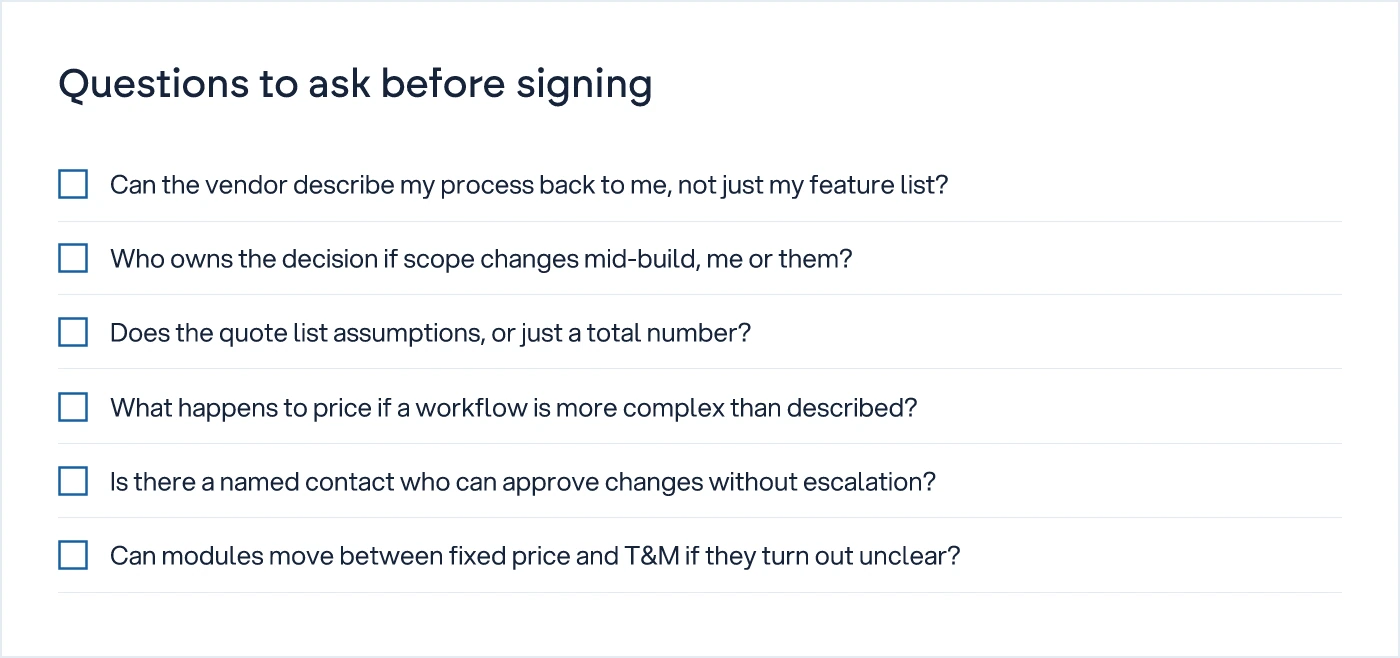
A vendor who cannot answer the first two of these without a follow-up call has not done the groundwork to price anything fixed, however confident the quote sounds. For how to assess that groundwork more broadly, see how to evaluate an India-based transformation partner, and for what each model actually costs at different project sizes, see what digital transformation costs by engagement model.
If you are managing this relationship from a US timezone, the engagement model also affects how often you need live contact with the team, which is covered in managing a development team five or more hours away.
What to do before you sign anything
Write down the process you want built, in plain sentences, the way you would explain it to a new hire. Wherever you hit an "it depends" or a decision nobody has actually made, mark it. Those marked sections are not ready to be fixed-priced, whatever the quote says. Take that document into the first call and ask the partner to price against it section by section. Their answer, not their sales deck, is the real evaluation.
We understand how your business actually works first, then we design the system, and that includes deciding honestly which parts of your project are ready to be priced and which are not. You can see how we structure that conversation on our custom software development services page, or browse more on choosing and working with a transformation partner.
Common questions
Is time and material more expensive than fixed price in the end?
Not inherently. Fixed price often looks cheaper upfront because the vendor has priced in a buffer for the unknowns, which you pay for whether or not they happen. T&M costs track the real work, which can be lower if the process is simple and higher if it is genuinely complex. The honest comparison is against a clearly scoped process, not against the quote alone.
Can a fixed-price contract be converted to time and material partway through?
Yes, and it happens often once a hidden ambiguity surfaces. Build a clause into the original contract that allows either party to flag a module as unsuitable for fixed pricing and move it to T&M with mutual sign-off, rather than renegotiating the whole contract under pressure.
How do US buyers evaluating an India-based partner usually get this wrong?
They treat engagement model as a trust question answered by the model itself, assuming fixed price equals low risk. The actual risk sits in whether the process being priced is well-understood. A vendor offering T&M after genuinely asking hard questions about your process is often more trustworthy than one offering a confident fixed number on the first call.
Does a hybrid model slow down the project compared to one contract type?
It adds a small amount of contract complexity but usually speeds up delivery, because the defined modules move forward on a committed timeline while the undefined ones get proper discovery instead of rushed guessing. Most delays in operations software come from re-fixing a wrong assumption, not from running two pricing structures in parallel.
Sources

Sanket Vanani
Founder & CEO
Sanket Vanani is a business strategist and entrepreneur focused on helping businesses build structured systems for sustainable growth. His work spans sales, operations, manufacturing, process improvement, and business scalability. Through his experience working closely with business owners and teams, Sanket focuses on turning founder-dependent businesses into process-driven organizations that can grow with greater clarity, consistency, and control.
Related reading
Managing a Development Team Five or More Hours Away
A practical overlap-hours rule and decision log system for managing an India-based team from the UK, without relying on daily calls.
How to Evaluate an India-Based Transformation Partner
Distance isn't the offshore risk. Unverifiable decision-making is. Three checks to run before signing: discovery, code ownership, change pricing.
What Digital Transformation Actually Costs, by Engagement Model
A straight breakdown of what fixed-scope, phased, and dedicated-team engagements actually cost and commit you to, in USD and GBP.


