
Automate the Approval Process or Redesign It First?
Redesign first. If a workflow tool is dropped onto a process with too many sign-offs, unclear ownership or missing information, the delay does not go away, it just moves faster and becomes harder to question. Fix who decides and what they need before you choose any tool.
If a purchase order in your business currently needs three sign-offs and takes eight days, a workflow tool will not make it a two-day process. It will make it an eight-day process that nobody chases anymore, because the request is sitting quietly in a queue instead of sitting visibly on someone's desk.
That is the trap. Workflow and low-code platforms are being sold hard across the UAE right now as a fix for exactly this pain: pending approvals, chasing people over WhatsApp, purchase orders stuck because the MD is travelling. The pitch is speed. What actually gets delivered, if nobody redesigns the process first, is the same delay with a nicer interface and no one left to blame it on.
This matters more than it sounds, because once a workflow tool goes live, the old habits that used to compensate for a bad process disappear. Nobody calls to chase anymore. Nobody double-checks with the PA. The process now looks handled, so it stops getting questioned, even when it is quietly running exactly as slowly as before.
Why does automating a slow approval process make it worse, not faster?
Automating a slow chain removes the friction that used to force someone to notice the delay. It does not remove the delay itself.
Take a trading company buying stock from three or four regular suppliers. Today, a purchase request goes to the purchase head, then finance, then the MD if the value crosses a threshold. It moves on email and WhatsApp. It is slow, seven to ten working days is normal, but it is slow in a visible way. People chase. The purchase head calls finance. Finance calls the MD's PA. Someone always knows where the request is stuck, because chasing it is the only way it moves.
Now put that exact three-step chain into a workflow app. The request no longer needs a phone call to move, so nobody makes the phone call. It sits in an approval queue. The MD, now getting fifteen notifications a day instead of three urgent calls a week, starts approving in batches from his phone without reading the backup documents. The purchase head stops following up because 'it's in the system.' The delay is the same, or worse, and it is now invisible, because the process looks automated and automated things are assumed to be working.
The same pattern shows up on the shop floor. A manufacturer digitising a maintenance sign-off, where a supervisor, a quality engineer and a plant head all had to approve a machine going back into production, found that automating the chain as it stood simply meant three notifications sitting unread instead of three people physically walking to the machine to check it. The paper version forced a walk. The digital version did not. Production resumed on a sign-off nobody had actually reviewed, and it took a near-miss on the line before anyone noticed the approval had become a formality dressed up as a control.
How do you know if your approval process needs redesign, not just software?
Three signs tell you the process itself is broken, not just the tool you're using to run it.
First: the same information gets entered or attached more than once, because no single stage actually owns the full picture. A purchase head fills in supplier and quantity, finance re-enters the same detail to check budget, and the MD asks for it again because neither earlier stage passed it forward cleanly. Second: at least one sign-off in the chain exists to record that someone looked, not to change the outcome, because that approver has never once rejected a request in the current process. Third, and the clearest test: if the answer needs a phone call, it's not a system. If your team still has to call someone to find out where a request is stuck, or to explain an exception the form doesn't cover, no amount of workflow software fixes that. You've automated the parts that were never the problem and left the actual bottleneck exactly where it was.
A fourth, quieter sign worth checking: how many exceptions has the current process accumulated. Most approval chains that have run for a few years carry two or three rules added after a single incident, a second sign-off added because one shipment went wrong in 2021, a mandatory attachment added because one invoice was disputed. Each rule made sense at the time. Together, they turn a simple decision into a five-step ritual that nobody remembers the reason for. A redesign is the point where someone finally asks whether each of those rules still earns its place.
We cover a version of this same diagnostic question for AI spend in The AI Readiness Check Before You Spend on AI: before you buy any tool, name the decision, name who makes it, and check whether the delay is a data problem or a people problem. The approval process test is the same logic, applied earlier, before anyone has spent a dirham on software.
What does a redesigned approval process look like, in practice?
A redesigned process has fewer approvers, clear thresholds, and no stage that exists purely out of habit.
For the trading company above, the redesign removed one sign-off entirely. Finance's approval had never once blocked a request in eighteen months, it existed because a previous finance manager had asked for visibility five years earlier. The redesigned chain has two approvers: the purchase head decides on anything under a fixed AED threshold, and the MD decides above it, with a named backup approver if the MD is unavailable for more than 24 hours. Backup documents are mandatory at submission, not requested afterwards.
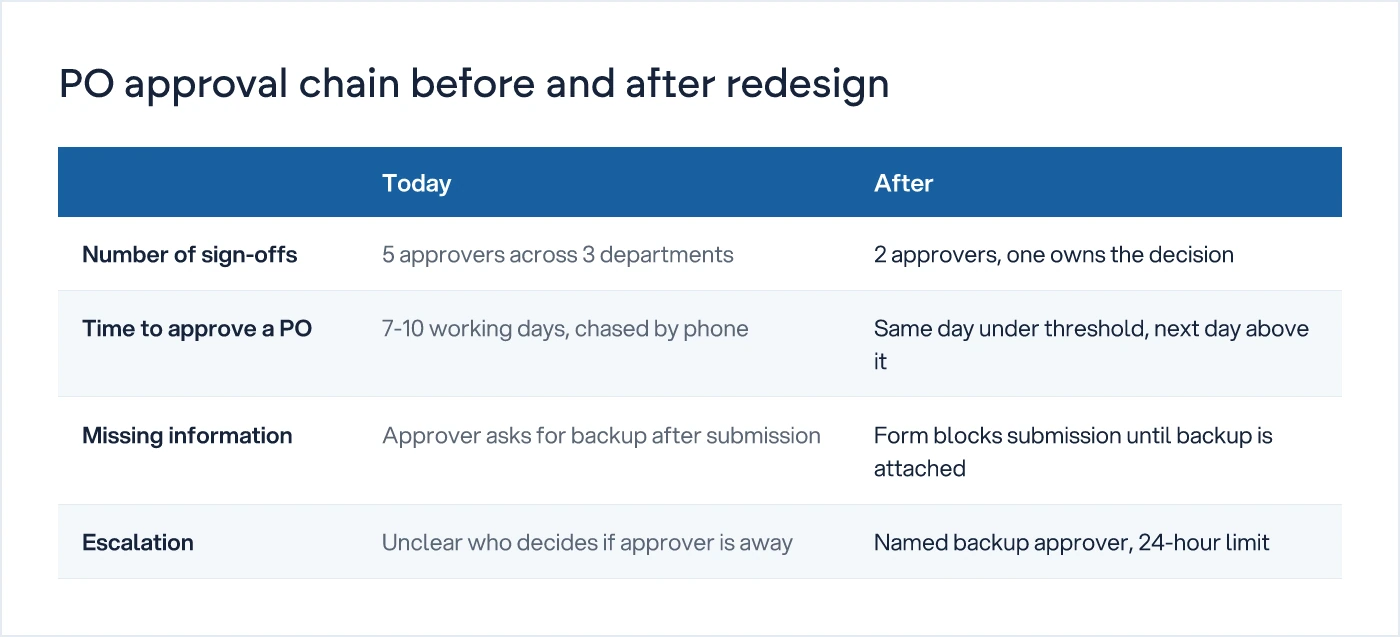
Only after that redesign did the company choose a workflow tool. The tool now reflects a process that makes sense. Before the redesign, the same tool would have made the old three-step, formality-heavy chain run faster and invisibly. The finance manager whose sign-off was removed did not lose visibility, she simply moved from approving every request to receiving a weekly report of everything approved above the threshold. She sees more now than the old sign-off ever showed her, because she is looking at a summary instead of one request at a time.
Should you automate the process as it is, or redesign it first?
Redesign first, every time the process has more than one approver whose sign-off doesn't change outcomes. Automating a bad process as-is only pays off in the rare case where the process is already lean and the only problem is that it runs on paper or WhatsApp.
| What changes | Automate the process as it is | Redesign, then automate |
|---|---|---|
| Speed of approval | Faster movement through the same number of steps | Fewer steps, genuinely faster |
| Who is accountable | Same unclear ownership, now hidden behind a workflow screen | One named approver per stage |
| Exceptions | Every exception becomes a permanent rule in the tool | Exceptions are reviewed, most are dropped |
| Cost to fix later | Expensive: the tool is now doing the wrong thing quickly | Cheaper: the tool reflects the right process from day one |
This is a well-documented pattern in process consulting, not a ThetaSol opinion. Very Big Things writes about it directly under the line 'don't automate a process that should be redesigned' (see sources below), and both Tiatra and Koder.ai make the same case from different angles: automation and AI amplify whatever process you feed them, good or bad.
What checklist decides whether to redesign before you choose a tool?
Walk through this with whoever currently owns the process, before any vendor call.
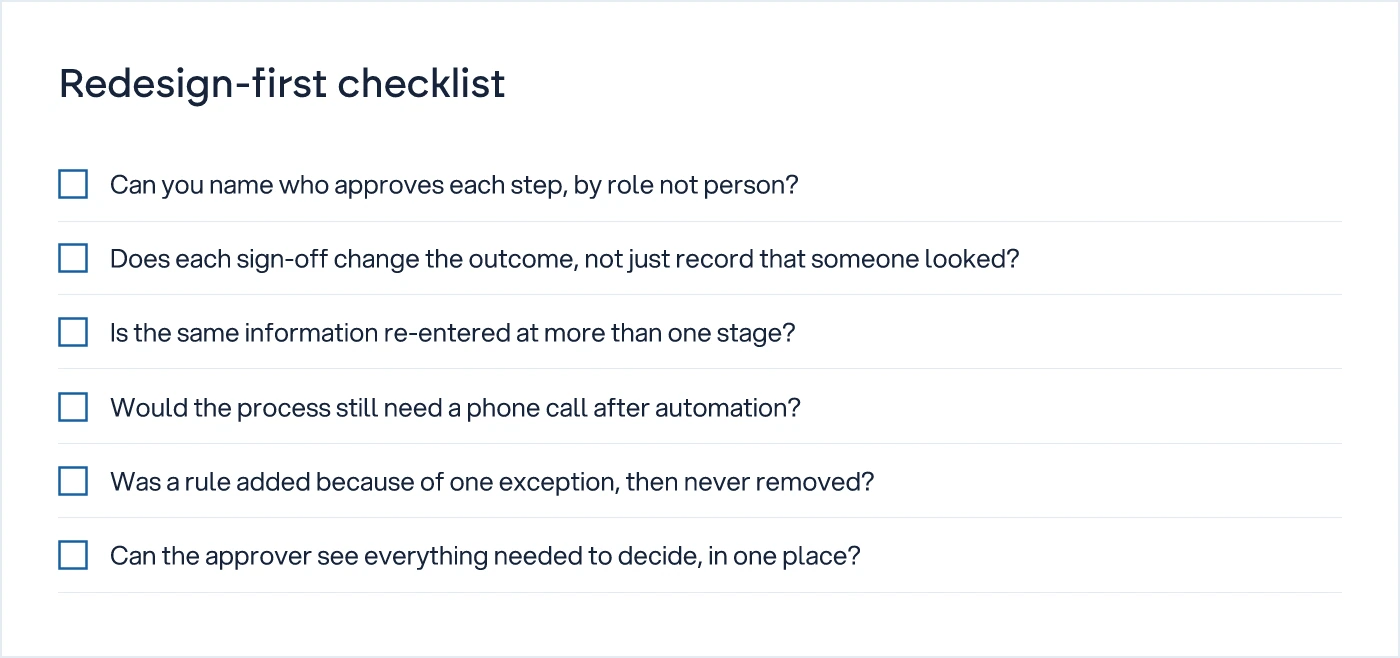
If you answer 'no' to more than two of these, redesign before you evaluate any workflow or low-code platform. If you answer 'yes' to all of them, the process may genuinely be ready to automate as it stands, that does happen, particularly in smaller, single-approver chains.
This is also why we don't start with a feature list or a software demo. Do not automate a bad process. We understand how your business actually works first, then we design the system, because a workflow tool configured around the wrong chain of approvals is expensive in a way that's hard to reverse once people have built habits around it. Once approvers get used to a queue and a report gets built around it, removing a step later means re-training people and explaining why a screen they trust is changing. It is far cheaper to have that conversation before go-live than after.
If you want a structured look at where your approval chains, or any other recurring bottleneck, actually sit before choosing a platform, our digital transformation service starts with exactly this kind of process mapping. You can also see how we think about the wider build-versus-buy and automation questions on the Technology and Trends hub.
What to do next
Pick the one approval chain that causes the most chasing this month, purchase orders, leave requests, credit notes, whatever it is. Before calling a workflow vendor, sit with the process owner and answer the six checklist questions above out loud. Write down which sign-offs survive that conversation. That shorter list, not the current one, is what gets automated. If the conversation surfaces a sign-off nobody can defend, remove it before you write a single line of the workflow, not after the tool is live and someone has to explain why the screen is changing.
Common questions
Is it always wrong to automate an approval process without redesigning it?
Not always. If the chain already has one or two approvers who each genuinely change outcomes, and the only issue is that it runs on paper or WhatsApp, automating as-is can work. The redesign step matters most when there are three or more sign-offs, or when at least one approver rarely rejects anything.
How long does redesigning an approval process take before automating it?
For a single process like purchase orders or leave approvals, mapping the current chain and agreeing a shorter one usually takes a few working sessions with the process owner and the approvers involved, not weeks. The delay comes from indecision about which sign-off to remove, not from the mapping itself.
What if the MD or owner insists on keeping every sign-off?
Ask what specific information that sign-off checks, and how many times in the last year it changed the outcome of a request. If the answer is rarely or never, the sign-off is a visibility habit, not a control. It can often be replaced with a report the owner sees weekly instead of a gate every request must pass through.
Do low-code and workflow tools make redesign unnecessary because they're easy to change later?
In theory yes, in practice no. Once a workflow is live, people build habits and reports around it, and changing approver counts later means re-training everyone and re-explaining why the old queue behaviour has changed. It's cheaper to get the chain right before go-live than to redesign a live system.
Sources
- Redesign Work Before Automating It — Very Big Things
- Don't Automate Bad Workflows: Why AI Should Begin With Redesign — Tiatra, LLC
- Digitize or Rebuild a Process? A Simple Framework — Koder.ai

Sanket Vanani
Founder & CEO
Sanket Vanani is a business strategist and entrepreneur focused on helping businesses build structured systems for sustainable growth. His work spans sales, operations, manufacturing, process improvement, and business scalability. Through his experience working closely with business owners and teams, Sanket focuses on turning founder-dependent businesses into process-driven organizations that can grow with greater clarity, consistency, and control.
Related reading

The AI Readiness Check Before You Spend on AI
Before any AI vendor conversation, check whether you have a named decision and clean data behind it, not just enthusiasm for the idea.


