The plant runs fine when you're on site. Leave for a week and the pending tray doesn't clear itself: three dispatch approvals, two credit exceptions, a purchase order stuck because nobody was sure which supplier to use. Everyone was busy. Nothing moved. That's owner dependency, and it's rarely because your team can't make decisions. It's because you're the only one who can see enough of the business to make them.
Why can't the business run without the owner for even a week?
Because the owner is usually the only person in the building with visibility across departments, not because the team lacks judgement.
Take a textile trading business. Sales knows what the customer promised. Production knows what's on the floor. Dispatch knows what's loaded and ready. Accounts knows what's outstanding. Each department has a slice of the picture. The owner has all four slices, built up over years of walking between departments and taking every call. So when a dispatch has to be prioritised, a credit note approved, or a supplier swapped mid-order, the person who decides is the person who can see the whole board. Everyone else is working with half the picture.
This is why delegation on its own doesn't fix it. You can hand a department head the authority. If that head still only sees their own department, every decision that touches more than one function still has to come back to you to connect the dots.
Is owner dependency a delegation problem or a visibility problem?
It looks like a delegation problem from the outside. From the inside, it's almost always a visibility problem.
Most owners try to fix dependency by writing job descriptions, appointing a GM, or telling senior staff to use their judgement. This helps with routine, single-department decisions. It does little for decisions that cut across departments, because the new decision-maker still has to phone around to get the information the owner used to hold in their head. If the answer to a decision still needs a phone call to the owner, or to three other people, it isn't a system yet, it's just a longer chain with the same bottleneck.
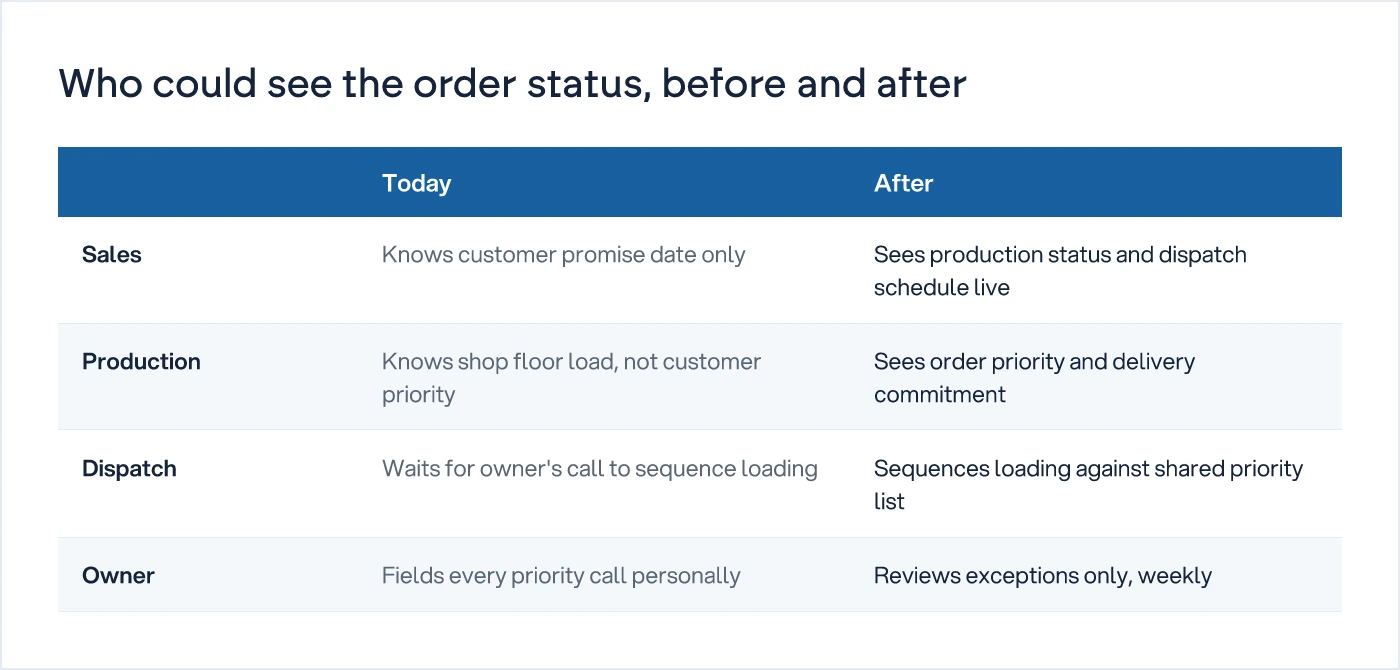
The fix comes from redesigning who sees what, so the person making the decision already has the information in front of them, rather than asking the owner to let go faster.
What does redesigning who sees what look like in practice?
It means giving each decision-maker a live view of the specific information their decisions depend on, rather than a dashboard of everything.
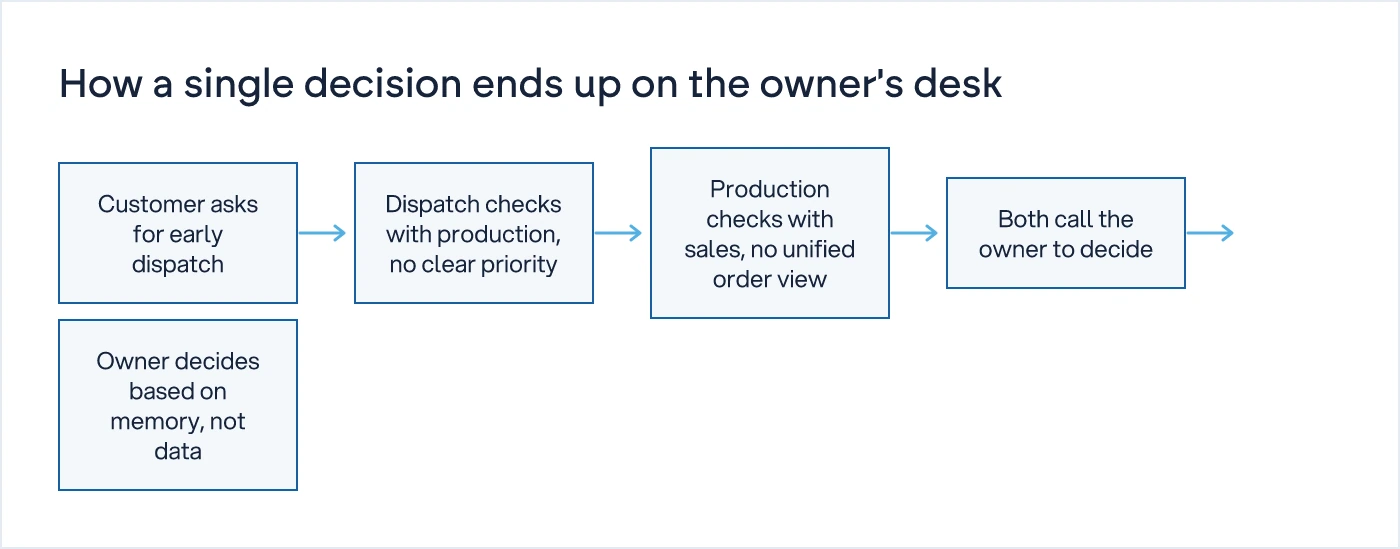
In the flow above, the dispatch decision defaults to the owner not because dispatch can't decide, but because dispatch doesn't know production's priority and production doesn't know the customer's commitment. Close that gap and the decision resolves itself two steps earlier, without anyone asking the owner to trust the team more.
This is the pattern we come back to in every operations audit we run: the delay is usually a visibility gap sitting between two departments that have never been given a shared view of the same order, rather than a skills gap. If you want to see how we map this before recommending anything, What Actually Happens When We Audit Your Operations walks through the shadowing process.
How do you map which decisions actually need you?
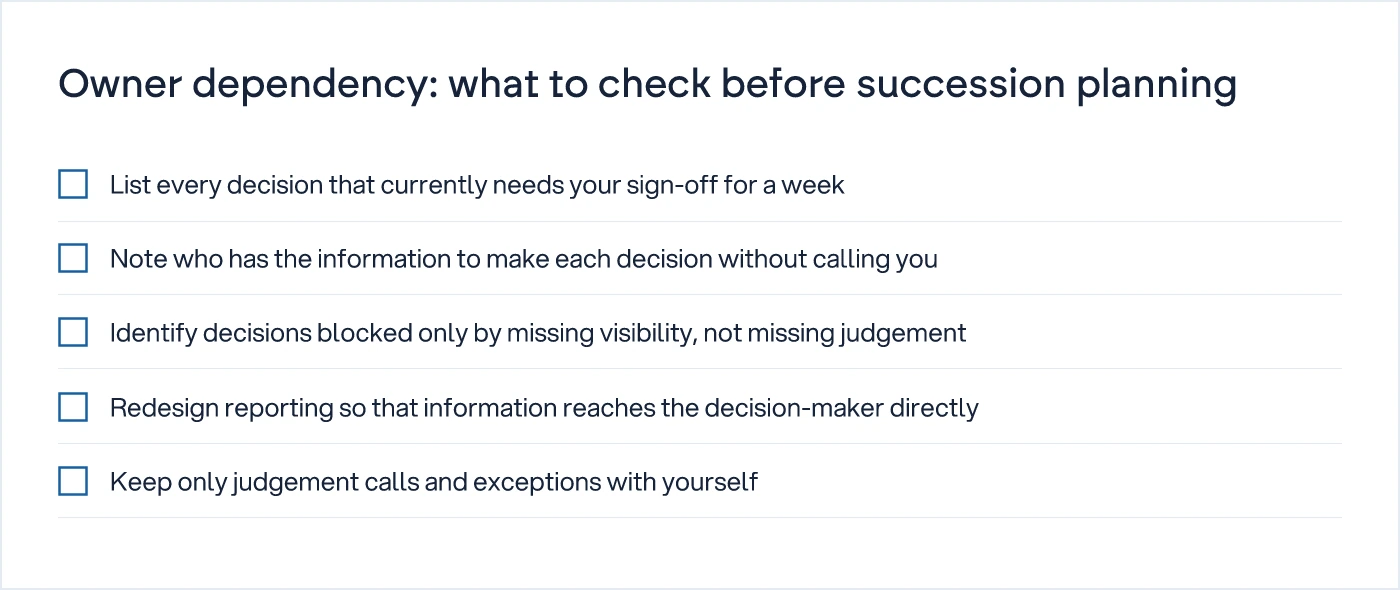
Start by listing every decision that came to you last week, then ask two questions for each one: did it need your judgement, or just information you happened to hold?
Most owners are surprised by the split. A decision like "should we release this order without full payment" often turns out to be a visibility gap dressed up as a trust issue, once accounts and sales can both see the customer's payment history and current order value at the same time. A decision like whether to exit a senior hire genuinely needs the owner, at least until the business has a formal succession structure in place.
| Decision | Who has the information today | Who should have it | Does it still need the owner? |
|---|---|---|---|
| Approve a discount beyond 5% | Sales rep escalates, owner decides | Sales head, with live margin data | No, once margin is visible to the sales head |
| Release an order without full payment | Accounts flags it, owner decides | Accounts and sales head, jointly | Only above an agreed credit limit |
| Decide which order ships first | Dispatch calls the owner | Dispatch, with live production and order status | No |
| Approve a purchase over budget | Purchase escalates, owner decides | Purchase head, with cash position visible | Only above a set threshold |
| Exit or hire a senior team member | Owner decides alone | Owner, with HR input | Yes, until succession is formalised |
Notice the pattern. The decisions that stop needing you are the ones where the blocker was information, not judgement. The ones that still need you are the ones where the business hasn't yet built a second person with the standing, the data, and the accountability to own the call.
What should change first: people, process, or software?
Fix the process and the visibility gap first. Software should come after, to hold the new structure in place once it exists.
Do not automate a bad process. Put a system on top of a workflow where three departments still don't share information, and you get a faster version of the same bottleneck, not a fix. This is why we insist on understanding how decisions actually move through a business before proposing anything. We understand how your business actually works first, then we design the system. In practice that means agreeing which decisions move to whom, agreeing what information each person needs to make that call without a phone call to you, then deciding what needs to be visible in a shared system rather than in your head or in someone's inbox.
If you want a sense of what this is costing you today in delay and rework, What Firefighting Actually Costs You Each Month sets out a simple way to put a number on it before you invest in fixing it.
What should stay with the owner, even after the fix?
Judgement calls with consequences that outlast a single transaction, and decisions with no precedent yet, should stay with the owner until someone else has both the visibility and the standing to make them.
This matters for succession planning specifically. A son or daughter joining the business, or a professional GM being brought in, doesn't fail because they lack capability. They fail because they inherit the title without inheriting the visibility. They're expected to make the same calls the owner made, using a fraction of the information the owner had, gathered over twenty years of standing on the floor. Fixing visibility before the handover is what makes the handover survivable.
Where to start
Pick one week and write down every decision that landed on your desk that only you could resolve. Against each one, note whether the block was judgement or information. That list is the honest starting point for a succession plan, and it's usually the first thing worth mapping properly. Digital Transformation for Growing Businesses covers how this fits into a wider operational fix, and our digital transformation service starts with exactly this kind of mapping, before any software gets discussed.